Showing posts with label ecumenical adventures. Show all posts

Saturday, June 13, 2026

Women and Authority and Southern Baptist Decisions

I wonder if the social media feeds of other people are full of rage at the Southern Baptist governing body and their decisions about women in leadership.  In many ways, it's not a surprise:  they've forbidden women pastors for decades now.  The recent decision seems to say that women can't even be church council members or Sunday School teachers or speak in worship at all--no lectors, much less assisting ministers.  

Obviously, I disagree with these decisions.  I am lucky to have other denominations, including my own, the ELCA, the more inclusive expression of Lutheranism in the U.S.  I am not Southern Baptist and neither are most of the people filling my feed with rage.  Living in a "free" society and believing in free will does mean that people get to make their own decisions, no matter how much I think they are on a wrong path.

I do wonder who will do all the work, if women aren't allowed to do even volunteer work, even the work traditionally done by women, like teaching of all kinds.  Are there really all these men, waiting in the wings who have been chomping at the bit to do the work?

It's hard for me to believe that they do.  Of course, I've been in congregations that are tiny, where everyone who is breathing has been put to work, churches that don't have the luxury of excluding half (or more) of the congregation.

I am happy to be part of a church that welcomes everyone into the circle to do the work of kingdom building.

Tuesday, February 10, 2026

Teaching from the Buddhist Monks Who Are Walking for Peace

Like many, I've been moved by the Buddhist monks who are walking from Texas to D.C. for peace.  I even talked about them in a sermon in early January, as something giving me hope.

Today they'll be at the National Cathedral, and I'm not sure of their time in D.C. beyond that.  It's hard for me to imagine any officials from the federal government meeting with them, the way that state governing people along the way have, but I'm willing to be happily surprised.

In this post on Diana Butler Bass's Substack, she gives the monks' answer to why they are walking.  I want to make sure I have this, should I want to find the words later, so let me post them here:

"Some people may doubt that our walk can bring peace to the world — and we understand that doubt completely. But everything that has ever mattered began with something impossibly small. A single seed. A first mindful breath. A quiet decision to take one step, then another.

Our walking itself cannot create peace. But when someone encounters us — whether by the roadside, online, or through a friend — when our message touches something deep within them, when it awakens the peace that has always lived quietly in their own heart — something sacred begins to unfold.

That person carries something forward they didn’t have before, or perhaps something they had forgotten was there. They become more mindful in their daily life — more present with each breath, more aware of each moment. They speak a little more gently to their child. They listen more patiently to their partner. They extend kindness to a stranger who needed it desperately.​​​​​​​​​​​​​​​​

And that stranger, touched by unexpected compassion, carries it forward to someone else. And it continues — ripple by ripple, heart by heart, moment by moment — spreading outward in ways none of us will ever fully witness, creating more peace in the world than we could possibly measure.

This is our contribution — not to force peace upon the world, but to help nurture it, one awakened heart at a time. Not the Walk for Peace alone can do this, but all of us together — everyone who has been walking with us in spirit, everyone who feels something stir within them when they encounter this journey, everyone who decides that cultivating peace within themselves matters.

One step becomes two. Two become a thousand. A thousand become countless. And slowly, gently, persistently — not through grand gestures but through ten thousand small acts of love — we can help make the world more peaceful.

This is our hope. This is our offering. This is why we walk.

May you and all beings be well, happy, and at peace."

Monday, April 3, 2023

Field Trip to a Buddhist Meditation Center

To get the MDiv degree, Wesley Seminary requires a World Religions class.  In theory, I approve.  In practice, many of the options haven't appealed to me.  I want the knowledge that might come after spending a term studying another religion, but I don't really want to immerse myself that way.  So when I heard about the World Religions as Resource for Theology and Mission class, I thought this approach would be my best option.  Even though it would mean a heavy load, I decided that I had time and money, and so I signed up.

I'm glad that I did.  It's been a remarkable experience.  The field trips were the most attractive part of the class, when I heard about it in advance.  It's probably the main reason I signed up; I knew that we would have this opportunity primarily because the professors had connections to area religious leaders, and that if someone else taught the class, we might not have the same opportunities.


On Saturday, we went to the last of the experiential parts of the class.  On Saturday, we went to a Buddhist meditation center in Silver Spring, Maryland.


We had an initial talk about Buddhism, as we sat in one of the meditation spaces.  Then, because that space was booked for a different group, we walked to the house across the street to do our meditation together.


I wish I could report that doing meditation led by a Buddhist was easier than the meditation that I do at the end of yoga classes, but this is not the case.  Still, it was a valuable experience.  


I was impressed by all the flowers--and these flowers are brought as offerings by local Buddhists.  They also bring food, so much food that the monks who live in the meditation center never have to cook.  We also got to see a tree that is the kind of tree that the Buddha sat under centuries ago when he had his first revelations:


To close our day, we did a meditation with a woven cord that connected us all.  And at the end, if we wanted a blessing, we came forward to receive it, along with strings from the cord tied around our wrist by the monk.

My wrist, in front of my seminary apartment window sill


This trip to the Buddhist meditation center was a great way to end our time together as a class.  If I'm ever lucky enough to get to lead this kind of class, I hope that I can orchestrate some similar experiential trips.  I learned much more from them than I ever can from a book.

Tuesday, February 7, 2023

Incarnation and Other Rules of the Universe

Once I am done with today's seminary classes, I will have completed my third week of the semester.  It feels like I've been enrolled in Spring 2023 semester much longer.  Let me record a few thoughts.

--As always, I do wonder if I could get almost the same intellectual growth if I just read the books on my own.  But I also have weekly writing assignments in most classes that force me to engage with the books in a different way than just reading.  Sure, I could do that on my own.  But I'm happy to report that interacting with my classmates, whether in class or on discussion boards, also helps me learn.  I have insights that I'm convinced I would not have had without that interaction.

--Could I have found that interaction outside of graduate classes?  Theoretically yes.  In practical terms, no.  In the non-seminary world, it's hard to find people with similar interests, with reading time, who will make time for deep discussion of books on a weekly basis.

--I woke up in the middle of the night thinking about incarnation, God taking on human flesh, which is not a common trait across religions.  I had been reading Queer Theory and Queer Theology, and the texts we have been reading want to celebrate bodies and sex and carnal pleasure and fluidity.  We've come across startling ideas, like God as Divine Orgy (a metaphor used to describe both the Trinity and the relationships that this Trinitarian God has with creation).

--But so far, we haven't read any Queer Theory or Queer Theology that wrestles with the ways that aging impacts our theory, thoughts, and theology.  Does it exist?  Perhaps we haven't read it because everyone in the class is much younger.  Perhaps we haven't read it because it doesn't exist.

--What if we've gotten incarnation all wrong?  What if God didn't take on human flesh to show us how to be a human or to redeem us, but for some other reason that has been lost to us through the ages?

--And now I'm wondering if there's a theology of aging (regardless of gender, sexual desire, relationship status) that I don't know about.

On to other subjects:

--I went back and looked at the birth narratives of both Luke and Matthew.  I'm struck by the fact that Matthew has the Divine plan revealed in dreams, while Luke has angels, both individual appearances by Gabriel and the angel choir that appears to shepherds.

--In last night's Luke class, we talked about the temptation of Jesus in the wilderness.  Our professor pointed us to a text for class that I had read, but I had missed the importance of a nugget as I read quickly to get ready for class.  Jesus is on earth, not all powerful, but hemmed in by rules established by God--and here I am back at Trinitarian theory, wondering how/if that conversation happened.  And then I thought about that eternal question;  why does God allow bad stuff to happen?  Maybe there are rules that God has to obey.  And if there are rules that God must obey, for whatever reasons, can we really say that God is all powerful? 

--I have become comfortable with the idea that God is not all powerful, for whatever reason.  But I know that I will meet people who are not comfortable with that idea, and I wonder if presenting it as a rules-based universe that limits what God is allowed to do--would that idea be easier?

--During our visit to the mosque, one of the leaders of the mosque talked about the separate worship space for women.  It's a space without walls, but it is behind the men.  The leader explained that the placement was out of respect.  They don't want men looking at the women as they bend and kneel.  They don't want women to feel exposed.  My younger self might have been outraged by this approach.  My older self wishes I had more space where I didn't feel exposed as a woman or as a human.

--In our Women in the Preaching Life, we began with a ceremony.  Our teacher made an altar out of a table:  with a cloth, a statue, some candles, and a bowl of small rocks.  We went around the room describing a woman (or two or three or more) who had been important in helping us discern our call to the preaching life.  Many of us talked about our mothers.  But we also talked about teachers.  And a few of us talked about a fellow worshipper who made time to listen.  It reminded me never to doubt that there are many ways to be a force for good in the world.  We took a rock to remind us of the people who have believed in us.

Sunday, February 5, 2023

Seminarians at a Mosque

Yesterday was a 9-5 day for my World Religions class.  This hybrid model works well:  2 week-ends during the semester with a Friday night class and an all-day Saturday class, with online modules in between, including discussion boards to keep us connected.  I'm glad we met for one of our week-ends before doing discussion boards.  I've never had hostile encounters in a class discussion board setting, but I know it's possible.

Each Saturday, we meet for a morning of instruction and discussion, followed by lunch, and then a field trip.  Yesterday's field trip was to a mosque.


Come to find out, it's the oldest mosque built by US born people--there are older mosques in the US that were built by immigrants.  This mosque is the oldest mosque in the U.S. built by descendants of enslaved people.


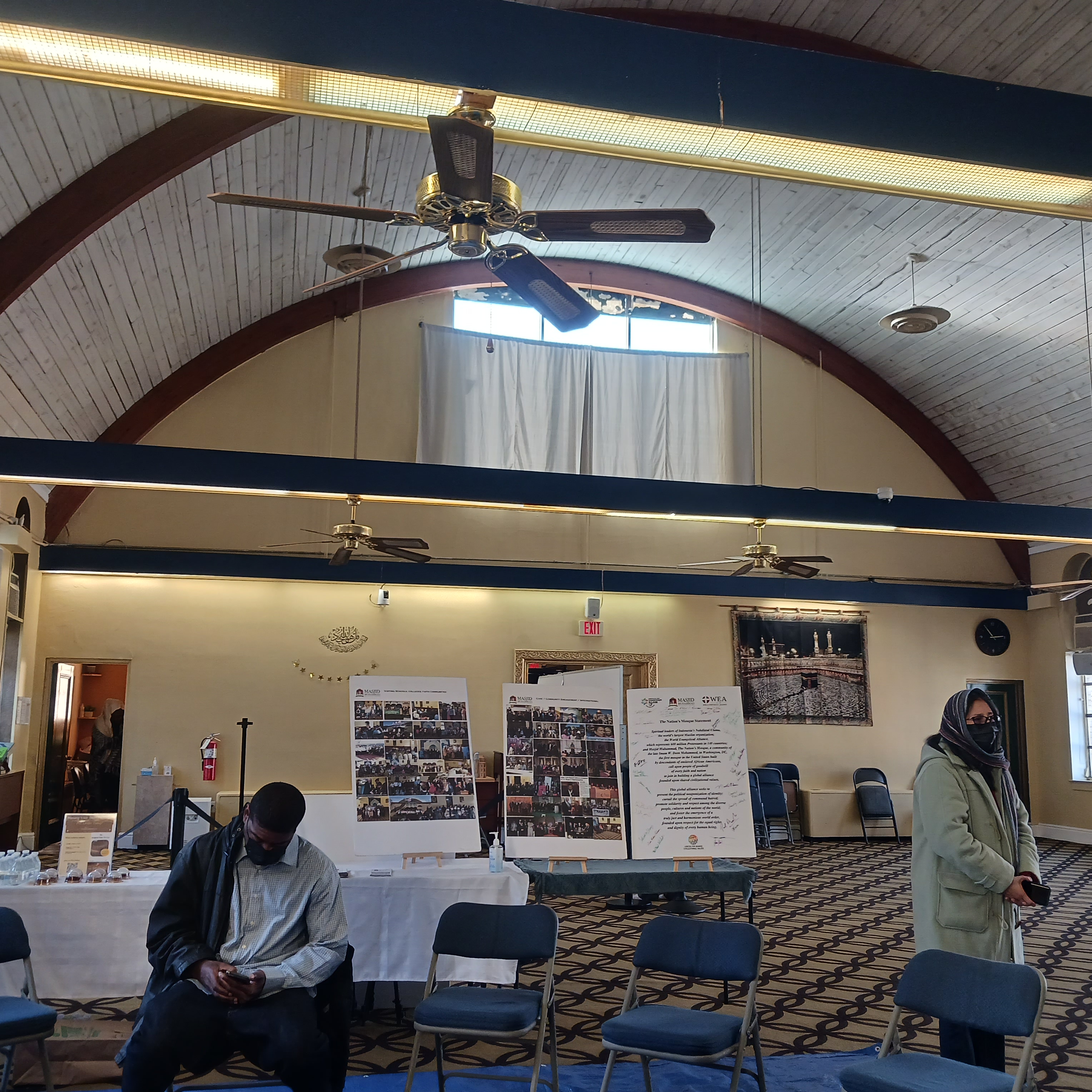
The mosque was once a Nation of Islam mosque, but it has since become a Sunni mosque.  The building has a community center or a reclaimed gym kind of feeling, but that's probably because of the curved ceiling:


Here's a longer view:


The mosque is open for prayers during 5 times a day, with an extra prayer time on Friday.  We were there to observe the prayers at 3:11 yesterday afternoon.  The leader asked each man where he was from:  Ghana (3 people), Ethiopia (5 people), Turkey (1), another East European country I didn't quite catch the name of (1), Pakistan (1), and 3 from the District of Columbia. The 5 leaders were also from DC. They do have women members, but none were there for 3:11 prayers.  The men prayed shoulder to shoulder on these rugs:


My class is half women, and we had been told in advance that we would need to cover our hair, so we did with scarves that we brought.  I thought we looked lovely.  I didn't feel oppressed particularly; the men who gathered for prayer also wore headcoverings.  Plus, I had a Muslim friend in grad school who explained why she covered her hair.  The idea that she reserved part of herself just for her husband to see made sense to me and felt less oppressive than the other explanations that had been offered by non-Muslim media that I had read.


We were all asked to wear masks, which makes sense to me, and everyone did.  People who arrived without a mask were offered the box of masks to take one, and no one protested.  On Friday, the synagogue had a section of seating reserved for those who wanted to wear masks and not sit next to unmasked people.  Two people sat there, clearly together, and one woman removed her mask part the way through the service.


At the mosque, we were offered bottles of water and a snack, which came in a globed container (see above).


The snack was some sort of bean cake, which was slightly sweet, with the moist texture of a very firm pudding.

At the end, we took group pictures, but no one has sent those to me.  When they do, I'll circle back here to post one.  I was touched by the men in charge of the mosque who wanted pictures and wanted to assure us that we're always welcome to return, either as a group or individually, for any reason.

In short, it was a great afternoon, and just the kind of opportunity I hoped I would have if I was able to take classes at the seminary, instead of only from a great distance.  I feel very lucky.

Saturday, February 4, 2023

Seminarians at a Synagogue

I am taking a World Religions class this term.  It's experiential, meaning that we go places and interact with people of different faiths, in addition to reading about the different faiths.  It's the kind of opportunity that might not always be mine to seize:  the professors might not always teach it, the hospitality from other faiths might not always be extended, and I live on campus, which makes it easy in a way that it might not be in the future, if the class is offered again.

Last night, our class went to the nearby Washington Hebrew Congregation, which we learned is one of the largest ones in the U.S. and the world.  We celebrated Shabbat in the smaller worship space, which is larger than many movie theatres in terms of seating.

Before we did that, we went to a Torah study that happens for a half hour before worship every Friday.  What a treat.  Here is the passage we studied, Exodus 13:  17-18:   "17 When Pharaoh let the people go, God did not lead them on the road through the Philistine country, though that was shorter. For God said, “If they face war, they might change their minds and return to Egypt.” 18 So God led the people around by the desert road toward the Red Sea.[a] The Israelites went up out of Egypt armed for battle."  There was a larger portion on the handout, but that's all we had time for.

We talked about how the people's hearts needed to change, otherwise they would go back to what was safe and familiar, even if it was a state of slavery.  We talked about how we are not unlike those ancient people.

Then we filed into the worship space and I did my best to follow along.  I did not try to sing, even though I had a sense of what we were doing in the prayer book.  I couldn't make sense of the Hebrew words on the page and the sung words.  I enjoyed it, and spent perhaps too much time wondering if the musicians were paid professionals and if this music would be the music I would hear at a Shabbat service at a different synagogue.  The service had familiar elements:  a sermon, readings, music, time with children, praying for those who needed prayers, offering up our joys.

There was food before and after the service, and not just food, but several tables full of serving stations of hot food, a table of non-hot food (crackers, cheese, fruits, veggies), and a tureen of soup (last night's soup was carrot ginger, and it was delicious).  There was also a full bar, including hard alcohol, with lots of choices.  It felt amazing to me, and I asked the rabbi if they eat like this every week.  He said, "We try to."  

After the service, my seminary group met with the rabbi for a bit of conversation about the differences between Jews and Christians.  We focused on the order of the books of the Scripture.  The highlight of the night, though, is when the rabbi took us to the much larger worship space and showed us the Torah scroll.  Here's where they are kept.


And here's one of the scrolls rolled out.


The glowing aspect above is because of the lighting and my older cell phone camera--but I kind of like the effect.

And here's the tool used to help read the Torah:


The rabbi said that Moses went up to the mountain, talked to God, and what did he come down from the mountain with?  I said, "A sunburn," an answer which surprised everyone.  The correct answer was the stone tablets.  It was such a correct answer that I thought it was too obvious and went with my sunburn reply, which I just blurted out without really thinking about it.

We asked a few questions, and then we adjourned for the night.  It was so fascinating I could have stayed and talked for several hours, despite the fact that it was past my preferred bed time.

Today we have time in the classroom this morning, and this afternoon we go to a mosque.  Tomorrow, I'll report back.

Monday, June 6, 2022

Pentecostal Visits on Pentecost

Our Synod Assembly was held In a conference area like the ones that so many big hotels seem to have:  huge rooms with collapsible walls so that many groups can meet throughout the conference area in various configurations. This was one of the first assemblies where I was aware of the group meeting next door. They seemed to have loud music at times when we were trying to hear various speakers.  When we had meditative moments before and during worship, loud music thumped from next door.

Midway through our meeting, we learned the group next door was a group of Spanish speaking women gathered to pray. Clearly, their prayer style is different than our Lutheran assembly prayer style. Knowing that fact however made it easier to be patient.

Our closing worship was on Pentecost Sunday, and for most of the service it seemed like a regular high church holiday:  special robes, special paraments, special music. But at the end of this service, a truly special event happened.

The leader of the group next door came to address our assembly. First she spoke to our Bishop. He is bilingual, and she only spoke Spanish. When she addressed the whole group, one of the younger women translated.

Many of us were moved by this expression of Christian unity. Their faith tradition is very different from ours.  it was a group of Pentecostal women, Latinas, and we were a group of high church Lutherans. The woman from next door pointed out that the wall that separated us was the only wall that was moveable. They had spent time in their assembly with their hands pressed to the movable wall as they prayed for us and the larger world. We had spent time in our chairs praying for them and the larger world.

Will any transformations happen because of this encounter? It's hard not to think of all the gun violence across multiple cities in the US yesterday and feel hopeful.

And yet I think back to the first Pentecost, those disciples with no reason to feel hopeful about the future of the Roman Empire. Then the Holy Spirit came, and they were transformed, and the world was transformed.

The 21st century will offer many opportunities for transformation. Let us hope that the Holy Spirit swooshes through the land, giving all of us a vision for how life might be better and the energy to make it so.

Saturday, January 8, 2022

Second Day of the 2022 Onground Intensive, with Icons

 I am tired this morning--this morning, it's a mix of the bad tired of not getting enough sleep in a bed that's not my own mixed with the good tired that comes from getting modules completed and staying up late to have good conversations with a Create in Me friend.  So let me try to capture the second full day of the intensive.

I tried to tell myself that it's called an intensive, not a relaxive, but I did feel myself racing from place to place yesterday.  We had a morning learning session on Native American spiritual practices.  I didn't learn a lot that was brand new, but it was interesting to hear it presented in the form of story and Native flute.

And for those of us reeling from the latest pandemic developments, here's an interesting note:  because they were suffering an outbreak of smallpox, the Catawba tribe was not relocated to Georgia with the rest of the South Carolina tribes.  Because they were not relocated to Georgia, they were spared from the trauma of the Trail of Tears and from being relocated even further west.

We had two small group sessions, and in between, I enjoyed a post-lunch walk with my spouse's brother.  I wasn't expecting him to be on campus because seminary students don't return until later in January, but he had to return to work on his externship--a happy surprise.  It was good to catch up.  I'm not sure we've ever had one-on-one time.  I usually see him when there are gobs of family members around.

The highlight of yesterday was the trip to the Greek Orthodox cathedral:


It was actually 2 cathedrals.  We started out in the smaller, older one.  


We got an information session about spiritual direction in the Greek Orthodox tradition, and then we went to the new cathedral that was finished in 2015.  We got an information session about the tradition of icons and about the specific icons in the cathedral.


This icon of Jesus is in the main dome, seven stories from the floor.  The distance from one tip of his nose to the other tip is 15 feet, although it doesn't look that big from the ground.


He is depicted as having no lower body, because the church filled with believers makes up the lower body.

There's a lot of information about the cathedral and all of the icons here.  My favorite piece of information that's not included is that the iconographer met with the Sunday school students to find out what specific animals they wanted him to include in his depiction of the creation story:


I was surprised that there weren't any dinosaurs: 


Two years ago when I first started this program, I heard about this field trip, and I am so glad that I finally got to go and see for myself.  It was one of the parts of the intensive that I was most looking forward to.

We returned to campus for dinner and Compline service.  Even though we were all tired after Compline, a group of us came to our on campus ramshackle house and enjoyed some treats and wine--and most of all, some good conversation.

In a few hours, there will be a commissioning service, and I will be a certified spiritual director.  Tomorrow I will drive home, and hopefully on Monday we will sell our house in the historic district.  Then I will get ready for seminary classes.

Let me focus on staying present to today's delights.  Let me not get overwhelmed by what is coming in the rest of January.

Friday, January 7, 2022

First Full Day of the 2022 Onground Intensive

 As I moved through the first full day of the onground intensive, the one that will leave me a certified spiritual director, I had to remind myself several times that it's called an "intensive," not a restful retreat, not a reconnect with every old friend you've ever had week, not an explore Columbia voyage.  We went at an intense pace yesterday, and today we won't have the afternoon break that we had yesterday.  But I am looking forward to exploring icons in a Greek Orthodox church this afternoon, so hopefully, we won't need a break.  

During yesterday's break, we went to the Fresh Market to buy wine and treats.  By the end of the evening, we were too exhausted to set out the treats.  But it was the good kind of exhaustion, the kind that comes from being fully engaged.

I began the intensive in the chapel.  I had volunteered to help with the morning service, and I wrote some Epiphany prayers (for more, go to this blog post and scroll to the end).  The other volunteer whispered, "Beautiful prayers" when I was finished, and that made me so happy.

The day was filled with a mix of educational sessions and small group work.  I've had the same small group for 2 years, and I feel fortunate that I like them so much.  This program would be impossible if one didn't like one's small group, or if a small group had a divisive person in it.

Yesterday's educational sessions addressed the history of spiritual direction in the Roman Catholic and Anglican/Episcopalian traditions (morning session), and in the afternoon, we explored the history of spiritual direction in the Protestant tradition.  They were good sessions, very informative, almost overwhelming at times.  I didn't know about John Wesley's mother Susannah, who had 10 children who lived and who ran the family home like a monastery of sorts, thus giving John Wesley some of his most inspired ideas about how to live in Christian community.  I must remember to read more about this remarkable woman.

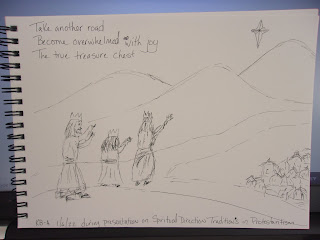
Along the way, I made this sketch, and a haiku to go along with it:


I created it after hearing/reading the second chapter of the Gospel of Matthew several times throughout the day and a session of lectio divina; here are the words to the haiku:

Take another road
Become overwhelmed with joy
The true treasure chest

In the evening, after a wonderful dinner, we heard from Axiom Farms, the ones who prepared our meal.  They have all sorts of initiatives to reach out to underserved, minority populations, to bring them healthier food and information about how to grow one's food and most importantly, to inspire people to have hope.  They have created a garden on the grounds of the seminary.  There's plenty of room--the seminary sits back from the road, and between the buildings and the road is a huge expanse of lawn.  The partnership with the seminary made me want to change all my plans--and do what, exactly?  Come to this seminary?  Buy a plot of land and farm it?  Give them money to support their work?  Yes, to all of those.  I'm not likely to act on any of them, at least not this month, but it was good to feel that hope for the future myself, even if I'm not the target audience for Axiom Farms.

We adjourned to the courtyard for our evening worship.  There's a Native American group that we'll learn more about today who came last night.  They had a smudging ceremony in the courtyard.  We each stepped forward to be smudged with sage that smoked in what looked like a giant shell.  The elders swirled the smoke around us with big feathers.

I wish I could have heard better.  At first I thought the same words were repeated with everyone, but as I watched, I realized that wasn't true.  I was second to be smudged.  The female elder of the tribe said, "Oh, such strong shoulders" as she touched them with the feather.  She said, "And a good heart."  I'm not sure of the rest, although at one point, she did say, "We're getting rid of all negativity."

Later she told me that there are 4 types of smudging smoke:  tobacco, sage, sweetgrass, and cedar.  I wonder if those smudging ceremonies are different.

The one we experienced last night was very powerful.  Many of us cried a bit, and a few of us were deeply shaken, and I'm not sure whether it was in a good way or a bad way.  Once again, I was reminded of how cerebral most of our mainline Protestant worship services are, and how it might be much more powerful/effective to do more embodied practices.

We then went into Alumni Hall for a drum circle, which is different from many drum circles.  There was a big, round drum in the center of the room with 6 people around it.  Their drum sticks looked like they had big cotton swabs on the end.  Around this drum circle, we sat in chairs that were much too close to each other, but this room is the largest on campus.

It was interesting to be in a room of Native Americans, after hearing from African Americans, all of whom were trying to reclaim cultures and practices that can heal both people and land.

We learned that some hymns, like "Spirit of the Living God" and "Amazing Grace," can be sung to Native melodies played on the Native wind instrument which I think is called a flute but looks more like a recorder.  We learned some Native phrases so that we could sing refrains to other songs and chants.  For one song, two women did a bit of a dance between the drum circle and our seated circle.  It was a meaningful experience, but nothing can compare to the smudging ceremony.  

It makes me want to create/recover similar ceremonies that draw from Protestant traditions.  I'm aware of the dangers of appropriating the culture of others, but I'm also certain that Christian communities have done something similar with incense and thuribles, so I don't think I'd be in the dangers appropriation territory.

I am ready to see what today brings.  I am so glad that I decided to attend in person.  In fact, knowing that we would experience the Native American version of Christian worship and that we would be going to a Greek Orthodox church to see icons in their home setting--those were two main reasons that convinced me that in person would be better for me than remote.

And if anyone asks if these experiences would be worth it, even if I get sick, I would say that yes, barring long COVID, it has been worth it.

Friday, September 10, 2021

Outreach in the Form of a High Holy Days Box

Before we get too far away from Rosh Hashanah, I want to document a cool experience that happened at work, of all places.  It happened last Thursday afternoon, when few of us were there, as classes had ended and grades had been turned in.

I heard a man's voice talking to one of our faculty members.  She brought him to me asking how many Jewish people we had working on the campus.  We could only think of one, and she was working from home where the internet was stable.

The man held a stack of boxes.  He handed us one, along with his card, and asked us to give it to our colleague:


When our Jewish colleague returned on Friday, we were all interested to know what the box held.  It had a picture of a shofar, so that's what I was expecting.  But no, it was a delightful collection:


There was a sweet cake, a small jar of honey with a twirler, a small cup, and a stress ball in the shape of an apple.  Underneath it all, under the blue cardboard, was a game for kids and some information about the holiday.

I always wonder how people respond to this kind of outreach within their own religion.  Does a gift box like this seem overbearing or insulting in some way, like one can't be trusted to find their own ingredients for a significant celebration?  Our Jewish colleague was charmed and touched.

As someone who has done community outreach for a church, I loved the idea of the box, but I wondered about the cost.  I also wondered why the rabbi decided to stop at our nondescript building.  Did he load up the car with boxes and stop at every workplace along the way?

I also wondered how he was received elsewhere.  I like to believe that South Florida is a crossroads kind of community, the intersection of many different types of cultures.  I want to believe that this kind of intersection leads us all to be more tolerant, but I know it's not always true.  I know that antisemitism is on the rise, and I worry about what it means for the safety of us all.

I'm glad that people will still show up with a good will gesture like a box of treats for the highest holy days.  May we all be blessed and have a sweet new year.

Tuesday, April 20, 2021

What I'm Reading in this Time of Racial Reckoning

Here we are, another April, another trial about police brutality.  Yesterday lawyers finished closing arguments in the trial of the police officer accused of killing George Floyd.  In  April of 1992, officers accused in the brutal treatment of Rodney King were acquitted.

Across the years, my response is the same:  how can people be that brutal?  I am not one of those who would argue that any of us could be that brutal, given the right circumstances.  But to beat a stranger who has done nothing to me personally?  In both cases, and in so many cases of police brutality, I look at the victim--the crime is not something like child molestation.  Traffic violations, high speed chases, broken taillights, minor drug offences--that doesn't inspire murderous rage in me.

Against this drumbeat of the trial in Minnesota, the subsequent police mistakes that have lead to death in just the two weeks since the trial started, I've been reading two works of fiction.  I realize that there are many works of nonfiction that could give me important viewpoints during this time.  In fact, I read some of them last year.

In terms of understanding police brutality, the best book on the subject that I've read thus far is Resmaa Menakem's My Grandmother's Hands:  Racialized Trauma and the Pathway to Mending Our Hearts and Bodies.  This April, I've been reading Yaa Gyasi's Transcendent Kingdom and Ayad Akhtar's Homeland Elegies.

Both writers are exploring the immigrant experience, as varied as that experience can be in the U.S.  Gyasi's immigrants come from Ghana and end up in Alabama and later California, when the immigrant daughter goes to Stanford.  Akhtar's immigrants come from Pakistan.  All of the characters are treated as racially different from the mainstream, and the authors explore what that means in the modern world.  It's good to be reminded that racial issues are much more layered than just black-white.

Both authors also explore the issue of religion in the U.S.  Gyasi's characters are Pentecostal Christian, and Akhtar's are Muslim.  But of course, it's rarely that simple.   And there are other types of beliefs that the authors explore:  the belief in wealth and money, the pursuit of truth (scientific truth, relationship truth, medical truth, geopolitical truth), and the embrace of the ecstatic, even when the ecstatic will kill.

I enjoyed each book, and I do wonder if I would have enjoyed them as much if I had read them further apart.  Probably.  I also heard each author interviewed on NPR's Fresh Air, which also enriched my experience, once I finally found the books in the library.

Have these books helped me understand the heart and mind of the police officer who can kneel on a man's neck for 9 minutes?  No.  I can't imagine wanting to read that story, and I really can't imagine writing that story.

But I do believe in the power of story to help us understand each other.  Yaa Gyasi's Transcendent Kingdom and Ayad Akhtar's Homeland Elegies are important pieces of that mission.

Thursday, January 21, 2021

Religious Elements in an Inauguration

I have written a long post on the Inauguration on my creativity blog.  Here I want to think about the religious elements of the day.

I have friends who are atheists, agnostics, and outside of mainstream Christianity and Judaism, by which I mean I have at least one friend in each of the following:  Hindu, Quaker, Unitarian/Universalist, Wiccan.  I am aware of the many ways that religious elements can make people feel excluded.

I was heartened that Biden went to a Mass on the morning of his inauguration.  I was REALLY heartened by the number of other political leaders (from both parties) who went with him.  While I don't think it was broadcast live or recorded, if you want to read the homily, you can go here.  

It did not contain many surprises, and perhaps this quote best summarizes the message:  "I am sure that today’s inaugural address will be a bit longer than Jesus’ brief reading from the Jewish scriptures! But knowing the Bidens, I am confident that the substance of today’s inaugural address will echo Jesus’ message because your public service is animated by the same conviction to help and protect people and to advance justice and reconciliation, especially for those who are too often looked over and left behind, the people whose voices you raised in the campaign and throughout your public life."

To me, there's nothing objectionable in the message of service and protection.  I felt similarly about the opening and closing prayers of the Inauguration, but I realize that I have a bias.  Here is the text of the opening prayer, which is a little less inclusive than the closing prayer, which I can't find in written form.  I was struck throughout the closing prayer about how it was inclusive--even in its reference to the Divine.  I'll keep looking for the specific words.  It didn't occur to me to take notes.

There will be a prayer service today which will be livestreamed at 10 a.m.  It's an amazing line up, and I plan to watch/listen while I'm working at my desk.  For more information, go here.  I'll be interested to see which religious elements people emphasize.  Can a spirit of unity and ecumenism be sustained?

I hope so.

Saturday, October 24, 2020

Creating Something Special (and Socially Distanced) for All Saints

How can we create something special for a worship community that can't gather in person?  I'm thinking specifically of All Saints Sunday, but this question seems essential to our time.

Disability activists would remind us that the question has always been essential but that many of us had the privilege of being able to avoid wrestling with it.

So, if we wanted to create something special for All Saints, what might we create?  If we wanted it to be participatory, what would we create?

I've thought of mailing something to all of our members, a care package of sorts.  I saw one person post about plans to send all the odds and ends of Christmas eve candles to members along with a liturgy of remembrance that could be done alone or with families/other pandemic pod members.  But the thought of addressing all those envelopes and getting everything mailed overwhelms me.  After all, there's not much time before All Saints Sunday on November 1.

Our church does drive through communion, and I've thought of having some sort of special package to hand out.  But that does eliminate the participation of those who can't get to drive through communion.

The other vision I've had involves setting up a meditative space on the church grounds.  In past years, we've had a table where people could bring pictures of lost loved ones.  I wouldn't think that people would want to do that.

I have a vision of a Day of the Dead type altar--we have an outdoor barbecue in the back.   It's made  out of cinderblocks and hasn't been used as a barbecue in years, if not decades.  Could that be transformed?

Here's a picture that I found by way of a Google search; It first appeared in this article in Los Angeles Magazine:


I could do the initial transformation by Friday, and then people could come during the week-end or send something that we'd add to the altar.  I could create some sort of video something that could be sent to members who can't get to the site.

Of course, the potential problem might be vandalism.  But I'd create it with cheap materials, and even if someone stole them, I wouldn't care.

In a different time, I'd invite people to bring a picnic and maybe we could start a different kind of All Saints tradition.  But that will not be this year.

Let me also wonder if I'm appropriating the traditions of a culture that's not mine.  Yes, in some ways, I am.  I'm a descendent of immigrants from northern Europe--this tradition is not mine.  Yet my hope would be that if we could do this in a respectful manner, that it might be meaningful, both for those of us who never had this experience and for those in the community who might be happy to have this opportunity, this temporary monument to memory.


Monday, February 10, 2020

Pictures from a Service in Celebration of World Interfaith Harmony Week

I confess that I haven't been aware of the United Nations World Interfaith Harmony Week before my church celebrated with a service on Sunday Feb. 9.  I went to church not quite sure what to expect.

I knew we would have breakfast:


I knew that we would have visitors from our mosque down the street.


I knew there would be some singing--would we all know the same songs?


Happily the songs that we chose have a lot of repetition, so they taught themselves.  Besides, many of us know songs like "This Little Light of Mine" and "He's Got the Whole World in His Hands."


We had prayers, both in English and in Arabic.


We had meditations on harmony from both the Christian and Muslim faith.


And then we anointed each other's hands with oil.


The pastor of our church said words of blessing, like "Blessed be your hands that reach out to your interfaith neighbors."


I took 133 pictures yesterday morning, but the pictures of our hands moved me the most.


Saturday, February 8, 2020

A Muslim-Lutheran Breakfast in Celebration of Interfaith Harmony Week

This Sunday, February 9, 2020, our Lutheran congregation has a special opportunity: we will share a meal and conversation with our neighbors from the mosque down the street.

Think about how miraculous this statement is. We're Lutherans--a minority Protestant variation in most of the country, although we are still mainstream Protestants. In most parts of the country, the non-Lutheran pockets, there aren't many Lutheran churches to choose from.

Muslims are even more of a minority in the U.S. Yet here we are, about to have breakfast together.

I think of South Florida as a non-religious place, but we have a variety of religions. We even have a Hindu temple. But how often do we have breakfast together?

We aren't going to try to convert each other. It's not going to be that kind of breakfast. There are many ways to God. There are many ways to live a good life. On Sunday, we'll hear more from each other about that.

It won't be a typical Sunday morning in a Lutheran church--but how wondrous that we live in this time where we can stretch our boundaries in this way.

So come join us in this moment of hospitality. We'll have a good meal, good conversation, and we'll glorify God in this way.

If you're so inclined, come celebrate Interfaith Harmony Week with us at 10:10 a.m. on Sunday, Feb. 9, at Trinity Lutheran Church, in Pembroke Pines, Florida, on the southeast corner of Pines Blvd. and 72nd

Monday, December 9, 2019

Quilted Christmas: Crafting a Doorscape

When I think back on this week, perhaps I'll think about the two sketches that I did or the poem that I wrote about Jesus going to the Black Friday sales.  Or maybe I'll remember creating this--what shall I call it?  This doorscape:


One of my colleagues wanted to have a door decorating contest, and she went all out, even creating a small roof over her door:


Not to be outdone, one of my other colleagues got busy creating with styrofoam cups.  Eventually his door looked like this:


I spent a good deal of time over the week of Thanksgiving wondering what I should do. I don't particularly want to win the contest, but I am happy creating library displays, calendars, and bulletin boards.  Perhaps a door would be the same sort of thing.  I thought about mermaids or something spiritual/religious.

But as I sat in my office, I thought about how much of my office space is devoted to textures, colors, and fabrics.  I came up with the concept of a quilted Christmas first.  I thought about doing all kinds of quilting, but time grows short.

Long ago, one of my colleagues at a different school gave me an unfinished quilt saying, "You'll know what to do with it."  I'm not sure this display is what she had in mind:


I thought about a variety of techniques for the door itself, from actually quilting every word or gluing fabric scraps to approximate a quilt.  The process for the letter Q took so long that I abandoned this idea:


Later, though, the idea of a wreath came to me, along with more possible ideas than I could use.  I wanted to quilt something new, but in the end, I went with what was quick.  I had some panels of strips in holiday colors already sewed together, and I wrapped them around a paper plate with the center cut out:


I am most proud of the bow.  I know that it's a ridiculously easy thing to do, but it's one of the few bows like this that I've made.

The trees at the base of the display answer the question:  "What should I do with the trees that don't light up anymore?"  The lights that you see are a battery operated string of fairy lights that came separately.  I love the chance to display some of my favorite ornaments.


The tree skirt was not made by me.  My first Christmas in grad school my mom sent it to me; she got it at a craft show at church, and I crocheted the stockings to go along with it:


For years, I resisted decorating an office--but in later years, thinking about how much time I spend in my office, I usually have something seasonal decorating this space.  Still, I've never gone as all out for Christmas as I have this year.

In my younger years, I worried about offending those of different religions--which is funny, because in my younger years, I wasn't living among anyone who didn't celebrate Christmas in some fashion.  Now I'm in a much more ethnically diverse place, and I've decorated my workplace to the hilt.  I've not tried to be ecumenical at all.  I feel a smidge guilty.

But I am surrounded by items from my past which bring me contentment and joy--and I still don't have space at home for all of them.  So let me take my joy where I can find it, and let me trust that I'm not offending anyone by my offering of a Quilted Christmas.

Saturday, September 14, 2019

Are We Ecumenical or Enabling?

Earlier this week, we had a conversation amongst church members about the 7 other church groups who use our space.  Some of those church groups have very different theologies, although they are all ostensibly Christian groups.

Some of us chafe about how filled our church space has become.  Scheduling a wedding for a church member takes a herculean effort, for example.

Some of us see the sharing of space as an essential part of our mission.  Over fifty years ago, our ancestors gifted us with a church building.  Now we have a resource to shepherd and to share.

I will be blunt and honest, since only about 7 people are likely to read this blog post.  I am not sure I want to share resources with people who won't allow a woman to preach.  I am not sure I want to share resources with people who believe that homosexuals are headed to hell.

I am also not sure how many of our groups have more repressive beliefs.  One group is Seventh Day Adventist, so I'm pretty sure at least one group is more repressive.

We could argue about ecumenism.  I would say that we have not had that many years of openness in the Lutheran church; it's easy to lecture about ecumenism when you've been allowed to control the pulpit for the last two millenniums.

I wonder when ecumenism becomes enabling.

I know that I might be more comfortable sharing our worship space with Hindus or someone radically different in another direction than with sharing our resources with those whose Christian fundamentalism will restrict the personal possibilities of so many.

I realize that I'm risking being judgmental and closed off.  I am trying to have an open heart and an open mind. 

But I also know that I don't want to be part of oppressive structures when I can avoid it.  I don't want to support those oppressive structures.

I am ready for the new society, the beloved community, even as I feel our society slipping back to a shadowy past.

Sunday, March 18, 2018

Mepkin Moving Forward

This morning, because of my Facebook friendship with Pastor Andy of my parents' church in Williamsburg (St. Stephen's Lutheran), I read this great piece in The New York Times about Mepkin Abbey.  It includes beautiful pictures of the Abbey in its present incarnation, along with historical pictures from the 1950's.

The essay explores the issues that this monastery faces, as their members grow ever older; a newer monk who is in his 60's is one of the younger ones.  It's not a problem that only Mepkin Abbey faces:  "Across all orders, the number of Catholic brothers in the United States has declined by more than two-thirds since 1965, according to the Center for Applied Research in the Apostolate. But Trappist communities may be particularly vulnerable, since their traditions are more isolating and, in many ways, more resistant to modernization."

The story discusses the direction that Mepkin Abbey will move:  "Many young people of the Roman Catholic tradition, Father Guerric added, will simply not be attracted to forms of monasticism that require celibacy and a lifetime commitment. But there’s a growing belief among Mepkin’s brothers that certain elements of the Trappist tradition — its cultivation of mindfulness, stillness and inward exploration — are increasingly relevant to today’s youth. And the abbey, they say, is a repository of wisdom about the benefits of contemplative living."

They will offer new programs, along with the retreats they've already been offering:  "The abbey’s new affiliate program will offer two new short-term monastic options for people of any, or no, faith traditions: a monthlong monastic institute, open to men and women, and a yearlong residency. And in a departure from its otherwise passive approach, Mepkin created an ad campaign — albeit a small and highly targeted one — to publicize the program. (It featured copy that read: “BE A MONK. FOR A MONTH. FOR A YEAR.”)."

In the past year or two, I've been noticing that the Abbey offers more retreats that are more organized and cost a pre-set amount.  I wonder if that move is tied to the Abbey's efforts to offer more so that they can keep going.

Every time I go to Mepkin Abbey, I wonder how they sustain themselves--and the answer that this article gives us shows us the precariousness of their situation.  They sustain themselves through mushroom sales, through retreatents, through donations of both money and time (they have volunteers that help keep the Abbey running) along with some paid labor.

I'm impressed that they are able to face their uncertain future, to pray, and to plan.  I love the idea of reaching out to spiritual searchers, even if they're not Catholic or Christian.  But I also love that they're not abandoning their core monasticism.  I look forward to seeing where they head--and hopefully being part of that journey.

Sunday, March 11, 2018

Writing as Hospitality

As I noticed before the AWP conference, there were only 2 sessions that dealt overtly with faith and writing.  One session sounded like it would be about writers who grew up in faith communities and were struggling with having to get those voices out of their heads.  I skipped that one.

I finished my time at AWP by going to a panel entitled "The Ganesh in the Room:  Speaking of Faith in the Literary Community."  They began by noting the potential offense and insensitivity contained in the title, especially for a panel that contained no Hindu participants.

The panel was moderated by a Jewish man, and one of the participants was a Jewish woman.  The other participants were a Muslim woman from Pakistan and a Christian woman.  It was fascinating.

Here are my two favorite take-aways, both from Amy Frykholm, the Christian woman participant.  She talked about her Christian belief as being less of an identity than as a location and a territory.  I loved that metaphor.  It explains the wrestling to leave as well as the longing to return.  It takes our faith away from the issue of what we believe (and can or cannot prove) and the creeds.

When we had 5 minutes until the end, the moderator asked how many people still had questions.  Five people raised their hands.  The moderator asked each person to ask their question and then the panel would see if they could somehow address them all.  The questions ranged from how to deal with readers who may not understand all the references to publishers (who also may not understand all the references). 

Amy Frykholm said that what she noticed as a common thread both in the questions and in the way she would answer:  the need for hospitality.  Who is receptive already?  What do people need to know to understand the work and to feel welcome in the world?

In the end, the panel encouraged us to be in awe of the mystery and to say the unsayable.  In some ways, that's good advice for us all, regardless of our faith, regardless of whether or not we write.

Tuesday, January 2, 2018

Messiahs, Last Jedis, and Christmas Connections

On our recent trip to San Diego, we went to a beautiful Lutheran church downtown for Christmas Eve service.  We sang almost every Christmas carol possible, and we had communion.  We took our lit candles out into the chilly patio--we sang "Go Tell It on the Mountain," after singing "Silent Night" as we lit the candles; it was that kind of service.

And then we walked the 6 or so blocks back to our swanky downtown hotel.  We saw people sleeping on the ground, and I thought about the Gospel and what it means when there's no room at the inn.  On every block, people settled down to sleep on sidewalks and huddled beside buildings as Christmas Eve moved to Christmas morning.

I prayed for them as we walked past; the act of praying made me realize how many San Diego residents sleep/live out in the open.  I wanted to do more.  I had a vision of passing out Christmas cookies, but I had left them in my freezer a continent away.

I wish I could do more, like providing affordable housing.  But I know that homelessness is a complex issue.  If everyone had a house, we'd need a source of funding to care for the house.  Not everyone can hold down a job.  Not everyone is mentally stable enough to live in a house alone or with family members.  Not everyone wants to stay put.

On Christmas day, we hiked back down the hill to the Gaslamp district to see the latest Star Wars movie.  I'm a different kind of geek, the kind that sees the Jungian architecture, the one who sees everything through my English major lens, the one who can find a theological reading for every pop culture product that comes my way.

How interesting to see The Last Jedi less than 24 hours after Christmas Eve service and after an Advent month of longing--and after a political season that has included shifts I never would have forecast or believed.  I spent a lot of time thinking about what kind of theology the movie presents.  It's an interesting blend of ancient religions and modern spirituality, as always.  I don't believe that the movie tells us that the destiny of humans is pre-ordained--and how interesting that twist is to me.

I love the message of the movie, at least the take-away message for me:  we don't fight evil by adopting the tools of the evil regime, we fight evil by saving what we love.  A parallel message is that we don't have to be part of a spiritual dynasty to join the fight for the future--the Force is available to us all.

I thought of our cultural desire for a Messiah, for someone who will save us.  But we're often doomed by our insistence on being the Messiah--it was interesting to watch this movie with the words of John the Baptist ringing in my head:  "I am not the Messiah."  I'm still thinking about these parallel ideas--how to respond to a world with so much need for a Messiah?  We can't be the Messiah, but people need more than just the promise that a Messiah will come.  I worry that I'm transposing my theological ideas on the movie, but here it is:  the Force (which I've always understood to be God) operates much more effectively in the world when there are spiritually attuned people to help.  Those light sabers and rocks won't move themselves. 

The idea that the Force can be used for good or for evil (or for profoundly mixed motives) isn't one that Christianity traditionally presents to believers, but it makes sense to me.  I don't see God as a parent, but as a partner, albeit a partner who knows more and has more resources than I do.

We left the movie and walked back through the ritzy dining establishments that were open on Christmas day.  We left the Gaslamp district and walked by all the people setting up camp for the night by the city's sidewalks.  We exchanged Christmas greetings.

And again, I prayed for us all.