Sunday, April 13, 2025
Sermon for Palm/Passion Sunday
April 13, 2025
By Kristin Berkey-Abbott
The Palm and Passion Narrative in Luke
Today’s readings give us all sorts of contrasts, some of which we’re aware of, some of which may be lost on us. Let’s see if we can explore some of them, and by doing so, let’s see if we can hear the story in new and relevant ways.
Our Palm Sunday narrative, the first one we read, gives us Jesus entering Jerusalem on a colt. Two thousand years later, some of the significance might be lost on us. There’s prophetic significance, which many of us have been trained to recognize. After all, we often have our Holy Week Gospel readings paired with Old Testament texts that the first century Christians would have used to interpret and understand what they had witnessed in the life of Jesus and his resurrection.
A piercing piece of information in the Palm Sunday story is the entrance of Jesus. We might hear the story of Jesus on a colt and assume that he was tired or that he was riding on a colt because an Old Testament prophet peered into the future and said that the savior of Israel would enter Jerusalem on a meager animal.
But first century believers would have contrasted the entrance of Jesus with the entrance of Caesar or Caesar’s representative, Pontius Pilate, the Roman emperor, who would likely have also had a grand entrance into Jerusalem. In their book about Holy Week, Marcus J. Borg and John Dominic Crossan point out that it was standard practice for Roman governors of Judea to come to Jerusalem for major Jewish festivals. Passover was the biggest one. Let’s be clear—they weren’t in Jerusalem because of their deep reverence for God. No, they were there in case there was trouble.
Jesus enters on a young horse. Pilate would enter on a stallion—a much more impressive steed--and he would be flanked by calvary and soldiers. Every movement would proclaim that Rome was in charge. This imperial procession would be very different from Jesus, who entered with a throng of peasants, singing songs and glorifying God.
If we didn’t already know the implications of this contrast, we might think that the Jewish leaders would be happy at the proclamations of the people. But we know that these two contrasting triumphant entries set the stage for what is to come. Jesus enters on a colt, with people pledging allegiance to God, not Caesar. The contrast between the Kingdom of God and the Empire of Earth isn’t always this visible. We shouldn’t blame the religious leaders for wishing the people would quiet down. This kind of behavior isn’t the kind that will go well when imperial powers take notice. Anyone aligned with the Romans would see this as a piece of performance art that made a mockery of Roman power.
And those people in alignment with Roman power are in Jerusalem, and they will take notice of this demonstration. Jesus has been on a collision course with Rome for a long time as he taught resistance techniques and insisted on justice. This week is the time it will come to a boiling point.
The Holy Week texts show us all the ways that nearly everyone betrays Jesus, each in their own contrasting way. The crowds who are so enthusiastic on Palm Sunday demand Jesus’ death by Friday. What has changed their minds? What were they hoping would happen and why do they feel so angry that they would rather have Barabbas, a murderer and a terrorizing insurrectionist, back in the community than Jesus, the one who fed and healed them and drove out demons from their midst?
When we think about the betrayals of Holy Week, we probably think about Judas and Peter, but look at that Last Supper text again. We see that the disciples still don’t understand what Jesus has called them to do. In Luke 22: 24, the disciples show that they still don’t understand the nature of the Messiah with whom they have spent so much time. They seem to think that they are operating in a system with a familiar hierarchy, the kind of hierarchy announced with imperial processions and royal armies. If Jesus is the head of the organization, then who gets to be the greatest after him, the second in command? Once again, in verses 25-27, Jesus reminds the disciples of the different kind of system he has come to implement, one based on service, not being in charge. The inbreaking kingdom of God will be different from the world they have experienced. In God’s inbreaking Kingdom, the least will be first.
We might do some comparing of ourselves with these people of ancient times. We might think that we would never betray Jesus in this way, enthusiastic on Sunday, disillusioned and bitter by Friday. We might think that we would never be like those disciples, the ones who don’t understand what Jesus calls them to do. We might say that we would never sell out Jesus with coin or kiss. We might say that we would never deny knowing Jesus three times before the cock crows.
The good news of this Holy Week story is that Jesus does what he came to do, regardless of the reaction of those around him. Even on the cross, Jesus continues his mission of forgiveness and redemption. Luke is the only gospel where Jesus prays, “Father forgive them, for they know not what they do.” While he is dying on a cross, Jesus asks for forgiveness for those who nailed him up there. In Luke, the thief on one side of him asks to be remembered, and Jesus invites him to come to Paradise too—redemption, even in the midst of death.
When I think about the contrasts in the Holy Week story, this contrast between life and death, between the world that crucifies and the one that redeems—this contrast is the greatest one. Jesus comes into our broken world, which tries in every way to break him, and even in the most gruesome death, Jesus remains unbroken by the forces which send everyone else whimpering away. Even in the agony of the cross, Jesus still proclaims that the Kingdom of God is at hand.
In a world that tries to slaughter all that we hold dear, that message is Good News. That Good News has been delivered by angel choirs in the skies over Bethlehem, through a distant star that spoke to wise observers far away, in the words and actions of Jesus, and in the lives of two thousand centuries of believers. Let us hear it with fresh ears this morning: The Kingdom of God is at hand. Let us go proclaim it.
Tuesday, April 8, 2025
Meditation on This Sunday's Gospel
The readings for Palm Sunday, April 13, 2025:
Liturgy of the Palms
Psalm
Psalm 118:1-2, 19-29
Gospel
Luke 19:28-40
Liturgy of the Passion
First reading
Isaiah 50:4-9a
Psalm
Psalm 31:9-16
Second reading
Philippians 2:5-11
Gospel
Luke 22:14-23:56 or Luke 23:1-49
Those of us who have been going to church for awhile have heard these stories dozens of times. If we go to many or all of the Holy Week services, we'll hear these stories again and again this week. As we enter Holy Week, how can we hear them differently?
This year, what would happen if we imagined these stories from the perspective of a variety of characters? I imagine that many of us hear these stories and imagine ourselves one of the disciples. But what if we told the story through the view of the palms? What if we thought about the donkey's perspective? The poet Mary Oliver did just that in "The Poet Thinks About the Donkey," a poem that you can find here: https://predmore.blogspot.com/2016/03/poem-poet-thinks-about-donkey-by-mary.html.
The journey that takes us from Palm Sunday to Good Friday offers us some serious reminders. If we put our faith in the world, we're doomed. If we get our glory from the acclaim of the secular world, we'll find ourselves rejected sooner, rather than later.
Right now, we live in a larger culture that prefers crucifixion to redemption. For some of us, we see a brutal world that embraces crucifixion: no second chances, perhaps no first chances. The world hurls a new challeges at us while reminding us of old fears, like world war that ends in nuclear blasts.
The Palm/Passion Sunday readings remind us that the world has always been this way, although the particulars change. Jesus and the disciples lived in an empire far more brutal than the ones that Northern Hemisphere, western culture Christians inhabit. We may find comfort in our smaller communities, but we are called to live in ways that will likely bring us into some sort of conflict with the larger culture.
We may not end up hanging on a cross, but we may be among those weeping at the foot of the cross. We may have seen this ending coming, as we have watched our loved ones headed towards an ending that might have been avoidable. We may find ourselves asking, weeping, lamenting: "Is there no other way?"
We know that the story doesn't end on Good Friday. We know that God will make a way when humans cannot see a way. We know that God promises resurrection, even when we can only see ruin every direction we look.
We worship a God who has been working through time and outside of time to transform this human condition. We don't always see it, but Easter assures us that the process is in place and that resurrection will break through, even in the most unlikely circumstances.
Sunday, March 24, 2024
Hearing the Holy Week Story Anew
Today is Palm Sunday, or for some of us Passion Sunday. Some of us will hear the whole Holy week story today, and some of us will hear it throughout the week, and some of us will do both--the whole story today and then returning to church and/or devotional time that returns us to the story.
Today in my sermon, I'll suggest that we approach this repetition as a lectio divina. As we hear the story again and again, what word or phrase lodges within us?
We will be hearing stories that many of us have heard many times before. How can we hear them with fresh ears? One way is to use the Ignatian discipline of trying to imagine ourselves as part of the story.One year I was startled to realize how much I identified with Pontius Pilate as an administrator. That year, I saw the Good Friday story in a different light. One year I read Mary Oliver's "The Poet Thinks about the Donkey" (you can read it here: https://predmore.blogspot.com/2016/03/poem-poet-thinks-about-donkey-by-mary.html). I hadn't thought much about the donkey that carries Jesus into Jerusalem on Palm Sunday, and my perspective shifted.
Here are some ideas to get you thinking. Tell the story from the perspective of:
--the person who cleans up after the last supper
--the towels used by Jesus to wash the feet of the disciples
--the cross itself
--an indifferent observer on Palm Sunday
--the sibling of Jesus who had always seen this day (Good Friday? Palm Sunday?) coming
--the disciple we don't usually hear about
--the rooster that crows three times
Here's hoping for a creative week-end, in all the ways our creativity can manifest itself!
Tuesday, April 4, 2023
Erasure Poem as Lectio Divina and/or Teaching Tool
Last night in my Luke class for seminary, we arrived at the Palm Sunday text--a happy coincidence, not a planned collision. My professor wanted to try something interesting.
One of the dangers/problems with a familiar text is that we think we've heard it all already. How can we approach it with fresh ears? The Palm Sunday text is one of those familiar stories, yet it is so different from Gospel to Gospel.
My teacher gave us the text of Luke 19: 29-40 as a Word doc. We had five minutes to see what words spoke to us. We changed the text of those words to a different color, then we blacked out the rest of the text, using the highlight feature of Word as a black highlight.
I had never done this in Word before; I've always just used a marker, the few times I've done it. And I've never done erasure poetry, which my professor called blackout poetry, as part of a religious practice.
At first I thought it was a blah effort--and then I wrote the words in my notebook:
Untying
Path down
Loud voice
Stones shout
Very interesting! Several other students read their poems and they were all so different. Mine was the shortest and sparest. But the long and winding ones intrigued us too.
This exercise seemed to have a lot of applications, which is why I'm recording it here. It could work well as part of lectio divina, where we look at a text (often reading it out loud) several times to see what is speaking to us. It could work well as part of a Bible study. And I'm interested to think of its applications in the English classroom, applications beyond a poetry writing session. Hmmm.
There are so many delights to being a seminary student, and last night's class reminded me of them. Once again, I feel so lucky. And I'm happy to think about the ways I'll apply some of these possibilities to the English classroom, where I will be teaching in person again for the first time since the pandemic.
Sunday, April 2, 2023
Palm Sunday and the Collision Course
This time there will be no flight to Egypt.
The donkey has too much to carry, too far.
The shadows wait for me. Around the table at Passover
Among those in high places, in the condemned cell,
On the hill outside. Fear haunts my waking moments,
and I cannot sleep. Why has God forsaken me?
People:
The crowd today is with me. But not for long.
They are the powerless ones (the ones who matter).
The ones who count are counting.
Time is running out. This time, there will be no flight to Egypt.
I think the above is from Cry of the Whole Congregation by Walter Wangerin. We use the liturgy/chancel drama for Palm Sunday, so that's why I'm guessing at the author's identity.
I find it the most meaningful part of Passion Sunday. It reminds us that Jesus has been on a collision course with the Roman empire since his birth--or since the Wise Men showed up to let Herod know that he had a rival.
And yes, I understand that these stories are not exactly true, in the way that we define true as factual.
But in the other way that we define true, this final Palm Sunday passage reminds us about the totality of Christ's life. It's important for us to remember the basic lesson of the Scriptures: God is not fickle; it's humans and the societies that humans create that are fickle. You can be acclaimed in one season and denounced in the next.
Sunday, April 10, 2022
Palm Sunday at the Quilt Retreat
How do we respond when we meet the Divine in unexpected places?
How do we react to reminders that of God's humanity?
Can we worship a God who has been working through time and outside of time to transform this human condition?
Do we believe in the promise that resurrection will break through, even in the most unlikely circumstances?
Tuesday, April 5, 2022
Meditation on This Sunday's Gospel
Liturgy of the Palms
Psalm
Psalm 118:1-2, 19-29
Gospel
Luke 19:28-40
Liturgy of the Passion
First reading
Isaiah 50:4-9a
Psalm
Psalm 31:9-16
Second reading
Philippians 2:5-11
Gospel
Luke 22:14-23:56 or Luke 23:1-49
Those of us who have been going to church for awhile have heard these stories dozens of times. If we go to many or all of the Holy Week services, we'll hear these stories again and again this week. As we enter Holy Week, how can we hear them differently?
This year, what would happen if we imagined these stories from the perspective of a variety of characters? I imagine that many of us hear these stories and imagine ourselves one of the disciples. But what if we told the story through the view of the palms? What if we thought about the donkey's perspective? The poet Mary Oliver did just that in "The Poet Thinks About the Donkey," a poem that you can find here: https://predmore.blogspot.com/2016/03/poem-poet-thinks-about-donkey-by-mary.html.
The journey that takes us from Palm Sunday to Good Friday offers us some serious reminders. If we put our faith in the world, we're doomed. If we get our glory from the acclaim of the secular world, we'll find ourselves rejected sooner, rather than later.
Right now, we live in a larger culture that prefers crucifixion to redemption. For some of us, we see a brutal world that embraces crucifixion: no second chances, perhaps no first chances. The world hurls a new disease at us while reminding us of old fears, like nuclear weapons.
The Palm/Passion Sunday readings remind us that the world has always been this way, although the particulars change. Jesus and the disciples lived in an empire far more brutal than the ones that Northern Hemisphere, western culture Christians inhabit. We may find comfort in our smaller communities, but we are called to live in ways that will likely bring us into some sort of conflict with the larger culture.
We may not end up hanging on a cross, but we may be among those weeping at the foot of the cross. We may have seen this ending coming, as we have watched our loved ones headed towards an ending that might have been avoidable. We may find ourselves asking, weeping, lamenting: "Is there no other way?"
We know that the story doesn't end on Good Friday. We know that God will make a way when humans cannot see a way. We know that God promises resurrection, even when we can only see ruin every direction we look.
We worship a God who has been working through time and outside of time to transform this human condition. We don't always see it, but Easter assures us that the process is in place and that resurrection will break through, even in the most unlikely circumstances.
Sunday, March 28, 2021
Sermon for Palm Sunday 2021
I was happy that my pastor let me do the video sermon for Palm Sunday. We are still meeting remotely, so it needed to be pre-recorded. This time, I used still photos and wrote out most of the sermon before, so that I could record segments and put them together.
I still have much to learn, but I'm pleased with how it turned out. It's too big to post here, but you can go here to my YouTube channel to see it.
And because I wrote it out, I can paste the sermon below:
Palm Sunday 2021 Sermon
In some ways, it seems strange to be celebrating Palm Sunday again, here in year 2 of our pandemic. When we had to cancel in-person services last year, so many of us probably assumed we’d be back to “normal” again soon. And here it is, a year later. In some ways, nothing has changed. In some ways, so much has changed.
Palm Sunday reminds us of the cyclical nature of the world we live in. The palms we use on Palm Sunday traditionally would be burned to make the ashes that will be smudged on our foreheads in 10 months for Ash Wednesday. The baby that brings joy to the manger at Christmas will suffer the most horrible death--and then rise from the dead. The sadnesses we suffer will be mitigated by tomorrow's joy. Tomorrow's joy will lead to future sadness. That's the truth of the broken world we live in. Depending on where we are in the cycle, we may find that knowledge either a comfort or fear inducing.
Palm Sunday reminds us of life's journey. No one gets to live the triumphal entry into Jerusalem day in and day out. If we're lucky, there will be those high water mark periods; we'll be hailed as heroes and people will appreciate our work. Our friends will be by our side. We won’t grow disillusioned with our loved ones.
If we’re lucky.
But we know where Palm Sunday is taking the story of Jesus. As we move through Holy Week, we’re reminded that today’s adoring crowds can turn on us quickly and demand our death just a few days later.
Palm Sunday offers us some serious reminders. If we put our faith in the world, we're doomed. If we get our glory from the acclaim of the secular world, we'll find ourselves rejected sooner, rather than later.
If we put ourselves in the crowd on Palm Sunday, we’ve got lessons there, too. Those first century people with palms in their hands, welcoming Jesus—they, too, were expecting something totally different. They weren’t interested in spiritual liberation. They wanted a conquering hero, someone who would kick the Romans out of Jerusalem, someone who would restore the Homeland to Jewish rule. They didn’t want to be free to love each other. They wanted to be free of the rule of dictators.
Our world has not changed that much. The rule of government can still be tyrannical. We still live in a culture that will choose crucifixion over death. How can we live in such a place? How can we not yearn for freedom?
The passage from Palm Sunday to Easter tells us to take heart. God will not leave us abandoned in this crucifixion worshipping culture. God who has been working through time and outside of time to transform this human condition. We don't always see it, but Easter assures us that the process is in place and that resurrection will break through, even in the most unlikely circumstances.
Sunday, April 5, 2020
Precarious: Palm Sunday in a Time of Pandemic
We begin by knowing that we won't be together, physically gathered in one place. We no longer need to feel guilt about all the worship opportunities we will miss. Maybe we will remember this hunger when we are able to gather in person again.
Palm Sunday has always reminded us that life is precarious, but for many of us, life has never felt more personally precarious than right now. We're told that the unemployment rate will likely surpass that of the Depression--we are now where we were in the depths of the Great Recession. We know that many hospitals were at capacity before the pandemic began.
This morning as I journaled, I thought about palms, both the tree and the part of our hands. I remembered one of my favorite images of God, from Isaiah 49:15, which tells us that our names are written on the palms of God.
Palm Sunday offers us some serious reminders. If we put our faith in the world, we're doomed. If we get our glory from the acclaim of the secular world, we'll find ourselves rejected sooner, rather than later.
Saturday, April 4, 2020
Palm Sunday Doors and Other Ways to Stay Engaged from a Distance
My pastor has been doing evening prayer, along with a midday Bible study. I've been doing Morning Watch; I use parts of Phyllis Tickle's The Divine Hours, along with time for sketching.
Last week, my pastor put out a call for pictures of palms decorating our doors. We live in South Florida, so there's no problem procuring palms.
My spouse had ripped a small palm right out of the ground because it was growing too close to the house, so we had palm branches to spare. We have an iron grid around the little window that opens, so we had a place to put them.
I had a vision of a weaving of small Palm strips, but I liked my spouse's arrangements just as well. So we've left it as big branches.
As dusk moved from twilight to dark, I thought about the ways that doors are part of springtime religious festivals. The Jewish festival of Passover features doors most prominently, but Christians consider people hiding behind shut doors as we move from Maundy Thursday to Good Friday to Easter. I don't have a tradition of decorating the door for Holy Week, but this year, it seems to fit.
Monday, April 15, 2019
Palm Sunday's Launch into Holy Week
This time there will be no flight to Egypt.
The donkey has too much to carry, too far.
The shadows wait for me. Around the table at Passover
Among those in high places, in the condemned cell,
On the hill outside. Fear haunts my waking moments,
and I cannot sleep. Why has God forsaken me?
People:
The crowd today is with me. But not for long.
They are the powerless ones (the ones who matter).
The ones who count are counting.
Time is running out. This time, there will be no flight to Egypt.
I think the above is from Cry of the Whole Congregation by Walter Wangerin. We use the liturgy/chancel drama for Palm Sunday, so that's why I'm guessing at the author's identity.
I find it the most meaningful part of Passion Sunday. It reminds us that Jesus has been on a collision course with the Roman empire since his birth--or since the Wise Men showed up to let Herod know that he had a rival.
And yes, I understand that these stories are not exactly true, in the way that we define true as factual.
But in the other way that we define true, this final Palm Sunday passage reminds us about the totality of Christ's life.
Sunday, April 14, 2019
Palm Sunday in Pictures
Some days the sun blazes as it comes over the horizon, and we feel that all of our hopes and dreams are about to be made manifest:
Some days, we wonder if our sun has set already:
Some days, we make art out of the wreckage:
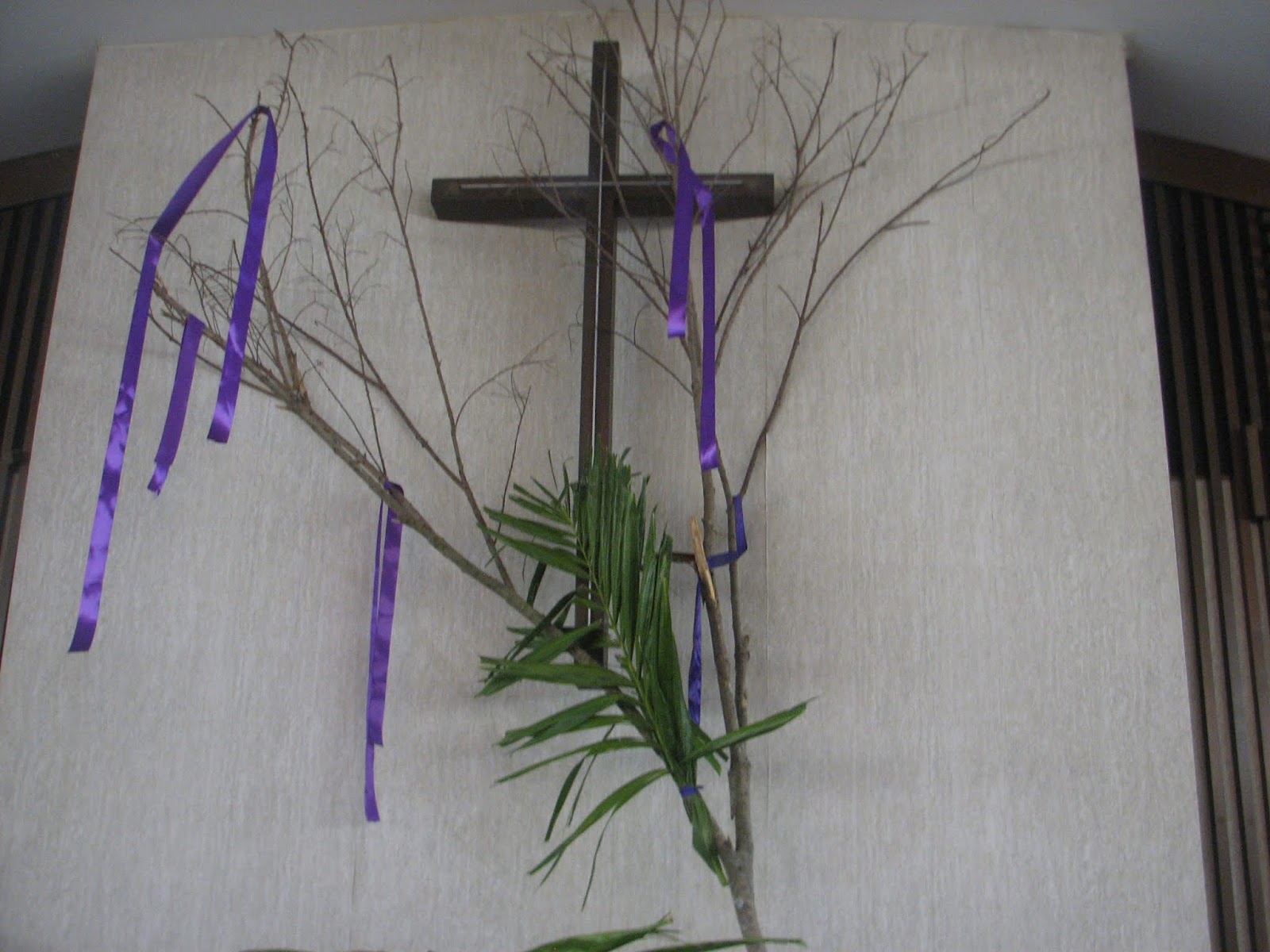
Some days, it's all too much, our lives dried to twigs and shredded to ribbons:
But we resolve to go on, to rest in the promise that out of brokenness, beauty can come:
We follow the path where others have gone before us:
Monday, March 26, 2018
Contemplative Palm Sunday
I had a car full of palms, and my pastor had also cut palms--what a treat to live in Florida where we can decorate with abandon.
I spent a meditative half hour, thinking about where to put the palms and thinking about Palm Sundays past. I remembered at our old church, after Hurricane Wilma destroyed the carpets, when the floors were concrete since it takes time after a hurricane to get the insurance money and then the building supply materials. My spouse laid palms down the entire center aisle, which made it look thatched. It was striking, but people were hesitant to walk on it.
I, too, put palms in the center aisle, but I left plenty of room for people to walk. If they wanted to avoid the palms, there were pews without palms blocking the entry. And of course, there are aisles up the side of the sanctuary.
I was delighted to see a 5 year old at the 11:00 service make a point to walk on each palm. Did he make the connections between the day's readings and the palms?
I waved the palms as I walked them to places around the sanctuary and church grounds. I thought about the fickleness of crowds who will sing "Hosanna" one day and "Crucify" a few days later.
I placed the palms along pathways. I wondered if people would see the palms as pointing them towards the sanctuary, and once in the sanctuary, towards the altar.
In the end, the palms will go to various places around the grounds, left to decompose and return to the earth. We don't let them dry and turn them into ashes for Ash Wednesday. They don't burn evenly, and they leave a chunky ash behind--not really suitable for smudging.
I participated in the life of the church in all sorts of ways yesterday: reading, anointing with oil, handchime practice, helping count the money, and clean up. But my half hour of contemplation during the laying down of the palms (sounds better than decorating) was my favorite part of the day--totally unanticipated and restorative.
Sunday, March 25, 2018
Marching to Palm Sunday
Jesus warns us that to follow him will mean taking up a cross, and it may be the literal cross of death. The story of Passion Sunday reminds us that we are not here to seek the world's approval: the world may love us one day and crucify us next week. Passion Sunday offers us some serious reminders. If we put our faith in the world, we're doomed. If we get our glory from the acclaim of the secular world, we'll find ourselves rejected sooner, rather than later.
It's important for us to remember the basic lesson of the Scriptures: God is not fickle; it's humans and the societies that humans create that are fickle. You can be acclaimed in one season and denounced in the next.
The Passion story and the story of Oscar Romero remind us that dreadful things may happen to us. God took on human form, and even God couldn't avoid horrific pain and suffering. But the Passion story also reminds us that we are not alone. God is there in the midst of our human dramas. If we believe in free will and free choices, then God may not be able to protect us from the consequences of our decisions. But God will be there to be our comfort and our strength.
We live in a time where we might feel overwhelmed by how much evil we see, and how determined those forces of evil seem to be. A more important lesson comes with Easter. God can take horrific suffering and death and transform it into resurrection. We know what happened to Jesus and those early Christians after the death of Jesus. Likewise, in death, Oscar Romero became a larger force for justice than in life. His death, and the martyrdom of other Church leaders and lay workers (not to mention the deaths of 75,000 civilians) galvanized worldwide public opinion against the forces of death in El Salvador. God is there with us in our suffering and with God's help, suffering can be transformed into a more loving world.
Monday, April 10, 2017
The Day After Palm Sunday
And do I take the Palm Sunday story literally? I'm very cautious about taking any part of the Bible literally, as something that actually happened the way that the Bible tells us. But let me play with this idea. And when I talk about disciples, I'm not limiting myself to just the named twelve. I assume that there were plenty of people who tagged along from town to town who were just as worthy.
Would the disciples have understood the triumphant entry? Had they seen enough by then to understand the response to Jesus?
Surely there would have been at least one disciple who said, "We are now on the radar screen of lots of people who might do us harm. We've managed to avoid the Pharisees, but it won't be that easy to escape the notice of Rome. We're headed towards serious consequences."
I am sure that some disciples would have welcomed those serious consequences--they're the ones who would have assumed that Jesus was here to start the political revolution and that the days of Roman oppression were numbered.
Likewise, there must have been a clueless disciple who assumed they were on a path to fame and fortune. Perhaps that disciple said, "At last! We'll be able to stop living this nomadic life. We can make some money and finally have some stability. Maybe we can even start a family or two."
I suspect the bulk of Christ's followers didn't spend much time on introspection--most humans don't, after all.
But if all the Holy Week events really happened in a literal week, could they really have remained oblivious?
Probably at least one or two would have stayed completely clueless from beginning to end. Probably even more. And I'm sure there were some who thought they were all on a much different trajectory, who considered possibilities that are lost to us now.
Those early disciples aren't that very different from any of the rest of us. Do we understand the story?
Thursday, March 17, 2016
Meditation on this Sunday's Gospel
Liturgy of the Palms
- Psalm
- Psalm 118:1-2, 19-29
- Gospel
- Luke 19:28-40
- First reading
- Isaiah 50:4-9a
- Psalm
- Psalm 31:9-16
- Second reading
- Philippians 2:5-11
- Gospel
- Luke 22:14-23:56 or Luke 23:1-49
We get the whole Passion Week story in Sunday's readings. It's tempting to drift off, especially for those of us who will return to church on Maundy Thursday and Good Friday. But stay awake. Pay attention. Try to hear it again, as if for the first time.
Jesus continues to teach the same lesson as he has been teaching his whole life: it is better to serve. If we weren't familiar with the story, we might wonder at its strangeness. We make ourselves better by humbling ourselves? We might hear the echo of other Gospels: Jesus washing the feet of the disciples, Jesus riding through Jerusalem on a donkey. Jesus has sent out the disciples with nothing--and they want for nothing. There's a lesson here for our possession-crazed culture. Empty yourself, so you can find what's essential.
Here we see Jesus moving through varying ruling branches of his society: the church, the government, the masses of people. One day they're on your side, the next day they're not. Things haven't really changed all that much, have they?
Here, too, Jesus makes it clear what following him will mean for our earthly life. Jesus shows us our highest potential as humans, what we can strive for, what we can reasonably expect to accomplish in our own lives--and it won't necessarily be greatness in the way that earthly life defines greatness: who gets to sit at which position of power and authority. According to this way of thinking, we can't let ourselves off the hook by saying, "Oh, but Jesus was divine, so what was expected of him would be different than what would be expected of me."
No, Jesus came to show us how to live a life for which we yearn. And how do we do that? By serving others. By sacrifice, perhaps the ultimate sacrifice of our lives, but certainly of our time and our treasure.
Sacrifice. It's such a grim sounding word. And yet, think of the times when you've felt most at peace, most like you were fulfilling your destiny. Those were probably some times of sacrifice. We finish an academic degree, which requires much sacrifice of time and money, and we get an incredible amount of joy. We weather tough times in our personal relationships. Any long-term relationship demands some sacrifice of ourselves. We can't always put ourselves first and expect people to stick around for that. But with the sacrifice, if we're lucky, comes the reward of a richer relationship.
I've met (or read the books of) people who have made even deeper sacrifices, people who have formed intentional communities to better serve the poor and outcast. Those communities have made a deep and lasting impression on me, so much so that I spend a great deal of time yearning to return, wondering if I, too, could make that commitment. Those communities seem filled with peace and purpose. One senses God's presence there, in a way that one doesn't ordinarily in regular life, like, say, when stuck in rush hour traffic. These people in intentional Christian communities seem to be living a life most like Christ's. And though they may lack for things that our Capitalist culture tells us we NEED to have, like the latest electronic gizmos or speedy Internet access or health insurance or meat on the table for every meal, they seem to have found a way to fill the yearnings that many of us feel in our souls.
When we feel these yearnings for something more, many of us turn to food or exercise of Internet wanderings or alcohol. What would happen if we turned towards God?
Soon Easter will be just a hazy dream, and we'll have to return to life in ordinary time. We'll have forgotten about the story of Christ's passion and returned to focus on our own passions. But Christ calls us out of ourselves, to focus on the suffering of others. Paradoxically, here is where we will find our deepest joy, by serving others.
Tuesday, March 31, 2015
Interactive Worship in the Butterfly Garden
Our 9:45 service is fairly unique, blending elements from Sunday School and a traditional worship service. We have a liturgy that we follow most weeks. Instead of a sermon, we have a puppet show or a reader's theatre or some sort of interactive approach--although occasionally we don't. We break into small groups where we model a Faith 5 approach to faith development that families can practice in their homes (discuss highs and lows, tie to Bible reading, pray, bless each other). Every other week, we have an arts/craft project of some kind.
Lately, after several years of this approach, I feel my creative well running dry. I was doubly distressed, because it was Palm Sunday.
Our first week with the Palm Sunday text, the week before Palm Sunday, our pastor asked us to think about the best ways to show love to each other. So, on Palm Sunday, we talked a bit about that. And I brought up showing appreciation.
Then we moved our worship outside. Our church has lovely butterfly gardens, so we walked through them together. We stopped and noticed signs of God's love and resurrection (yes, jumping ahead to Easter).
And we did our Faith Five as we walked, a sort of stations approach. At the first stop, we talked about our highs. And the second stop, we discussed our lows. At the next stop, we talked about how our highs and lows intersected with the Bible reading that instructed us to love each other. At our last stop, we prayed and blessed each other.
So, at each stop, we began by noticing God's beauty and generosity, made manifest in the garden. And then we did the Faith Five portion.
It worked beautifully. I've noticed that when we sit at a table, under the fluorescent lights, we don't all pay attention. We have trouble staying focused--or we get too focused on just one step of the Faith Five. But moving outside, even though the walk was short, brought all our attention to a single focus.
It helped that it was a beautiful morning: a cold front had come through, so the temperature was perfect with low humidity. The sun beamed over us all.
When I look back over all the worship experiences I've tried to create, all the spiritual formation I've tried to foster, all the experiential encounters with the Divine, I don't know that I'll see Palm Sunday 2015 as a high point. But as a woman who was feeling drained and uninspired, I'm happy for how the Holy Spirit used that blank space to create something that felt meaningful.
Sunday, March 29, 2015
The Hush Before Holy Week Begins
Today, many of us will receive palms. The leftover palms will be burned and mixed with oil and saved for next year's Ash Wednesday service, where they will be smudged on our foreheads and we will be reminded of our essential dusty nature.
Palm Sunday reminds us that the people who will be our friends today may turn on us tomorrow. The adoring crowds of today may turn accusatory by the end of the week. And yet, as we journey through our lives, suffering every sort of betrayal, the Holy Week trajectory reminds us of the joy we will also experience along the way: good meals with friends, deep conversations, a God who so wants deep connection with us that he will wash our feet.
And the hectic hurry of Holy Week ends in Easter, where we are reminded of the ultimate promise: no matter how bad it gets, God has a plan. We may not be able to see it, we may not be able to believe it, but God is hard at the work and play that is the redemption of creation.
Now that's Good News!
Friday, March 27, 2015
Heading To Holy Week
Do the palms obscure the real Jesus?
What feet are waiting to be washed?
What table waits to be set for a meal made new with meaning?
The soldier looks impassively at the Passion. How are we colluding with our empire?
So many wounds to bind.
How can we celebrate Easter with the taste of ashes still in our mouths?
Thursday, March 26, 2015
Meditation on This Sunday's Gospel
First Reading: Isaiah 50:4-9a
Psalm: Psalm 31:9-16
Second Reading: Philippians 2:5-11
Gospel: Mark 14:1--15:47
Gospel (Alt.): Mark 15:1-39 [40-47]
Palm Sunday has become a busy Sunday. Somewhere in the past twenty years, we've gone from hearing just the story of Jesus' triumphant entry into Jerusalem to hearing the whole Passion story--on Palm Sunday many Christians leave the church with Jesus dead and buried. It's downright disconcerting to those of us who return to church for the rest of Holy Week--we hear the same stories on Maundy Thursday and Good Friday. It makes for a long, Sunday Gospel reading--and reinforces one of the paradoxes of the Passion story: how can people shout acclaim for Jesus in one day, and within the week demand his Crucifixion? Maybe it's good to hear the whole sad story in one long sitting, good to be reminded of the fickleness of the crowd.
It's one of the central questions of Christian life: how can we celebrate Palm Sunday, knowing the goriness of Good Friday to come? How can we celebrate Easter with the taste of ashes still in our mouth?
I find myself still in an Ash Wednesday frame of mind. Perhaps you do too. It's been a tough year for many of us. We’ve suffered job loss or house loss. If we’ve kept our jobs, we’ve said goodbye to colleagues. In any year, some of us lose loved ones in any number of ways. Because we are mammals that think and know, we are always aware that there will be horrors yet to come. We live in a culture that seems to prefer crucifixion to redemption.
Palm Sunday offers us some serious reminders. If we put our faith in the world, we're doomed. If we get our glory from the acclaim of the secular world, we'll find ourselves rejected sooner, rather than later.
Palm Sunday also reminds us of the cyclical nature of the world we live in. The palms we wave this morning traditionally would be burned to make the ashes that will be smudged on our foreheads in 10 months for Ash Wednesday. The baby that brings joy at Christmas will suffer the most horrible death--and then rise from the dead. The sadnesses we suffer will be mitigated by tomorrow's joy. Tomorrow's joy will lead to future sadness. That's the truth of the broken world we live in. Depending on where we are in the cycle, we may find that knowledge either a comfort or fear inducing.
It's at times like these where the scriptures offer comforts that the world cannot. Look at the message from Isaiah: "The Lord God has given me the tongue of those who are taught, that I may know how to sustain with a word him that is weary. . . . For the Lord God helps me; therefore I have not been confounded; therefore I have set my face like a flint, and I know that I shall not be put to shame; he who vindicates me is near" (Isaiah 50, first part of verse 4, verse 7, and first part of verse 8).
God promises resurrection. We don't just hope for resurrection. God promises resurrection.
God calls us to live like the redeemed people that we are. Turn your face to the light. Turn away from the dark. Commit to redemption. Commit to new life. With a peaceful mind, wait for the resurrection that God has promised to you.