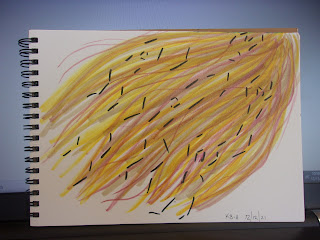
Showing posts with label spiritual journaling. Show all posts

Monday, April 8, 2024

Preservation through Prose: Spiritual Memoir for Yourself or for Valued Elders

Instead of doing a big post looking back at the Create in Me retreat, I am much more likely this week to write a series of smaller posts.  This morning, we are hoping that our bathroom remodel gets underway, and I still have to go to campus this week.  In short, it's not going to be a week of lots of downtime.  I'm hoping for some downtime in May.

But before we get too far away from the retreat, let me remember my writing workshop on Saturday, a workshop called Preservation in Prose, a spiritual autobiography/memoir workshop.  It was a delightful group, even though there were only two people in addition to me and a person who came late.  And even more delightful--I got some writing done too.

What we did is adaptable for individual writers and for larger groups.  It's good to capture our own stories, and it's also a way to capture the stories of other people who aren't as interested in writing.

I began with a collection of objects on the table:  quilt squares (one old and tattered, one a take-away from Quilt Camp), a nail, a game piece, an Easter bunny sticker, a Scrabble tile--in short, anything I could find on various tables at the Create in Me retreat, plus some goodies from an Easter Egg hunt bag of treats prepared for kids.  We each chose one and wrote about why we chose it.  Then we discussed.

We moved to a different kind of imaginative writing.  First we imagined ourselves twenty to thirty years from now.  It's a variation of asking my students to imagine themselves as 80 year olds.  I had them write a letter from their older selves to the people they are now.  Then we did the same thing in reverse.  Have your late adolescent self write to the person you are now.

Then we made some lists like this one:

6 natural objects

6 humanmade objects

6 ordinary actions

6 art materials

We talked about metaphor, simile, and imagery--how can our concept of God change if we compare God to something on the list?  

From there, we filled in this list on one side of the handout that I created:

Detail of shift from one season to another ________________________________

Type of noise ________________________________________

Element of nature _____________________________________________

Type of emotion _________________________________________________

Favorite flower __________________________________________________

Something very tiny ________________________________________________

Floor or wall covering ______________________________________________

Something nourishing ________________________________________________

Favorite fruit __________________________________________________________

Element of self-care ______________________________________________

Something only found in a park _________________________________________

Something that oozes _____________________________________________

Favorite treat ________________________________________________________

Something that turns _______________________________________________

Favorite musical instrument ________________________________________________

Something that grinds ___________________________________________________

Something huge_____________________________________________________

Something only found in a big city ____________________________________

Favorite food made for you by an older generation ___________________________


Then we filled out this list with the items from the first list:


--A commitment to God helps us offer __________________________________.

--We yearn for the day when justice covers the earth like ______________________________.

--We are crushed into bits smaller than _____________________ by Powers and Principalities, by the forces of the world, by Satan.

--Truth rolls down through the valley like ________________________________________.

--When I work with God, it’s as if _______________________________________.

--When I think of redemption, I think of __________________________________.

--I first heard God’s call as __________________________________ .

--Evildoers cover their rotten foundations with _____________________________.

--We burn with __________________________________for the vision of new life that Jesus offers.

--I have seen the Holy Spirit moving through world like ________________________________.

--My spiritual history is like ___________________________________________.

--Injustice grinds us like a giant ____________________________________________.

--The____________________________ of justice turns slowly, but the turning does occur.

--The community of God is like _____________________________________________.

--The ___________________________of justice has found fertile soil in my heart.

--A partnership with God is like _________________________________________.

--_________________________grows in the garden of redemption.


My brain created some poem fragments that had nothing to do with the two lists--that was a delight too.

Sunday, June 11, 2023

I Feed the Birds, and the Birds Feed Me

 I am late to the world of smart phones and the apps that go with them.  We just got smart phones in August, and so far, I've mainly used mine as a phone and a camera, which didn't seem revolutionary to me.  I've been grateful to be able to access a map and directions a few times.  I send a text here and there.  But the Merlin Bird ID app gives me a window into the ways that a smart phone might be a game changer in so many ways.

I haven't downloaded any apps until this one; my phone did come with apps, but I haven't used them.  We don't have unlimited data, but more than that, I don't want the phone sucking my attention away.  But unlike many other apps, the Merlin app helps me pay attention.  Yesterday on my morning walk, without a phone, I could identify the song of the cardinals.

Of course, birdseed helps me pay attention too.  We've been spreading birdseed along the deck rail, and the birds come to visit in the evening.  It feels magical, but I realize it's not.  It's a basic principle of hospitality--offer food and see what happens:
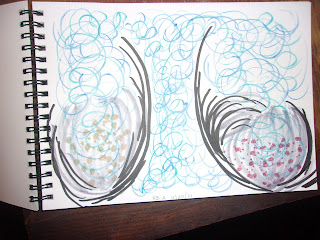


The other night, I tried to sketch these cardinals.  


I didn't want to try to add color, although I was tempted.  But my markers are imprecise, and many of them are dried out.  I made the sketch using the photo.  At some point, maybe I'll try a more impressionistic sketch.  Or maybe I'll just continue trying to snap pictures:


The birds are tough to capture as they zip down, grab a seed and go.  Last night, we didn't have the seeds spread out, and one landed and stared at us as we sat there with our cheese and crackers.  I didn't have my phone with me to capture that one, but it looked a bit like this bird:


We haven't seen any fireflies yet.  I'm too much of an early bird for that--I often go to bed before it's completely dark, in these days heading to the Summer Solstice.  


Each day, I wonder if I can last until that moment that the birds are most likely to feed, as the sun sinks.  Most days, I can.  After all, I'm getting fed too.  Feeding the birds has reminded me of a basic of hospitality: set out food, and the miraculous can happen (or the mundane will seem miraculous). 
Tuesday, April 4, 2023

Erasure Poem as Lectio Divina and/or Teaching Tool

Last night in my Luke class for seminary, we arrived at the Palm Sunday text--a happy coincidence, not a planned collision.  My professor wanted to try something interesting.

One of the dangers/problems with a familiar text is that we think we've heard it all already.  How can we approach it with fresh ears?  The Palm Sunday text is one of those familiar stories, yet it is so different from Gospel to Gospel.

My teacher gave us the text of Luke 19:  29-40 as a Word doc.  We had five minutes to see what words spoke to us.  We changed the text of those words to a different color, then we blacked out the rest of the text, using the highlight feature of Word as a black highlight. 

I had never done this in Word before; I've always just used a marker, the few times I've done it.  And I've never done erasure poetry, which my professor called blackout poetry, as part of a religious practice.

At first I thought it was a blah effort--and then I wrote the words in my notebook:

Untying

Path down

Loud voice

Stones shout

Very interesting! Several other students read their poems and they were all so different.  Mine was the shortest and sparest.  But the long and winding ones intrigued us too.

This exercise seemed to have a lot of applications, which is why I'm recording it here.  It could work well as part of lectio divina, where we look at a text (often reading it out loud) several times to see what is speaking to us.  It could work well as part of a Bible study.  And I'm interested to think of its applications in the English classroom, applications beyond a poetry writing session.  Hmmm.

There are so many delights to being a seminary student, and last night's class reminded me of them. Once again, I feel so lucky.  And I'm happy to think about the ways I'll apply some of these possibilities to the English classroom, where I will be teaching in person again for the first time since the pandemic.


Tuesday, October 11, 2022

Chlorophyll, for Trees and for Humans

 Yesterday I returned to my seminary apartment after a day away to celebrate my dad's birthday at my sister's house where my mom and dad stopped on their way back from their quick trip to Pennsylvania.  It was a whirlwind day, and when I got settled back into my seminary apartment, I felt that familiar upwelling of sadness.

I love being here, being alone, focusing on what matters to me--but I'm also missing a wide variety of people.  This dissonance is not new to me.

So I took myself out for a walk in the glorious autumn afternoon.  I picked up two beautiful leaves--solace for the moment, solace for later, as I tried to sketch them.


I'm using Copic markers, some of which blend better than others.  So there are places in the sketch I'd like to change, but overall, I'm pleased.

I continue to think about chlorophyll, vital to the process of making nutrients for the tree.  It's only when the nutrient making stops in the autumn and the chlorophyll breaks down that we see the true color of the leaf.

Or is it the true color?  Why is the color more true with the chlorophyll or not?  Is the summer color just another version of what is true?

Or maybe I want to think about chlorophyll as masking agent and ask what chlorophyllin our lives needs to fade away so that different colors can emerge.

This morning, as I was doing some online research about chlorophyll, I marveled at all I once knew about photosynthesis and all I no longer know.  I also marveled at the fact that enough people are taking/drinking chlorophyll that there are articles about the wisdom of this supplement.

I will just say that I am not a tree; I find it takes so much time, planning, prep work and eating/chewing/digesting to get the nourishment that my human body needs that I am not going to add tree nourishment to my plan.

My brain often returns to leaves in the autumn.  But this is the first time in decades that I've actually lived in a place where I could see the process, day by day.  It's fascinating, and I'll write more later as I have more time to reflect.


A sketch from autumn 2021


Friday, October 7, 2022

Cracks and Crevices and Sketches

I am part of a journaling/book study group, similar to ones I've been in before (same leader, same online set up, many familiar journaling friends).  We're making our way through Cole Arthur Riley's This Here Flesh.  We started, as one does, with the preface, and this part stayed with me:  

"Much of black spirituality while enslaved had to live and breathe in these crevices, every vale holy ground. A faith that depended on the interior life." This Here Flesh p. x
 
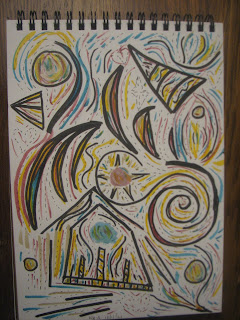
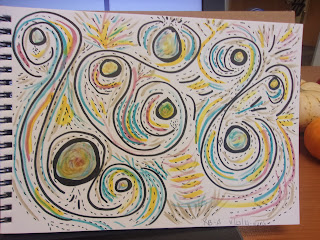
 And then I made a sketch.  When I drew this, I was thinking about crevices and what we find in the interior:


I've been sitting with this sketch for a week now, and I see aspects I didn't see at first.  I was trying to sketch mountains and crags.  But I'm seeing a descending dove, which wasn't a conscious design choice.  One of my group members said, "The movement on your page is like a wild current, inspiring me to imagine the folds and channels of interior life."

Another design note--we're only using a certain set of markers and black pens.  Here's what I'm using:


Having a limited number of marker also means that my sketches may be different than they would be if I used all my markers.  Perhaps the top sketch would have looked more like mountains and less like a dove or a descending river had I the full range of colors.

Or maybe the dove/river would have been such an important part of my subconscious that it would have emerged regardless.

Saturday, September 17, 2022

An Hour of Sketching Nature

One of the delights of taking a class is getting credit for something I might do even if I wasn't taking a class.  But I also delight in taking a class that forces me to do what I've always wanted to do but was never disciplined enough to make myself do.
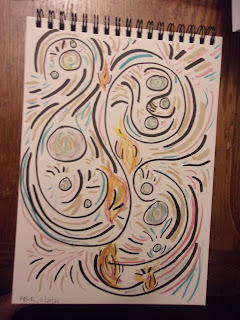
Did I learn a foreign language this week?  No.  But I did go outside and spend an hour sketching as part of my Creative Process, Spiritual Practice class.  What a simple activity:  take a pencil, take a sketchbook, try to really see what's in front of you.

We went to the lovely courtyard in the center of the campus buildings and spent a few minutes walking and observing.  We came back as a group for five minutes, and then we went forth with our task:  spend one hour fully observing and sketching, while being careful not to destroy the nature we're observing.

I had been captivated by a small tree, by the colors of the stem and the featheriness of the leaves.  I started sketching these leaves while I was standing close to them:


I tried sketching without looking at the sketch, which was an interesting process, but didn't lead to a very good sketch.  I approached the leaves from various angles.


Then I decided to sit across from the tree; in the above shot, you can see the ledge on top of the small brick wall where I perched.  That's when I noticed the trunk and decided it was time to shift focus.

I drew the curve of the branches and the swirls of the bark.  Then I decided to bend closer, and that's when I noticed a whole branch that I hadn't seen at first.  Eventually, I produced this sketch:


I remembered our teacher's instructions to get close, so I bent over and ducked under the tree too.  When I came back to my sketching perch, I had a dead leaf in my hair, so I decided to sketch that:


I felt a bug on me, but didn't stop to shoo it away.  Eventually, I looked down to see a small grasshopper (some other bug?) making its way into the sketch:


After the hour was up, we reconvened to talk about the process.  Where did we spend our hour?  Would it have been different if our teacher had specified not to erase?  Or if she had required us to stay focused on the first thing we started to sketch?

We briefly talked about the theology/spirituality aspect of the class.  Does God study us as closely?  How do we feel about that?

During numerous points of Thursday's class, I thought, I will do this process again.  I will return to this courtyard and sketch for an hour.  Will I?  Maybe.  But if not, I'm happy I had the chance to have this experience--and to get class credit for it!

Friday, September 9, 2022

Reaction Drawings

In my Creative Process as Spiritual Practice class yesterday, we explored an interesting practice that our teacher called Reaction Drawings.   She gave us a stack of blank paper (just regular paper like the kind you'd use in a copier or printer) and a graphite stick (like pencil lead without the wood around it and squared edges).

It was a 30 minute exercise.  Every 30 seconds, the timer dinged, and we turned the sheet of paper over and did a new sketch/drawing/scribble.  That was the only instruction.  Here's my first sketch:


And my last sketch (which might be upside down):


And a selection of the ones in between.


It was an interesting experiment.  Thirty seconds isn't enough time to worry about technique--it's not even enough time to finish a sketch.  Some of our sketches responded to past sketches, while others went in a different direction.  The frenzied pace didn't let us sink into a meditative space (both a plus and a minus).

I said that I expected to go through my pile of sketches and find one that I didn't remember drawing.  That didn't happen.  I was also intrigued by my approach to the graphite stick.  It took me about 12 sketches before I turned it on its side and experimented with broader strokes.

We spread out all of our sketches in one space which was an interesting way to see them.  It also allowed us to walk around the room, once we all gave permission, and to look at everyone's work.  And because we had all went through the same process, it wasn't a chance for one person's sketches to shine, for one person to be lauded as the best artist.

Our instructor talked about using the process as a reaction to something specific like a newscast or a piece of music or a mood.  She talked about her own experience, about using the process to journal in a way or to jolt herself out of boredom/blockage or to move herself out of a bad mood.

My teacher brain also thought about other ways that this group process could be interesting.  Could it be used in a Composition classroom?  Are there other places where fear of the blank page might need to be overcome this way?  I think the answer must surely be yes.

What a great class!  When I begin to doubt my reasons for being on campus (yes, it happens--I'm never far away from self-doubt), let me remember this class and the opportunity to take it.

Saturday, January 29, 2022

Sketching the Female Tree-Mermaid

For much of my life, I would have told you that I was no good at visual arts.  I was a word person.  But if you could look at my school notebooks, you would notice that I was always drawing.  I would have dismissed those efforts as doodling, the kind of drawing that doesn't count as art.

I still do that kind of doodling, particularly during meetings where I'm having trouble paying attention.  Sketching lines which turn into vines.  I'm also fond of swirls.  Sometimes the lines want to be something else, something larger:  a bird beak and then the whole bird.

This week, I was taking notes during a meeting, and then I drew a box around the date of the meeting.  At the edge of the box, I drew this:


I thought about how it looked like a tree, so I decided to start a new sketch that would be a tree.  I drew a few swirls, and I realized that my tree also looked like a woman dancing, perhaps a very flexible woman with her leg stretching to the sky.  I continued to sketch, and I ended up with this:


As I sketched lines at the base of the tree (or the woman's skirt), I noticed that it had a certain mermaid vibe going, so I emphasized that.

In the end, I liked the sketch enough to save it, which I don't usually do with my meeting doodles.  Maybe I should start calling them illuminated meeting notes.

If William Blake had to sit through some of the meetings that I have attended, he might have sketched a whole different set of doors of perception.

While I'm recording my sketching life, let me also record the words of my teacher from late in 2021.  She said the my swirling style reminds her of Van Gogh.

I think of my 7th grade self.  In 7th grade, I became obsessed with sketching a horse.  I had a friend who could draw such beautiful horses.  I could not.  I just kept drawing the same sad type of horse, over and over.  It was probably that experience that made me think I couldn't draw.  I kept drawing a horse, week after week, seeing no improvement.  It didn't occur to me to try something else.

Many years later, when I was in my 30's, I did try drawing something else, and I was delighted to be able to draw a flower that people could recognize as a flower.

Now I draw any number of creations, and many of them have a bit of whimsy--or a lot of whimsy, in the case of this female tree-mermaid.  They delight me, and they make the hum drum parts of life more enchanted.


Friday, December 24, 2021

Second Christmas Eve in a Global Pandemic

Here we are at Christmas Eve, a very strange Christmas Eve as a much more contagious variant of COVID-19 is ripping across the country.  As far as I know, our Christmas Eve service will go on as scheduled.  We can likely spread out across the worship space and keep the in-person crowd safe, and we'll livestream for the ones who need to stay away.

It's a very strange Christmas Eve, but humanity has had a variety of strange Christmas Eves.  In some ways, the message of Christmas Eve is even more important during times of stress.  Many of us hear the Christmas Eve message as something warm and cozy, but surely something warm and cozy was not the kind of message delivered by the angels to the shepherds.

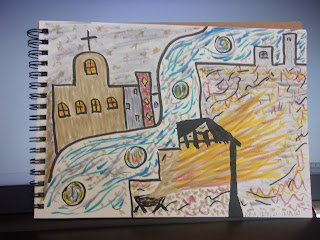
Earlier this month, I made this sketch.  I hadn't intended to include the manger and the stable that appeared:


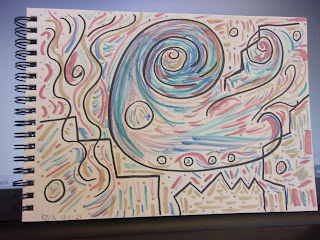
Do you see the descending dove in the picture?  The dove appeared before the manger.  I've returned to this picture often in December, meditating on the message it contains.  I'm also intrigued by the river rolling through the middle of the picture, the river that contains planets.  Or do we just see circles?

But I digress.  Back to the Christmas Eve message, God incarnate, God wanting to know us so deeply that God takes on human flesh.

God come to be with us in person?  God choosing to be born to poor peasants living at the edge of a powerful empire?  What can it all mean?

Here's what Richard Rohr said in his daily post this morning:  "I believe it’s all a school. And it’s all a school of love. And everything is a lesson—everything. Every day, every moment, every visit to the grocery store, every moment of our so-ordinary life is meant to reveal, “My God, I’m a daughter of God! I’m a son of the Lord! I’m a sibling of Christ! It’s all okay. I’m already home free! There’s no place I have to go. I’m already here!” But if we don’t enjoy that, if we don’t allow that, basically we fall into meaninglessness."

That message, too, is not one that worshippers will likely hear tonight.  Perhaps worshippers won't hear a sermon at all or maybe it will be a Christmas pageant.  Maybe, like the Peanuts gang, we'll hear the story from the Gospel of Luke, no homily necessary.  Maybe we'll get our message in song.

I am grateful for times of quieter contemplation, so off I go, a Christmas Eve walk in the morning coolness, a time to think about the twinkly lights, the sun that rises every morning, and the ending of a year.

Friday, December 17, 2021

Six Weeks of Sketch Responses to "Crisis Contemplation"

 Today I will turn in my last paper for my first semester of seminary.  It is written, but I want to take one last look at it.  But today, I want to write about a different class that I did for the past 6 weeks.  I joined a group organized by the artist Vonda Drees.  Together we read Crisis Contemplation:  Healing the Wounded Village by Barbara A. Holmes and did journaling, which was often in the form of sketching.  We had a once a week meeting to discuss the book and the journaling that we did.

One of my compatriots rearranged her sketches on a tabletop so that they were no longer in chronological order, and interesting patterns emerged.  My sketches are in a spiral bound book, and I don't want to destroy it.  But I think that putting the sketches here, with the quotes that inspired them, will yield some useful insights.  In past journaling groups, I wrote the quotes on the sketch, but this time I didn't.

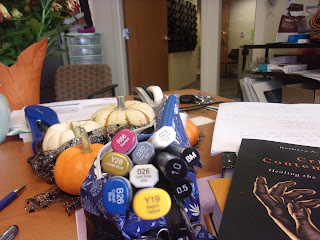
I began by posting a picture of the markers I would use:


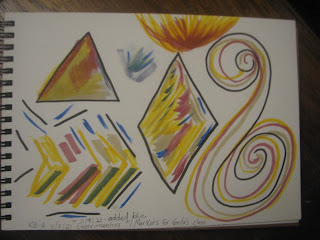
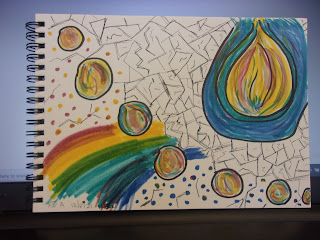
A first sketch--first I was undecided about having a blue marker, but I remembered the power of blue to create green. This morning, I added the bowl of flame shape, as I tried to see how deep an orange I could create. As I was creating the image in the bottom left, I was thinking about arrows and arrowheads, broken treaties and different directions, but I haven't started the book yet.


-------

This afternoon, on p. 13 in the Preface Practices, how we came to know our family histories. For me, it wasn't in the genetics or DNA, but in the stories we tell or were told, the connection to both farms and mountains, the faith that gets seeded (or lies in fallow soil) for each generation to sprout/grow/harvest in new ways:


---------

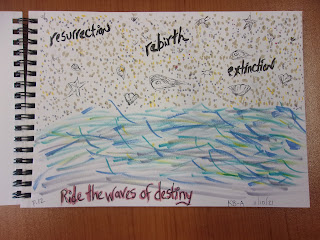
Here are two sketches that I worked on at the same time, inspired by this quote on p. 12:

"Once the unthinkable crisis has us in its clutches, we have no choice but to let go of our false sense of control and ride the waves of destiny. On the other side of this wild ride awaits extinction, resurrection or rebirth."


------

I don't have a sketch to go with this quote, but here's what jumped out at me from my lunch reading; her words from the acknowledgements demanded to be written down and shared: "When I look back on a lifetime of teaching and learning, I am thankful that I earned my degrees later in life. By then, I understood my gifts and my shortcomings, my call and my communities of accountability. Although I recognize the dynamic nature of the word 'understanding,' my point is that I pursued graduate studies when it was far too late to indoctrinate me into systems thinking" (p.16).


-----
I am at a Lutheran women's retreat at a conference center by a lake in the middle of the Florida peninsula. This morning's walk brought spider web after spider web, some small, some draped across several surfaces, all spectacular. Then I read the first few pages of chapter 1 and thought about "freefall through our carefully woven safety nets of 'normalcy'" (p. 20):


-------

"Rather, we are reminded that human beings are a part of a community of inspirited life" (p. 27). I love the word inspirited (one picture with flash, one without):


-----

"The truth of the matter is that we live on a mysterious planet, with other living beings, whose interiority and spiritual realities that are just beyond our cognitive reach.

If life, as we experience it, is a fragile crystal orb that holds our daily routines and dreams of order and stability, then sudden and catastrophic crises shatter this illusion of normalcy" (pp. 19-20).

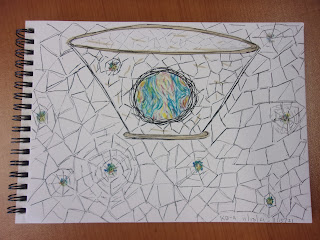
These words, along with the ones I wrote down earlier on Saturday, about safety nets and spider webs, were ones I was thinking of as I created this sketch. I was remembering the quote mistakenly, thinking that life was held in a fragile crystal cup, an image I also like.

------
I, too, was haunted by this idea:
"Slowing down is...about lingering in the places we are not used to. Seeking out new questions. Becoming accountable to more than what rests on the surface. Seeking roots. Slowing down is taking care if ghosts, hugging monsters, sharing silence, embracing the weird...the idea of slowing down is not about getting answers, it is about questioning our questions. It is about staying in the places that are haunted. " Bayo Akomolafe, p. 39
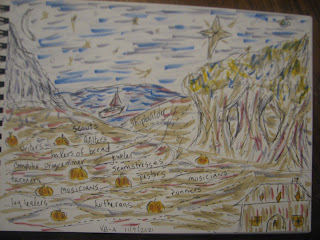
Process Note: My first idea was for a haunted house and I would put all the regrets that haunt me on the boards of the house. But I made the house too big, with no room for all the ghosts and monsters that I envisioned circling the house. And then these other aspects appeared: the woman on the side of the house, the stuff going on in the attic (not exactly sure what's going on there), the plants and pumpkins and cats and the table inside that's ready for tea. So instead of writing regrets on the house boards, I wrote parts of the passage.
I'm posting 2 versions of the same drawing, one with flash and one without.


--------
I have not made much progress with my reading. But this sentence did leap out at me: "In the darkness, we can gather in Spirit and be filled by this Source" (p. 44).
It's not the sketch I saw in my mind when I started, but it has some appeal (same picture, one with flash, one without)


------

". . . we fall headlong, together, into the power of divine intention and the mystery of an inner and outer cosmos" (p. 50).
Solar systems, the mind of God, inner wisdom, what the mind knows, what the body knows . . .


-------

I was short on sketching time and short on connectivity last week. I did work on this sketch, which is less of a response to a specific passage from the work, and more what emerged as I thought about wounds and what it takes to heal (stitching, partners on a path, a way out of no way, protection of our soft spaces):


------

I haven't made it far into chapter 4--the first sentence made me reach for my sketchbook: "It takes a village to survive" (p. 83).


-------
Although I hadn't read any further in the book, I needed to keep my hands busy and my face neutral during a boring/aggravating meeting yesterday. So I worked on this sketch. This morning, as I read this quote, the sketch seemed to fit: "The child has recently come from the realm of the ancestors and the grandparents are on their way. There is much wisdom and special knowledge to be imparted between these generations" (p. 85).
I also see some Advent themes: unlikely wombs incubating improbable miracles, marginalized women saying yes to God's invitation.


-------
I confess that I was once again sketching without having a specific response to the text in mind. Today, as I looked at the sketch and text, this sentence jumped out at me: "Art opens a portal to new realities" (p. 98).


------
I created this one as I was thinking about lament. Before I started filling in the circles with color, my thought was that each circle would represent a lament. I also had in mind a tear (as in the drops one cries, not a torn spot) to the right of the page. The sketch went in different directions than I planned, but I still think it's an interesting response to the idea of lament.


---

"Although relief seems to be an impossibility, we know that we are embedded in a quantum world with nothing but possibility" (p.118).
"A liminal space is the time between the 'what was' and the 'next.' It is a place of transition, a season of waiting, and not knowing. Liminal space is where all transformation takes place, if we learn to wait and let it form us" (Jon DeWaal and Shonnie Scott quoted on page 128).


-----
"What is called for in times like these is a deep dive into unknowing, a trusting, and a liminal float in spiritual depths that sustain our collective wellbeing" (p. 129).


------

"We leap, trusting the glory of ancestral guidance, the blessed hope of the dawning of a new world order, and the promises of God" (p. 137).
The leaping didn't turn out the way I envisioned it, but I offer this sketch because the quote really speaks to me--what a way to close the book!


Tuesday, December 14, 2021

Unlikely Advent Places

Here is a quote that spoke to me today.  I found it in James Lumsden's blog post, which is worth reading in its entirety.  The quote is from Henri Nouwen, a favorite theologian across all of my ages.

We expect God to show up in “spectacles, power plays, significant and extraordinary events” that will change the course of history in their grandiosity. We, ourselves, are often taken-in by wealth, prestige, and sparkling things that glitter and shine. We can be so easily distracted. Perhaps that is why God chose to come to us as a small child of Palestinian peasants in an insignificant stable surrounded by animals and shepherds. This way we see that God’s kingdom is humble, simple, small, and very vulnerable. One of the gifts and surprises from Jesus is that he shows up for us in the most unlikely little places – and if we refuse to look for holy in what is small, we will likely give-in to despair.

And here is a sketch I've been working on for the past week.  I didn't begin with an intention to draw a stable and a manger.  Those appeared as a surprise, distressing at first, because the page wasn't what I envisioned.  But as I've worked with it, it's become one of the highlights of my week:


Now it's back to finishing grades for my online classes and finishing papers for my seminary classes.

Saturday, December 11, 2021

Holiday Treats

 While I have not done any holiday baking yet, I have had some treats.  Let me make a list so that I remember later:

--I've been enjoying the holiday lights.  Each morning, with each block of my walk, there's at least one house that has lights on.  Delightful!

--We also had a holiday light tour of a different neighborhood on a golf cart--fun!

--Last night, we were spontaneous.  I came home from work and said, "I'd really like to go over to the beach to the Hollywood Brewery and have a burger and a beer."  And that's just what we did.  I get off work at 3 on Fridays, so we got there before the crowd arrived.  We enjoyed our food and drink and the view of the ocean.

--Early this morning, I made this Facebook post: "Kitchen alchemy: craving a Starbucks peppermint mocha but not wanting to drive to the closest store that's a few miles away. I have milk, peppermint extract, coffee, sugar, and cocoa. I have tried this experiment before, and I know the dangers of peppermint extract. This time, the smallest amount, added to the milk first. It's a different take on peppermint mocha, less sweet and cloying, with more dark chocolate depth. Yum."

--One of the biggest treats of the week:  I've been writing some poems.  Hurrah!

--Let me also record a poem idea, in case I don't get a chance to write it next week.  Here is the title or the first line:  On the feast day of Santa Lucia, I pay the credit card bill.

--It has also been a week of good sketching.  Here's my favorite of the week:


Sunday, December 5, 2021

First Saturday in Advent

 I am reading posts about people's holiday ramblings:  craft fairs, breweries, cookie exchanges.  While my life is not quite as glamorous, let me record what the first Saturday in December held for me yesterday:

--I went for a walk early in the morning.  I am noticing pelicans around North Lake, which I've never seen before.  Have some of them set up a homestead?

--I was grumpy for a variety of reasons.  Happily, I was able to talk to my spouse and strategize.  This morning, I am less grumpy.

--I tried to set up a photo that captures my Advent/holiday frame of mind:


--I had a Zoom call with my quilt group.  Should I still call us a quilt group?  That's how I think about us, so I will continue.  It was good to catch up, even though not much has changed for any of us.  There's a tiredness that I'm sensing, a tiredness born of this pandemic, about the fact that we're all working in higher ed at the end of a semester, and about the Zoom call itself.  Or maybe it's just me that has a weariness borne out of a semester of looking at more screens than usual, with my virtual classes that I'm taking for seminary.

--I got off that call and then had another Zoom call with my small group for my certificate in spiritual direction program.  This time the primary purpose for the call was to check in before our in-person intensive in January.  With this new variant, we may not be meeting in person.  Sigh.

--My spouse and I went to the grocery store to get a few provisions:  wine, broccoli, and powdered sugar.  As we walked back, my spouse carrying the 2 wine bags, me carrying broccoli and powdered sugar which I didn't have them put in a bag.  I wondered if people saw us and said, "What recipe are they making?"

--We got back and strung lights on the top rail of our balcony railing.  We plugged them in and played Yahtzee on the balcony to enjoy the lights.


--I also strung some fairy lights on the giant poinsettia:


--We came in and had some cheese and crackers to go with our wine.  The broccoli is for today's late lunch/early dinner of turkey tetrazzini and baked sweet potatoes.  The powdered sugar was just in case we wanted to make Christmas cookies with powdered sugar frosting.  

--We watched some stand up comedy on TV, and I did some sketching.  This morning, I was delighted by the sketch that I did:


--I went to bed super early, at 7.  I hadn't gotten good sleep from Friday night to Saturday morning, so I was glad for a chance to catch up.