Tuesday, February 7, 2023

Incarnation and Other Rules of the Universe

Once I am done with today's seminary classes, I will have completed my third week of the semester.  It feels like I've been enrolled in Spring 2023 semester much longer.  Let me record a few thoughts.

--As always, I do wonder if I could get almost the same intellectual growth if I just read the books on my own.  But I also have weekly writing assignments in most classes that force me to engage with the books in a different way than just reading.  Sure, I could do that on my own.  But I'm happy to report that interacting with my classmates, whether in class or on discussion boards, also helps me learn.  I have insights that I'm convinced I would not have had without that interaction.

--Could I have found that interaction outside of graduate classes?  Theoretically yes.  In practical terms, no.  In the non-seminary world, it's hard to find people with similar interests, with reading time, who will make time for deep discussion of books on a weekly basis.

--I woke up in the middle of the night thinking about incarnation, God taking on human flesh, which is not a common trait across religions.  I had been reading Queer Theory and Queer Theology, and the texts we have been reading want to celebrate bodies and sex and carnal pleasure and fluidity.  We've come across startling ideas, like God as Divine Orgy (a metaphor used to describe both the Trinity and the relationships that this Trinitarian God has with creation).

--But so far, we haven't read any Queer Theory or Queer Theology that wrestles with the ways that aging impacts our theory, thoughts, and theology.  Does it exist?  Perhaps we haven't read it because everyone in the class is much younger.  Perhaps we haven't read it because it doesn't exist.

--What if we've gotten incarnation all wrong?  What if God didn't take on human flesh to show us how to be a human or to redeem us, but for some other reason that has been lost to us through the ages?

--And now I'm wondering if there's a theology of aging (regardless of gender, sexual desire, relationship status) that I don't know about.

On to other subjects:

--I went back and looked at the birth narratives of both Luke and Matthew.  I'm struck by the fact that Matthew has the Divine plan revealed in dreams, while Luke has angels, both individual appearances by Gabriel and the angel choir that appears to shepherds.

--In last night's Luke class, we talked about the temptation of Jesus in the wilderness.  Our professor pointed us to a text for class that I had read, but I had missed the importance of a nugget as I read quickly to get ready for class.  Jesus is on earth, not all powerful, but hemmed in by rules established by God--and here I am back at Trinitarian theory, wondering how/if that conversation happened.  And then I thought about that eternal question;  why does God allow bad stuff to happen?  Maybe there are rules that God has to obey.  And if there are rules that God must obey, for whatever reasons, can we really say that God is all powerful? 

--I have become comfortable with the idea that God is not all powerful, for whatever reason.  But I know that I will meet people who are not comfortable with that idea, and I wonder if presenting it as a rules-based universe that limits what God is allowed to do--would that idea be easier?

--During our visit to the mosque, one of the leaders of the mosque talked about the separate worship space for women.  It's a space without walls, but it is behind the men.  The leader explained that the placement was out of respect.  They don't want men looking at the women as they bend and kneel.  They don't want women to feel exposed.  My younger self might have been outraged by this approach.  My older self wishes I had more space where I didn't feel exposed as a woman or as a human.

--In our Women in the Preaching Life, we began with a ceremony.  Our teacher made an altar out of a table:  with a cloth, a statue, some candles, and a bowl of small rocks.  We went around the room describing a woman (or two or three or more) who had been important in helping us discern our call to the preaching life.  Many of us talked about our mothers.  But we also talked about teachers.  And a few of us talked about a fellow worshipper who made time to listen.  It reminded me never to doubt that there are many ways to be a force for good in the world.  We took a rock to remind us of the people who have believed in us.

Monday, February 6, 2023

Fibers and Fragments as February Begins

 I am feeling anxious about all that I need to do today, even though I have plenty of time before my first commitment, my class on Luke that starts at 6:30.  In part the anxiety blossoms because of all that I didn't do yesterday--although I did write a short paper from start to finish to submission and did some reading and attended a mandatory student housing meeting.  I did not achieve my usual level of productivity because I spent much of the week-end in class, but my anxiety is taking no notice of that.

So, let me just collect a series of brief observations and captured Facebook posts and get on with the work of the day.

--Yesterday I was on The Chronicle of Higher Education website scrolling through job postings for English faculty, and I came across this posting for someone to teach quilting and fiber arts.  Why was this posting in the English section?  I have no idea.  But I did spend the rest of yesterday thinking about it.  There are all sorts of reasons why I'm not qualified.  The ideal candidate would have "Knowledge of African American, Latinx, or other quilting traditions outside of European and European-American traditions."  That's not me.  I don't have "Professional experience in fiber arts," although I have done more than just quilting, another wish of the department.  The ideal candidate needs to do hand sewing and machine sewing.  For most people, the hand sewing would be a deal breaker, but for me, the machine sewing is something I don't do.

--I am surprised by how many full-time jobs there are at Virginia community colleges.  Several of them are still within an easy drive of DC.  I am in the process of applying to them for a variety of reasons that I may blog about later.  I don't need additional part-time work, but a full-time job is attractive for many reasons.  I'd be willing to take fewer seminary classes if I had the stability and joy of a full-time faculty job.

--It's been the kind of week where I've had reminders of the joys of teaching.  On Tuesday, I made this Facebook post:  "We had a great Queer Theology class today. Even more interesting to me, I'm seeing works of Queer Theory referenced, and I'm thinking about reading some of them, like works by Judith Butler, when they first were published back in the 90's. But even more interesting, during that same decade, I was teaching David Henry Hwang's 'M. Butterfly' in my first year Intro to Lit classes at a community college near Charleston, SC, and we were having fascinating discussions about gender fluidity, long ago and far away."

--I also saw a photo of some colleagues from that community college, colleagues who are still meeting for meals even though many of them have retired.  I left this comment:  "Some of the best colleagues and friends I've ever had."  In fact, many of the best friends I've ever had come from schools where I've been teaching and before that, from schools where I've been taking classes.

--I am not interested in any sort of academic administrator job.  Too much stress.

--Last week, I did some of my writing in the library.  I needed the page numbers for my Luther assignment, and the online version of the book didn't have them.  So I went to the library to use the reserve copy of the paper version of the Luther text.

--While there, I made this Facebook post:  "My seminary's library is small compared to the libraries at large research universities. There's a smell that's comforting and familiar, a smell I remember from undergraduate days in the library at Newberry College, the smell of old paper and the knowledge of the ages held in precious containers. Back to finishing my paper on Martin Luther's view of sacraments and the 'Pagan Servitude of the Church' (what a title! My paper will not have that kind of zinger of a title)."

--I wonder why John Dillenberger, the editor of the Luther text, didn't use the more common title of the essay:  "On the Babylonian Captivity of the Church."

--Our seminary apartment building has had the water turned off once a week for the last few weeks.  It's only for a few hours at a time, but it makes me conscious of needing to plan.  I fill up the empty gallon pitcher with water, and later, I use it to rinse.  So far, I've never needed it for a cup of tea or a drink or to flush.  Today is another outage, so let me go take a shower.

Sunday, February 5, 2023

Seminarians at a Mosque

Yesterday was a 9-5 day for my World Religions class.  This hybrid model works well:  2 week-ends during the semester with a Friday night class and an all-day Saturday class, with online modules in between, including discussion boards to keep us connected.  I'm glad we met for one of our week-ends before doing discussion boards.  I've never had hostile encounters in a class discussion board setting, but I know it's possible.

Each Saturday, we meet for a morning of instruction and discussion, followed by lunch, and then a field trip.  Yesterday's field trip was to a mosque.


Come to find out, it's the oldest mosque built by US born people--there are older mosques in the US that were built by immigrants.  This mosque is the oldest mosque in the U.S. built by descendants of enslaved people.


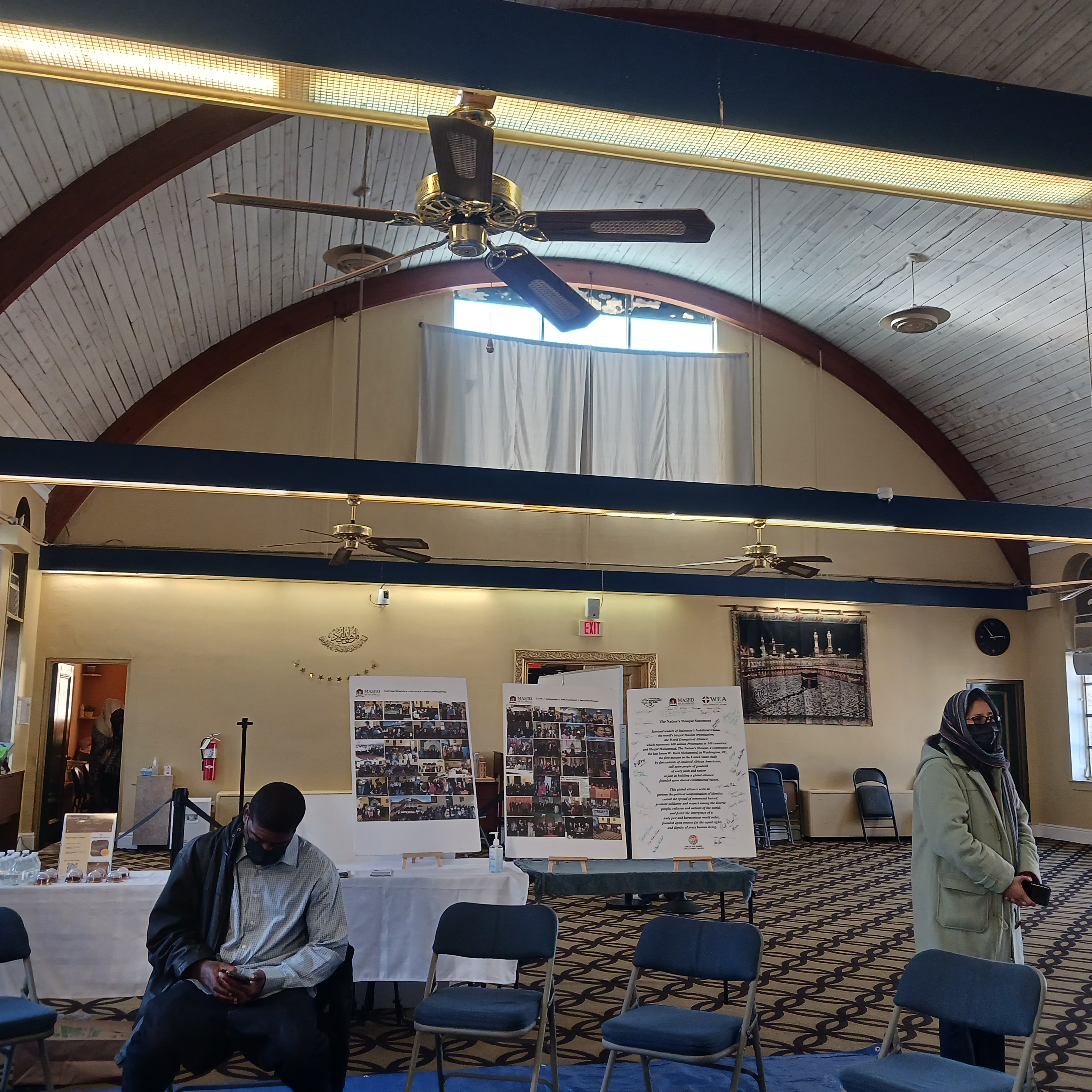
The mosque was once a Nation of Islam mosque, but it has since become a Sunni mosque.  The building has a community center or a reclaimed gym kind of feeling, but that's probably because of the curved ceiling:


Here's a longer view:


The mosque is open for prayers during 5 times a day, with an extra prayer time on Friday.  We were there to observe the prayers at 3:11 yesterday afternoon.  The leader asked each man where he was from:  Ghana (3 people), Ethiopia (5 people), Turkey (1), another East European country I didn't quite catch the name of (1), Pakistan (1), and 3 from the District of Columbia. The 5 leaders were also from DC. They do have women members, but none were there for 3:11 prayers.  The men prayed shoulder to shoulder on these rugs:


My class is half women, and we had been told in advance that we would need to cover our hair, so we did with scarves that we brought.  I thought we looked lovely.  I didn't feel oppressed particularly; the men who gathered for prayer also wore headcoverings.  Plus, I had a Muslim friend in grad school who explained why she covered her hair.  The idea that she reserved part of herself just for her husband to see made sense to me and felt less oppressive than the other explanations that had been offered by non-Muslim media that I had read.


We were all asked to wear masks, which makes sense to me, and everyone did.  People who arrived without a mask were offered the box of masks to take one, and no one protested.  On Friday, the synagogue had a section of seating reserved for those who wanted to wear masks and not sit next to unmasked people.  Two people sat there, clearly together, and one woman removed her mask part the way through the service.


At the mosque, we were offered bottles of water and a snack, which came in a globed container (see above).


The snack was some sort of bean cake, which was slightly sweet, with the moist texture of a very firm pudding.

At the end, we took group pictures, but no one has sent those to me.  When they do, I'll circle back here to post one.  I was touched by the men in charge of the mosque who wanted pictures and wanted to assure us that we're always welcome to return, either as a group or individually, for any reason.

In short, it was a great afternoon, and just the kind of opportunity I hoped I would have if I was able to take classes at the seminary, instead of only from a great distance.  I feel very lucky.

Saturday, February 4, 2023

Seminarians at a Synagogue

I am taking a World Religions class this term.  It's experiential, meaning that we go places and interact with people of different faiths, in addition to reading about the different faiths.  It's the kind of opportunity that might not always be mine to seize:  the professors might not always teach it, the hospitality from other faiths might not always be extended, and I live on campus, which makes it easy in a way that it might not be in the future, if the class is offered again.

Last night, our class went to the nearby Washington Hebrew Congregation, which we learned is one of the largest ones in the U.S. and the world.  We celebrated Shabbat in the smaller worship space, which is larger than many movie theatres in terms of seating.

Before we did that, we went to a Torah study that happens for a half hour before worship every Friday.  What a treat.  Here is the passage we studied, Exodus 13:  17-18:   "17 When Pharaoh let the people go, God did not lead them on the road through the Philistine country, though that was shorter. For God said, “If they face war, they might change their minds and return to Egypt.” 18 So God led the people around by the desert road toward the Red Sea.[a] The Israelites went up out of Egypt armed for battle."  There was a larger portion on the handout, but that's all we had time for.

We talked about how the people's hearts needed to change, otherwise they would go back to what was safe and familiar, even if it was a state of slavery.  We talked about how we are not unlike those ancient people.

Then we filed into the worship space and I did my best to follow along.  I did not try to sing, even though I had a sense of what we were doing in the prayer book.  I couldn't make sense of the Hebrew words on the page and the sung words.  I enjoyed it, and spent perhaps too much time wondering if the musicians were paid professionals and if this music would be the music I would hear at a Shabbat service at a different synagogue.  The service had familiar elements:  a sermon, readings, music, time with children, praying for those who needed prayers, offering up our joys.

There was food before and after the service, and not just food, but several tables full of serving stations of hot food, a table of non-hot food (crackers, cheese, fruits, veggies), and a tureen of soup (last night's soup was carrot ginger, and it was delicious).  There was also a full bar, including hard alcohol, with lots of choices.  It felt amazing to me, and I asked the rabbi if they eat like this every week.  He said, "We try to."  

After the service, my seminary group met with the rabbi for a bit of conversation about the differences between Jews and Christians.  We focused on the order of the books of the Scripture.  The highlight of the night, though, is when the rabbi took us to the much larger worship space and showed us the Torah scroll.  Here's where they are kept.


And here's one of the scrolls rolled out.


The glowing aspect above is because of the lighting and my older cell phone camera--but I kind of like the effect.

And here's the tool used to help read the Torah:


The rabbi said that Moses went up to the mountain, talked to God, and what did he come down from the mountain with?  I said, "A sunburn," an answer which surprised everyone.  The correct answer was the stone tablets.  It was such a correct answer that I thought it was too obvious and went with my sunburn reply, which I just blurted out without really thinking about it.

We asked a few questions, and then we adjourned for the night.  It was so fascinating I could have stayed and talked for several hours, despite the fact that it was past my preferred bed time.

Today we have time in the classroom this morning, and this afternoon we go to a mosque.  Tomorrow, I'll report back.

Friday, February 3, 2023

The Feast Day of Anna and the Feast Day of Simeon

Today we celebrate the lives of Simeon and Anna.  Yesterday was the feast day that celebrates the presentation of Jesus at the temple 40 days after his birth.  Simeon was the priest at the temple that day.  God had promised Simeon that he would not die without seeing the Messiah, and at the end of Simeon's life, God fulfills the promise.

When he held Jesus, he said the words that many of us still use as part of our liturgies: "Lord, now you are letting your servant depart in peace, according to your word; 30 for my eyes have seen your salvation that you have prepared in the presence of all peoples, a light for revelation to the Gentiles, and for glory to your people Israel."

On this day, we also celebrate Anna the Prophetess, who was also there for the presentation.  Like Simeon, she's at the end of her life, and she's spent much of her life in the temple, doing the support work that keeps religious work running smoothly.  It's interesting that I assume she did the support work--the text says she spent her days worshiping God and fasting and praying.  My brain filled in the rest:  that she did the sweeping and the care of the candles/lamps and the feeding of everyone.

We have the song of Simeon; I wonder if Anna sang a song?  I wonder what it would be?

I am fairly new to this pair of feast days; in fact, I only realized a few years ago that Anna and Simeon share the same feast day.  I love feast days that celebrate humans at the end of life, humans who haven't done anything particularly remarkable--although staying faithful for a lifetime is fairly remarkable.

The churches of my childhood didn't spend much time on the old people in any story. The lectionary readings focus on Jesus and the disciples, who are often presented as men in the youthful prime of their lives.

I'm forever grateful to feminist scholars who have returned to these texts and given them a new spin as they imagined what would happen if we moved women to the center of the narratives--or, if not the center, at least out of the marginal shadows.

I feel a need to do something similar with the stories of the old folks. Elizabeth, Simeon, and Anna are great places to start.

Today, let us remember that God makes us a similar promise to the one that Simeon receives. We need but open our eyes to see the presence of the Divine.  And if we're faithful to the best of our abilities, we may find out we've been holding the Divine in our hands all along.

Thursday, February 2, 2023

Holidays Halfway through Winter

We are at the halfway point of winter--halfway between the Winter Solstice and the Spring Equinox. Today is Candlemas, where Christians celebrate the presentation of Jesus at the Temple (also known as the Feast Day of the Presentation of Jesus at the Temple), and pagans long ago celebrated the goddess Brigid (and the feast day of St. Brigid was yesterday), and some Wiccans today will be celebrating at Imbolc, or a variation of any number of pagan holidays. It's also Groundhog's Day. It's one of those times when we can almost perceive the shifting of the seasons. It's not spring yet, but it will be soon.

Candlemas is the feast day that speaks to me. Candlemas celebrates the presentation of Jesus at the temple. It's the last feast holiday that references Christmas. We could see it as the final festival of Christmas, even though most of us have had the decorations packed away since even before Epiphany.

Some churches and monasteries will bless the year's supply of candles. I love this tradition. Today would be a good day to light a candle and to think about our own lights. Are we dimly burning wicks? Take heart--the Bible promises that we can still be useful. Does our light burn pure and true? Take care to protect that flame.

This morning I tried to sketch a basket of candles, and then a haiku-like poem-like bit came to me:

Basket of candles
Waiting to be blessed today
Year of light to come

The holidays of early February (Groundhog Day, Candlemas, St. Brigid's Day, Imbolc and Oimelc ) remind us that the light hasn't really left us. Spring will be here soon.

Wednesday, February 1, 2023

Saint Brigid's Cross in Cloth

 In the past, I've felt sad as feast days come and go, and I have no time to do much more than a blog post (and often, it's a reposting of what I've done before).  If you were hoping for that kind of reading, head over to this blog post, where you can also enjoy a poem.

This year, as I thought about the feast day of Saint Brigid, I thought, I could make a woven cross.  Sure, I don't have reeds or rushes, but I have cloth.  I have so much cloth.  Just a year ago, I didn't have enough to even think about a small project, much less a bigger one.  But now I have enough cloth for several large projects and any small project I might want to do.  I used the directions here to walk me through it.

I cut 9 strips of cloth--in the end, I would need 12 strips.


I began weaving--so far, so good, although I did think that a stiffer reed or straw would make the weaving easy.


I was glad that I had the foresight to use pieces of cloth from across a wide range of colors:


Here's my finished project.  


And a close up of the middle of the cross, the knot, which is not nearly as tidy as it would be if I had used straw:


Now the question:  what to do with this cross?  I know that the traditional answer would be to hang it over a door, but to do that, I'll need to get something to stiffen the cloth:


I realize it's not over the door, but it's the only hook I had.

I am glad to have had this experience, although it took longer than I thought it would, about an hour from start to finish.  I tried to do it meditatively, giving thanks for women like Saint Brigid, who founded some of the first Christian monasteries in Ireland, most famously the legendary one in Kildare.  She also founded a school of art that focuses on metal working and illumination. 

Now let me go out for a walk.  We got our first dusting of snow last night, and it's beautiful to look at from inside.  Let me go get a closer look.