Showing posts with label gardening. Show all posts

Thursday, September 11, 2025

Osama's Sunflowers: A Poem for September 11

In the years since September 11, 2001, I have never not thought about that anniversary each year.  In 2017, it wasn't the first thing on my mind, since we had just had a hurricane, and we were trying to decide if it was safe to return home.  But eventually, I did realize what day it was.

In the years just after 2001, everyone remembered that anniversary each year when it arrived.  Now I have students who weren't born in 2001.  I think of my own reaction to my elders remembering the anniversary of the JFK shooting, which happened just a few years before I was born.  It seemed like such ancient history to me, while it was still very vivid for my elders.  I suspect the same is true of my students.

In 2001, we seemed to have shifted from the violence of assassinations to the violence of terrorist acts.  And now, we have a wide variety of types of violence, and I have no idea where the world is headed.

In 2011, I heard  this interview with Lawrence Wright, who wrote The Looming Tower.  I'm haunted by all the things we missed, all the pieces we didn't put together.  I'm haunted by the folks who say they tried to get a meeting with the President and key staff to go over all of this, but the scheduled meetings were cancelled again and again and again.

It makes me think about my life and all its facets.  What am I missing?  What should I focus upon?

Lawrence Wright told this nugget about Osama bin Laden, who flirted with both terrorism and agriculture, before committing to terrorism.  He loved his sunflowers.  

I understand how people become disaffected enough to leave their sunflowers behind and turn to dreams of destruction.  I'm grateful for my religious heritage that reminds me of the seductive qualities of evil, that warns me not to succumb to that glittery facade.

I continued to think about the terrorist that loved sunflowers, and not surprisingly, that nugget later led to a poem:


Osama’s Sunflowers


The terrorist sits in his armed
compound and watches videos
of himself. He counts
his weapons and yearns
for a nuclear bomb.

The terrorist dreams of hamburgers
and the joy of a cold beer
on a hot day.
The terrorist remembers the grill
he used to have, a container
of gas used to cook,
not to kill.

The terrorist tamps
down his longing
for the sunflowers he used to grow,
their bright smiles turned
towards blue skies.
He wonders about the different trajectory
had he chosen seeds and soil
instead of flame and ash.

Sunday, March 17, 2024

The Seeds of Saint Patrick's Day

I have never done much celebrating of St. Patrick's Day. I don't drink green beer, and if someone else served me corned beef, I'd eat it, but I don't love it enough to make it for my own homestead. Occasionally I make Irish soda bread, and I wonder why it isn't tastier. I've made a cake with Guinness beer occasionally, and here, too, I wonder why it isn't more delicious. I'm not braving the crowds to go to an Irish pub--I like my pubs deserted.

I may spend some time contemplating Celtic aspects of Christianity, but I might do that any day, whether it's a day that celebrates the life of a famous Irish saint or not.

I am intrigued by the crowds of people who have no connection to Ireland or Christianity or any of the reasons we celebrate today. But I'm not critical. I believe in injecting festivity into daily life in whatever way we can.

Today I will go to church, people may wear green. That's fine.  I am preaching a sermon that thinks about Saint Patrick, the Oscars, the U.S. presidential race, and today's Lectionary text: John 12:  20-33, a text about seeds and the necessity to die so that we may live again.  Many would preach this text as an eternal life text, but I'm encouraging us to look at our current lives.  What bulbs do we need to be planting?  Where are we stuck in the mud of life?

Saint Patrick, before he was a saint, surely felt stuck in the mud, sent to a distant outpost to help solidify Christianity in Ireland in the 500's, when Ireland was a wild and wooly place, when the empire of Rome was in a state of slow collapse.  Yet he used his gifts to transform the community of faith--and one of those gifts was the 6-7 years he spent as a teen enslaved in Ireland before he escaped.

Here's how today's sermon ends:

Our sprouting and blooming will almost surely not look like the success that our larger culture has trained us to value. We’re not likely to win an Oscar or to be a presidential nominee. Even though I’d vote for just about any of you, our system isn’t set up that way. But the life of Saint Patrick reminds us to be of good cheer. Even if we feel like we’re stranded in a distant outpost, we are making a difference just by living our lives in an authentic way, the way that God calls us to live. Even if we feel like we’re stuck in the mud, in truth, we are bulbs in the process of transformation to blooms.

Friday, March 1, 2024

March, Meteorological Spring

 A new month--is March coming in like a lion or a lamb?  It depends.  We have a wintry mix forecast for this morning, but tomorrow, the high is supposed to be in the 60's.  Of course, in month we expect this meteorological whiplash.  It is the first day of Spring--meteorological spring.


Earlier this week, I had wondered if my daffodil bulbs would spring into life.  Around the neighborhood, we have lots of daffodils in full bloom.  My yard doesn't have as much sun as the rest of the neighborhood so I haven't been surprised that my daffodils aren't showing signs of life.

And then, on Wednesday, when I took the trash cans to the curb in the late afternoon, I saw the first stalks from my bulbs, the ones that we planted along the fence line.  An hour later, when my spouse noticed stalks along the other fence line.  I would swear that they weren't there when I took my walk in the morning.  If I had camped out by the fence line in the afternoon, would I have seen the stalks poking through the soil and leaf cover?


My brain always turns to metaphors, but I'm aware of the dangers of a tired and worn out metaphor.  But the metaphor of seeds and bulbs sprouting before anyone realizes what's going on--that metaphor always seems relevant to me, even though admittedly, it's not a new metaphor.  

I think of all the parables of Jesus, parables that involve seeds and soil--yes, not a new metaphor at all.


And now, the wintry mix is falling.  It's much more ice/freezing rain than it is snow.  Hang on, little daffodils!

Thursday, August 17, 2023

Nourishment: Quilt Groups and Tomatoes

Yesterday, I made my way back to the quilt group that's part of the Lutheran church that's closest to my Lutheridge house.  This group meets every Wednesday to work on quilts for Lutheran World Relief.  They have a space that would be the envy of many--it's made of two portable type buildings, which means there are larger rooms and smaller and bathrooms.  It means we can work without disrupting the preschool that occupies much of the church during the week days.  It means we have plenty of storage for all the fabric that people donate.  It means we have lots of tables set up in configurations that make it easy to assemble the quilts that are 60 by 80 inches.

When I first joined the group in the spring, they had lots of assembled quilts that needed knotting.  I was happy to help.  Yesterday, we had lots of material that needed to be assembled into quilt tops.  I can do that too.  Yesterday I used one of the sewing machines so that it would go faster.  

It's the fanciest machine I've ever used.  As with many fancy things (the computer, our new stove), it has all sorts of functions that I don't know exist, functions that I wouldn't use, even if I did know that they existed.  

I chose fairly large panels in browns and autumnal colors that went together, and went to work sewing them together.  I worry a bit about my ability to measure and cut, but I came close to the measurement requirements.  If it's not quite square, we can fix that when we assemble it.  With the exception of a few annoying moments in measuring and cutting, it was so, so, so satisfying to put together a quilt top in just over an hour.

I put it in the cabinet where we put quilt tops, and I admired the colors of another one.  The leader of the group said, "You put the fabrics together for me, and I assembled it.  Don't you remember?"  I do not.  I do remember several sessions where I spent a wonderful afternoon going through fabrics and putting them in bundles.  I didn't realize that our leader was doing the next step.  

She showed me another quilt top assembled with fabrics that I had sorted and put together more recently.  I did remember that group.  I was happy to see that the fabrics did match each other in ways that I envisioned.

I tend to assume that anybody could put fabrics together, even though I know it's not true.  As with so many of my skills, I assume that everyone can do what I can do--and that they can do all the things I cannot, which means there's something wrong with me.  It's good that I know this tendency of my brain, but annoying that it can take me some time to realize the dynamic at work.

It's great to work in fabrics that get stored somewhere else.  It's great to work on projects that will head out into the world to do good:  people use them as quilts, but also floor coverings and room dividers and protection of all sorts.  It's great to make friends with women I might not get to know in any other setting (many of them don't go to the church that gives us space and time).  

And I returned home with tomatoes!  The quilt group leader brought the surplus from her garden, and I was happy to take them home with me.  They are delicious in ways that make me remember the good gardens of my youth.  And quilting with this group also makes me remember other good quilting groups, both the ones quilting for charity and the ones that had us working on our own quilts.  What a blessing those groups have been for me, what nourishment.

Monday, July 24, 2023

Sunday Sermon Report: Weeds and Seeds

A week ago, I gathered seeds and things that might make a sprout.  I put them in a shallow pan:


Then I covered them with potting soil.  I had hopes that I'd have a pan of seedlings by Sunday, a visual to go along with my sermon about wheat and weeds.

During the week, the pan was saturated with rain water, so much rain water that I thought they wouldn't sprout.  But we poured off the water and waited to see what would happen.  Happily, by yesterday, we had a pan of sprouts.  I put the pan on a small table in the front of the sanctuary:


I delivered two sermons that I thought were strong, both on the idea of seeds and weeds.  I asked questions about how we distinguish between seeds and weeds--how do we know what is worthwhile?  The answer:  we may never know, particularly if we working on cosmic time, God's timeline, not ours.  We keep doing the work and the results shouldn't matter.


I also talked about our judgmental tendencies, particularly of ourselves.  This part near the end came to me as I walked up to the chapel on Saturday,  I prayed, asking God to let me know what the congregation needed to hear.  This paragraph sprang fully formed into my head:

"Like Mary Magdalene, we may be tormented by demons, the voices in our heads and outside of our heads, over and in and through society, voices that tell us that we will never be enough: good enough, rich enough, accomplished enough, nice enough, attractive enough, loved enough. Rest assured, when we hear those voices, we are not hearing the voice of God. When we are convinced that we are weeds, destined for the fire, that’s some other voice. It’s not the voice of God."

My preaching professor would say that it's a message that most people have never heard, and a message that is so important. I agree. 

I ended the adult sermon this way:  

"Even here, in the middle of Summer, The Easter message comes to cast out these demons again and again. Christ reminds us that he’s here, always waiting, always watching, always ready for us. Even if we don’t recognize him, Jesus will not cast us away. It is the voice of Jesus that can silence all of our demons and help us to be at peace. Jesus came to declare, to emphasize the Genesis message—God creates us and claims us and declares us good and very good. Let us hear that declaration today and every day."

I knew that I was taking risks with the sermon.  I subtly (was it subtle?) undercut the judgment imagery of weeds being cast into the fire; I focused on the message of putting judgment aside to let God sort it out, but I also claim that God will not throw us into the fire.  I wasn't sure how it would go over.

I got more positive feedback yesterday than I have so far--most days, I get no feedback at all, aside from smiles and interested looks.

Next week is the set of parables that includes yeast.  I will be baking bread for communion and doing interesting yeast experiments with the children's sermon.  I am so grateful for these sermon opportunities which include inspirations for visual elements and some participatory elements.

And one parishioner told me about a bread baking project in his old church, as he heard me ask if it would be OK if I brought homemade bread for communion next week.  His face lit up at the thought of homemade bread as part of the service.

I have always thought that homemade bread was part of my mission field, and it has been, in so many ways.  I am feeling deeply nourished this morning.

Sunday, May 21, 2023

Connections and Blooms

 Another week has zoomed by.  A week ago, I would have been on the road for a few hours.  And although I have had 2 naps this week, I hit the ground running when I got here.  Let me record a few snippets:

--I thought that most of the blooming season in the mountains was over, but the mountain laurel is in full bloom in a way that it wasn't two weeks ago.  There are still some dogwoods emerging.  And although it's not flowers, if I look at the tips of branches and plants, I see new growth emerging.

--I snapped this picture and called it "Flare Corona with Hydrangea and Mountain Laurel."  These poems are wonderful!


--My spouse knows I love hydrangeas, even though some people have told us that they're "old lady flowers."  Perhaps I've joined the old lady club?  But I have loved them from my youth.

--I've seen drought charts which include western North Carolina, but it's hard to believe them.  We've had rain two nights this week.  It's been lovely to sleep with the window open, hearing the patter of rain through the night.

--It's been a week of many Zoom calls:  the HR person at Spartanburg Methodist College, the person in the Southeast Synod of the ELCA who will be my mentor for my internship, the meeting with the church in Bristol where I will be the Synod Appointed Minister for the next 9 months, and a Bible study group from my Florida church.  I am glad I don't have to do these kinds of meetings all day, day after day.  But I'm grateful that I live in a time where I can meet with people without traveling vast distances.

--My spouse said, "You're going to a seminary in D.C., you're a candidate through the Florida-Bahamas Synod, you're part of a church in North Carolina, you're affiliated with the Lutheran seminary in South Carolina, and you'll be preaching at a church in Tennessee, while also having an internship with the Southeast Synod of the ELCA"--I interrupted to say, "And my parents' church in Virginia gave me a scholarship."

--I thought of his comment, and I thought of my experience last week at the seminary graduation activities.  I saw so many people that I knew from so many Lutheran contexts, and I often greeted people warmly as my brain raced to remember how I knew them:  retreats?  the spiritual direction certificate program?  my Lutheran undergraduate school?  On and on I could go.

--Today we will go to the church that is minutes away from our Lutheridge house, and we'll be part of the celebration of 60 years, which includes a barbecue lunch.  Yummm.  I will need to start telling people why we're about to disappear on Sundays--but I could still be part of the women's quilt group that meets every Wednesday (another old lady club signifier?  But I have loved quilting since my youth).

Monday, May 1, 2023

Solidarity Forever! Happy May Day!

Here we are in the merry month of May--how can it already be May?  The first day of May has ancient roots as a celebration of Spring and new growth and the return of warm weather.  More recently, the first day of May has become a celebration of workers.

So let's think about some ways we could make the day special:

--The traditional way would be flowers, traditionally flowers that we would leave on dark porches for people to discover when they woke up.  It's probably too late for that approach, but it's not too late to appreciate flowers.  You could buy some flowers or a flowering plant.  Or, for future enjoyment, you could do what we did:  buy some seed packets, plant them, water them, and see what happens.

--It is probably also too late to weave long ribbons around a Maypole.  But we could braid ribbons or strips of cloth and meditate on the types of joy we'd like to invite into our lives.

--Today is a good day to think about workers, workers of all sorts.  We're having more of a national conversation these days about work, about gender, about who takes care of children and elders while people work, about the locations of work.  I look forward to seeing how it all turns out--I'm holding onto hope for positive change, even as I'm afraid we can never make the improvements that need to be made.

--If we're one of the lucky types of workers, the ones who aren't under threat by bosses or by globalization or by robots, we can support those who aren't as lucky.  Send some money to organizations that work for worker's rights. I'm impressed with the Coalition of Immokalee Workers, which works to protect the migrant workers in the fields of Florida, but you certainly have plenty to choose from.

--Can't afford to make a donation? Write letters on behalf of the unemployed, the underemployed, everyone who needs a better job or better working conditions. Write to your representatives to advocate for them. What are you advocating? A higher minimum wage? Safer worksites? Job security? Work-life balance?

--Today, Anglicans, Episcopalians, and Lutherans celebrate the feast day of Philip and James; others will celebrate May 3. These are not the most well-known disciples. Today you could reread the Gospels, a kind of literary Easter egg hunt, to try to find them.

--Can you create something that weaves these strands together? Here are some possibilities: a sculpture made out of ribbons that explores the world of migrant workers. A poem that celebrates flowers and contemplates the ways that we love some blooms (flowers) but not others (algae, cancer). A painting that uses weaving in some ways to think about the past century of efforts to enlarge the workplace and make it safer. A short story that updates the story of Philip--who would he be today? 

Sunday, July 31, 2022

Of Squash and Farmers Markets

Yesterday, I went to a farmer's market, the kind that happens only on a Saturday, the Mills River Farmer's Market.  It was in the parking lot of an elementary school, and the vendors sat under the pop-up shelters they brought.  We used to have similar green markets in South Florida, but in South Florida, I didn't find many vegetables.  There was jewelry and essential oils and various craft projects and flowers, but not much that was edible.

When I first moved to Columbia, SC for grad school, I went over to the State Farmer's Market, the very same one where my grandfather used to bring the truckload of vegetables from the family farm in Lexington, SC.  It was an institution of permanent structures by the time I discovered it in the summer of 1987 with lots of 18 wheeler kind of trucks, not the kind my grandfather had driven.  I remember late on day, I got a great deal on a bushel of yellow squash ($3!), and only later did I wonder what I would do with that many squash.  After I gave away as much as I could, we ate squash for days and had frozen squash through the winter.

Yesterday, I drove through beautiful mountain vistas, more than I needed to, because of the way the roads were named.  Only on the return trip did I find the correct road--from the other side of the street, the road name changed.  In some ways, I didn't mind--the surroundings were so beautiful.  And finally, I found the farmer's market.


Baby butternut photographed on my back deck in Arden, NC


I was delighted to realize that the farmer's market offered a variety of vegetables, some organically grown, some not.  The farmers were there to answer questions.  I noticed a basket of winter squash like these with a large pumpkin that had a sign:  "These squash will be ready in 25 days."  When I expressed my delight over the baby butternut squashes and asked how much, the farmer said, "Well, they're really not for sale."  Then she gave me one with my corn on the cob purchase.

I bought a variety of tomatoes, 4 ears of corn, and a cucumber.  I also got baked goods and some smoked fish dip.  We ate well yesterday, and we will eat well again today.

My uncle stopped by on his way back from rafting with my cousin's family.  It was a joy to sit on our back deck, eat baked goods that I had just bought, and catch up.  It seems to be the kind of neighborhood that encourages this dropping by.  And unlike other neighborhoods I've lived in, I'm happy to see our neighbors.  One even brought us some tomatoes and cucumbers from her garden.

I wonder if there will be baskets of summer squash that will appear when the zucchini yield is bigger than expected?

Friday, January 7, 2022

First Full Day of the 2022 Onground Intensive

 As I moved through the first full day of the onground intensive, the one that will leave me a certified spiritual director, I had to remind myself several times that it's called an "intensive," not a restful retreat, not a reconnect with every old friend you've ever had week, not an explore Columbia voyage.  We went at an intense pace yesterday, and today we won't have the afternoon break that we had yesterday.  But I am looking forward to exploring icons in a Greek Orthodox church this afternoon, so hopefully, we won't need a break.  

During yesterday's break, we went to the Fresh Market to buy wine and treats.  By the end of the evening, we were too exhausted to set out the treats.  But it was the good kind of exhaustion, the kind that comes from being fully engaged.

I began the intensive in the chapel.  I had volunteered to help with the morning service, and I wrote some Epiphany prayers (for more, go to this blog post and scroll to the end).  The other volunteer whispered, "Beautiful prayers" when I was finished, and that made me so happy.

The day was filled with a mix of educational sessions and small group work.  I've had the same small group for 2 years, and I feel fortunate that I like them so much.  This program would be impossible if one didn't like one's small group, or if a small group had a divisive person in it.

Yesterday's educational sessions addressed the history of spiritual direction in the Roman Catholic and Anglican/Episcopalian traditions (morning session), and in the afternoon, we explored the history of spiritual direction in the Protestant tradition.  They were good sessions, very informative, almost overwhelming at times.  I didn't know about John Wesley's mother Susannah, who had 10 children who lived and who ran the family home like a monastery of sorts, thus giving John Wesley some of his most inspired ideas about how to live in Christian community.  I must remember to read more about this remarkable woman.

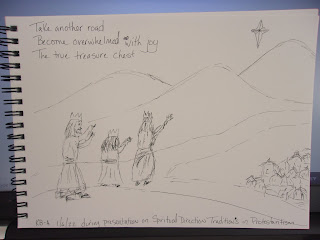
Along the way, I made this sketch, and a haiku to go along with it:


I created it after hearing/reading the second chapter of the Gospel of Matthew several times throughout the day and a session of lectio divina; here are the words to the haiku:

Take another road
Become overwhelmed with joy
The true treasure chest

In the evening, after a wonderful dinner, we heard from Axiom Farms, the ones who prepared our meal.  They have all sorts of initiatives to reach out to underserved, minority populations, to bring them healthier food and information about how to grow one's food and most importantly, to inspire people to have hope.  They have created a garden on the grounds of the seminary.  There's plenty of room--the seminary sits back from the road, and between the buildings and the road is a huge expanse of lawn.  The partnership with the seminary made me want to change all my plans--and do what, exactly?  Come to this seminary?  Buy a plot of land and farm it?  Give them money to support their work?  Yes, to all of those.  I'm not likely to act on any of them, at least not this month, but it was good to feel that hope for the future myself, even if I'm not the target audience for Axiom Farms.

We adjourned to the courtyard for our evening worship.  There's a Native American group that we'll learn more about today who came last night.  They had a smudging ceremony in the courtyard.  We each stepped forward to be smudged with sage that smoked in what looked like a giant shell.  The elders swirled the smoke around us with big feathers.

I wish I could have heard better.  At first I thought the same words were repeated with everyone, but as I watched, I realized that wasn't true.  I was second to be smudged.  The female elder of the tribe said, "Oh, such strong shoulders" as she touched them with the feather.  She said, "And a good heart."  I'm not sure of the rest, although at one point, she did say, "We're getting rid of all negativity."

Later she told me that there are 4 types of smudging smoke:  tobacco, sage, sweetgrass, and cedar.  I wonder if those smudging ceremonies are different.

The one we experienced last night was very powerful.  Many of us cried a bit, and a few of us were deeply shaken, and I'm not sure whether it was in a good way or a bad way.  Once again, I was reminded of how cerebral most of our mainline Protestant worship services are, and how it might be much more powerful/effective to do more embodied practices.

We then went into Alumni Hall for a drum circle, which is different from many drum circles.  There was a big, round drum in the center of the room with 6 people around it.  Their drum sticks looked like they had big cotton swabs on the end.  Around this drum circle, we sat in chairs that were much too close to each other, but this room is the largest on campus.

It was interesting to be in a room of Native Americans, after hearing from African Americans, all of whom were trying to reclaim cultures and practices that can heal both people and land.

We learned that some hymns, like "Spirit of the Living God" and "Amazing Grace," can be sung to Native melodies played on the Native wind instrument which I think is called a flute but looks more like a recorder.  We learned some Native phrases so that we could sing refrains to other songs and chants.  For one song, two women did a bit of a dance between the drum circle and our seated circle.  It was a meaningful experience, but nothing can compare to the smudging ceremony.  

It makes me want to create/recover similar ceremonies that draw from Protestant traditions.  I'm aware of the dangers of appropriating the culture of others, but I'm also certain that Christian communities have done something similar with incense and thuribles, so I don't think I'd be in the dangers appropriation territory.

I am ready to see what today brings.  I am so glad that I decided to attend in person.  In fact, knowing that we would experience the Native American version of Christian worship and that we would be going to a Greek Orthodox church to see icons in their home setting--those were two main reasons that convinced me that in person would be better for me than remote.

And if anyone asks if these experiences would be worth it, even if I get sick, I would say that yes, barring long COVID, it has been worth it.

Monday, August 30, 2021

Monarch Butterflies: The Late August Report

 If you need a sign of hope, here's a monarch butterfly sighting for you:


Two weeks ago, my spouse moved milkweed plants from the other house.  Did we also transport monarch eggs?  We had six caterpillars at one point.  We ended up with at least 3 chrysalises, and yesterday, a butterfly emerged out of one of them.


The chrysalis was hanging off the table, and we tried to avoid the area for a week.  Yesterday morning, our efforts paid off.  We watched the butterfly for a bit, and then we went to church.


My spouse returned in time to watch the butterfly fly away.  Was it confused by being six stories off the ground?  It did take some time for the butterfly to adjust to the strange way the wind works in the U of the condo building.  It landed on the top of a palm tree and then it flew away towards the Arts Park.


And this morning, the 2 other chrysalises have butterflies emerging.  


We may not have the kind of thriving butterfly gardens that we've had elsewhere, but there are 3 monarchs in the world today that weren't there last week because of our little 6th floor balcony butterfly garden.


Thursday, July 15, 2021

The Vinedresser's Greenish Thumb

This morning's readings in Phyllis Tickle's The Divine Hours included this reading from John:  

"Jesus taught us, saying: 'I am the true vine, and my Father is the vinedresser. Every branch in me that bears no fruit he cuts away, and every branch that does bear fruit he prunes to make it bear even more. You are pruned already, by means of the word that I have spoken to you.'"     John 15:1-3

I thought about this vine that's in my office.  


A year ago, a colleague brought me this orchid, and another colleague brought in a cake.

They had heard me talking the day before on the phone, when my parents called to wish me a happy birthday.  I hadn't let my work colleagues know it was my birthday, because I didn't want anyone to feel like they had to do anything special for me.

That orchid was in full bloom then, and it has never been without flowers in the year that follows.  I don't know much about orchids, but I do know that's unusual, for orchids or for any plant.


Is it something I'm doing?  I give it some water or some cold tea (when the tea in my mug cools) once or twice a week, and that's it:  no special fertilizer, no orchid food, no compost.  

I have never thought of myself as having a green thumb--in fact, just the opposite.  But perhaps it's time that I change that narrative.  A few months ago, I noticed some almost dead plants on a windowsill that had been abandoned during one of the layoffs in the fall.  I brought them to my office and gave them some water or cold tea once a week.  Now they are flourishing:


I wish I had some before pictures.  Imagine this aloe plant, but about 2/3 less length on the spines.


This plant once had more brown leaves than green.  I trimmed them off, and look at how it's thriving:


Yes, I see the life lessons here--trimming back to facilitate growth, a small bit of care goes a long way, on and on I could go.

But I also see it as an important reminder about the stories we tell ourselves about ourselves.  For years, when people asked me if I had pets or children, I would joke, "Oh please, I can't even keep a houseplant alive."

And I believed that story I told about myself.  I believed that it was a hard thing to do, to keep a plant alive, and I believed that I was not capable.

But it turns out, I have a green thumb, or at least a greenish thumb.  I've met people with amazing abilities to nourish plants and grow things out of the most non-nourishing soil.  I'm not sure that my skills are up to that level.

But I'm not sure that they aren't--both in terms of plants and in terms of many other possibilities.

Monday, April 19, 2021

Saving the Earth, One Butterfly, One Potato Chip Bag at a Time

 I have been feeling thrilled to see 6 butterflies, all monarchs, emerging out of their chrysalises this week-end.  We had a brief chat with our pastor when we got drive through communion.  He's taking a very different approach to butterfly gardening, as he builds enclosures and moves plants and tries to keep caterpillars and butterflies safe.  As a result, he's launched over 100 butterflies.  Many of them are monarchs. 

In some ways, it feels like important work, especially when I hear the news of how endangered this butterfly species is.  In other ways, it feel ludicrous, especially when I consider the lifespan of a butterfly.

I had similar thoughts this week-end, during my two long walks.  When I have time, I like to walk over to Holland Park, which is predominantly a boat launch area with some picnic tables.  But there are trails and more trees than in the neighborhood, and a different water view.

Saturday I found a big potato chip bag on the trail, so I picked it up and threw it away.  I did the same with some empty plastic bottles and a few other non-biodegradable food wrappers.  It felt like the ultimate Earth Day kind of action:  making a small gesture that likely won't have a long-term impact but it made me feel good.  On Sunday, I returned to the park only to find more trash.  I picked up a few more items and put the aluminum cans in the recycling bins.

I'm sure that there's more trash today.  The trash cans don't have lids, and there aren't enough of them.  It's been a week-end of beautiful weather, which means more people have been out and about.  It's a never ending issue.

Still, I'll keep making the effort, one butterfly, one potato chip bag at a time.

Tuesday, September 1, 2020

Pruning and Protecting

 Here we are at the first day of September.  Traditionally, September might be a month of change:  summer shifts into the school year, and we sense a change in the seasons.  But for 18 years, I've been on a different schedule, in a school that has an odd quarter system, down in South Florida where we are still months away from cooler weather.

It's still a fine time to think about a shift, a time to make new resolutions, a time to think about what's working and what still needs some attention.

This morning at the end of the morning watch broadcast that I do from my church's Facebook page, I invited us to think about God as a gardener, pruning away the dead branches and protecting the new growth.  Unlike some of the language of parables, I don't like the idea of our lives being dead trees that need to be thrown into the fire.

I prefer to use the idea of pruning as a way of thinking about our lives.  What needs to be pruned away?  What needs to be protected?  What fertilizer do we need?  How can we get enough water for that which wants to sprout in us?

Tuesday, December 31, 2019

2019: A Look Back

I began this post in mid-December, in an attempt to boost my mood.  I've been trying to jolt my way out of my sadness with cups of hot tea and buttered toast, and by the middle of the day, I decided to do something more intentional.  I finished this post this morning, on the last day of the year and the last day of a decade.

Let me take a look back at 2019.  Let me take stock.

Reading:

My goal was to read 100 books.  One of the unexpected benefits of increasing my reading amount was that I read so many more good books this past year.  As the year has come to a close, I've been trying to think about what book would take top place, if I had to choose the best book of 2019.  So many choices!  Perhaps I will write a future blog post about all the good books.

I remember the days when I would read 100 books in a summer--of course, they were shorter books when I was a child or a teenager.  I began this year feeling a bit dismayed about how my reading habits were slipping away.  I wanted to be more intentional, and I have been.  Hurrah!


Writing:

I'm calling this past year a mix of success and falling away from patterns that lead to success.  I'm happy that I started a novel, and I am frustrated at the ways it's hard to stay faithful to novel writing.  At times, I've written lots of poems and had no lack of ideas.  At other times in the past year, I've wondered if I'll ever have even a glimmer of inspiration again.  Most days I write a blog post, some days two--I try not to compare my output to past years when I wrote 2 new blog posts almost every day.

Writing Submissions:

My goal was 100 submissions.  At mid-December, I had 110.  I'm counting all submissions:  poetry packets, book manuscripts, short stories, essays.

Publications:

I know that some people have seen that their publication rate increases with a goal of 100 submissions.  That's not the case with me, but that's O.K.  This is the year that my book-length poetry manuscript was a semifinalist in not 1 but 2 competitions:  the Wilder Prize (Two Sylvias Press) and the Crab Orchard Series in Poetry.

I had a poem included in the Women Artists Datebook, published by Syracuse Cultural Workers group; I bought my first Women Artists Datebook from them decades ago, but never would have thought about submitting there back in those days.  Being included thrilled me.

I am also thrilled to have a poem appearing in Sojourners again.  When I wrote it, I thought it would be perfect for that magazine.  I'm so happy that the magazine agreed.

Culture/Getting Out of the House:

It's been a year of trying to do more cultural stuff.  During the first part of the year, I went to at at least 1 concert a month, from the professional ones (Carrie Newcomer!) to free concerts at the beach.  Summer disrupted that record.  I also went to more author readings:  Colson Whitehead, Te-Nehisi Coates, and Patti Smith, plus too many to list at AWP.

I don't see much TV, even though we're living in a golden age of TV, and some of the stuff sounds good, if I had various streaming services, which I don't.  I also don't make it to many movies.  Most of the movies I don't care about missing. 

I've been trying to stay connected to friends, which seems much harder than it used to be.  Sigh.  It's not that we don't want to be connected.  It was easier when we all worked at the same school and/or lived in the same county.

Cool Events for Students:

I began the year by creating a station in the break room where students could create vision boards.  I created a butterfly garden in late June that captivated us when we had butterflies emerge from their chrysalises.  And then we had a Come Out of Your Chrysalis Party.  We also celebrated the Dog Days of Summer with frozen treats and Pi Day (March 13). I helped with the Teal Takeover which raised awareness for the American Lung Association.  Not all of our events were new:  I'm overly fond of the pumpkin decorating, and it seems to be popular, as is the Halloween costume contest.  The bloodmobile comes to campus every eight weeks or so.  Let me remember that I do these things, and that they are important.

Social Justice

I admire people who write a daily letter in support of their social causes, but I am not that person.  Still, let me remember that I participate in a variety of social justice causes in an effort to build a more equitable world.  I give money on a regular basis, I support our church's food pantry, I show up at various assemblies to show that a critical mass of people demands justice.

And of course, I write letters to those in Washington D.C. who make decisions, but I have done less of that this year.  My representative will vote the way I want, so I tend to write thank you letters instead of letters demanding action.  My senators are not likely to be swayed by my letters.  And it's useless to write to the president of the U.S.

I also continue to go to Publix every Monday to pick up the bread and treats that would be thrown away.  I redistribute them:  I set out treats in the morning and the afternoon for students, and I leave the bread in baskets for anyone who wants them to take them home.  Is this justice?  Charity?  Just my grandmother's instinct to avoid waste?  It feels important, even though I often wish I was offering more nourishing food.

Unexpected Delights

When I started the butterfly garden, I fully expected the plants to be dead by August.  I think of myself as not being good at keeping plants or any living things flourishing.  I need to change that inner narrative.  When I arrived at work yesterday, all the milkweed plants were in full bloom.  Some of the other plants are scraggly, but they may make a comeback.  Yesterday, a monarch butterfly flitted across the plants.

The butterfly garden has given me joy every day.  Setting out bread and treats for students has given me joy most days.  I love creating events and book displays for the library and bulletin boards.  The days when the writing goes well--sheer joy.  Sketching--also joy.  Having bread in the oven and coffee brewing makes me happy--as does a cup of tea at work when the work coast is calm.  Let me keep remembering these delights.

Spiritual Developments:

This past year, our church moved away from the weekly interactive service, which was often a creative activity.  I still miss that service terribly.  It fed me in ways that our current approach does not.

But I did create some creative opportunities for my church.  We did journaling:  a weekly gathering for Lent and a one opportunity for one evening in Advent.  One Sunday when I was in charge, we wrote prayers on scraps of cloth and tied them to a huge hoop.  I continued to help with making the sanctuary more interesting in terms of visual elements.

I went to the Create in Me retreat and a retreat at Mepkin Abbey.  I am the social media coordinator for the Create in Me retreat, and I love elements of that work--should that love be telling me something?  I also love doing that kind of work at school.

I was asked to be part of creating a prayer chapel for Synod Assembly.  I created a station with a weaving frame, and I got good feedback--plus I was asked to be part of the process again.

What feels like the biggest development:  in January, I will begin a certificate program in spiritual direction.

Work for Pay

My online teaching progressed as usual.  In this way, 2019 seemed the same as 2015 or 2013 or any other teaching year.

When I reflect on the situation with my full-time administrator job, it's no wonder that I'm feeling a bit whipsawed.  In the beginning of 2019, we had 3 full-time Program chairs and 2 part-time.  During the first half of the year, 2 of the full-time chairs left; we replaced one but not until September and one full-time position was changed to a shared position with another campus.  In the beginning of 2019, my boss was only on campus one day a week, and now our campus is his only focus.  And of course, we had an accreditation visit which became all-consuming for almost 2 months.

Planning for the Future

The recent flooding reminds me that it may be time to get serious about making alternate plans, but what should they be?  Moving to higher ground?  Giving up on the cottage but enjoy the house for a few more decades?

Let me try the approach which has worked in other settings.  I am in a period of discernment--that sounds better than being paralyzed by the fear of making the wrong decision.  But let me also get a bit more intentional about actually discerning a good direction.

Sunday, November 17, 2019

The Last Sunday in Ordinary Time: Hildegard of Bingen's Mantle

Today is the last Sunday in Ordinary Time.  Next Sunday will be Christ the King Sunday, which takes us out of Ordinary Time--and after that, we plunge into the season of Advent.

When I was a child, I thought of the time between Pentecost and Advent as the long, green, boring season.  Truth be told, I still do.  I love the possibilities for observing and celebrating the time between Advent and Pentecost--the season of Ordinary Time often feels arid. 

In many ways, I think that the challenges of Ordinary Time mimic the challenges of a regular life.  We've got lots of highs and lows early on (until about age 25-35), and then we've got a long middle ground where we need to do more work to make meaning of it all.

Some of us will do this through the highs and lows of family members.  Some of us will make meaning by our involvement with larger communities.  Some of us will turn to art.

This morning, I wrote a poem.  I'd like to say that I wrote a poem, as I do every morning.  But I don't do that every morning.  I wonder if I would wrest more meaning from life if I did write a poem every morning.  I suspect I would have a similar reaction as I do to liturgical seasons.  Some of my poetry writing mornings would feel important and significant, but many more would leave me wondering about the larger meaning of it all and reflecting on drudgery.

This morning I baked the gluten free communion bread.  It needs to be made on the day of the worship service because of the nature of gluten free bread; I know from experience that it doesn't freeze well.  As I stirred together the ingredients, this line came to me:  On the last Sunday of Ordinary Time, I bake the communion bread.  Once I got the bread in the oven, I sat down to write.

I played with the line--should it be bake or create?  The idea of Hildegard of Bingen bubbled up in my brain--a creative woman of her time, a woman I see as subversive, although I don't know that she saw herself that way.  I wanted to hear some of her music, and we live in a wonderful age where the Internet can provide.  I spent some time writing my poem and listening to this group sing the medieval music of Hildegard of Bingen.

I was struck by the woman with the green swoosh in her auburn hair and the chunky boots visible from the slit of her formal gown singing the music written by a monastic woman centuries earlier.  What would Hildegard have said?

I like to think of Hildegard of Bingen smiling at the many ways we've seized her legacy and taken up her mantle.  Some of us do that by writing, the way that she did.  Some of us have seized her mantle by singing the music that she left us.  Some of us tend our gardens, the ones we grow for food, the ones we grow for herbs, the ones we grow for the beauty of the flowers, the interior gardens that we may or may not share.  Some of us take on the Hildegard's mantle when we scold bishops and legislators and remind them of the obligation of creating a more just society.  We wear Hildegard's mantle as we care for the next generations, some of whom we're related to biologically, some of whom we will never meet.

Friday, October 18, 2019

Butterfly Garden Gratitude Lessons

I don't want to keep starting blog posts by talking about how weary I am.  But I am so weary.  Let me also record some gratitude.

--I have been writing a bit in these days of weariness.  I have also been reading a bit.

--Yesterday I wrote this Facebook post:

"The milkweed is blooming this week--these are plants that have been eaten back to bare stalks several times since I bought them in July. They are hardy souls.

We are too.

The monarchs have returned to the milkweed to enjoy the new growth. Even the non-poets can see the metaphor."

--I have been taking very small breaks at school to enjoy the colors of the flowers in the butterfly garden.  Yesterday I took my camera.  And lo and behold, a monarch butterfly came, and I captured this great shot:


--I am in the process of finishing my application for the certificate program in spiritual direction--by which I mean that I've gotten the paperwork to the people who will write letters of recommendation.  I will write my essay over the next 2 week-ends, and have the application in the mail by Oct. 28.

--Let me remember the gratitude lessons from the butterfly garden.  Shriveled plants can regenerate.  What looks like abandonment might not be.  Concrete vistas can be transformed.

Tuesday, October 15, 2019

Parables from the Pumpkin Patch

I have often wondered about the parables of Jesus.  Most of us church going folk have heard them so often that they've lost their power to shock or surprise.  Most of us forget (or have never been taught) how shockingly bizarre they would have seemed when people first heard them.

As we were offloading pumpkins, I thought about what insight the pumpkins, the patch, and our work together might offer us.  Let me play.


The Kingdom of God is like a patch of pumpkins that have been separated from the true vine.  But as they gather together, they can remember what life was like before the separation.  They can act as if they are still connected to the life giving vine and the earth--and in doing so, they will eventually find the true vine again.


The Kingdom of God is like a patch of pumpkins.  They see themselves as vastly different one from another, and yet they are more alike than they know.


The Kingdom of God is like a patch of pumpkins:  some are big, some are small, some are deep orange, some are white, and some are shades in between.  God delights in this variety, and we should too.


What does the Kingdom of God look like?  A small church that comes together to take pumpkins off a truck.  Some of the members scramble on the truck to get the pumpkins from the back to the front.  Others walk slowly with pumpkins in their hands.  Those who can't walk create a line and hand pumpkins one to another.  Those who can't stand will help with sales.


The Kingdom of God is like a pumpkin.  It can be made into a sweet pie or a savory soup.  It binds disparate ingredients together into a whole.  It grows slowly but surely, in environments that would kill less sturdy plants--and thus, a patch of pumpkins can sustain a tribe in a harsh climate.


The Kingdom of God can be used in many ways:  the purely decorative gourd or ingested from the skin to the seeds.  The Kingdom of God can provide the nutrients and fiber to keep our bodies full.  The Kingdom of God can soothe our aesthetic yearnings.  The Kingdom of God nourishes us in ways we didn't know we needed.

Monday, August 12, 2019

Lessons from the Butterfly Garden #2

In early July, the caterpillars ate the milkweed plants, leaving nothing but devoured stubs.


But we knew that these plants only looked like they were dead. Now they have not only sprouted new leaves, but flowers—and we have some monarch butterfly visitors!


Let us remember that even when we feel used up, new growth is waiting, along with new discoveries.


Sunday, August 11, 2019

Lessons from the Butterfly Garden #1

When I transplanted this dutchman's pipe plant to a larger pot, I wasn't sure it would make it.


. 


At one point, it was the scraggliest plants in the garden:


The August rains have helped it flourish. Let us all remember that even when we might be in danger of wilting in the heat of our studies/lives/challenges, if we just dig in, we, too, can flourish.


Sunday, August 4, 2019

Fierce Joy: A Nonviolent Form of Resistance

Like many of us who went to bed with the shooting of El Paso, Texas on our brains only to wake up to find that there was ANOTHER mass shooting in Dayton, Ohio--I, too, have been left gobsmacked by 2 mass shootings in one day--less than a day. Madness. I wonder if people felt this way in the late 60's/early 70's when there was so much violence: assassinations, bombings, etc.

I don't have any ideas of what one might do. I'm not sure I think that stricter gun control will help. We have fairly tough gun laws now.

Of course I think it all speaks to a deep not-wellness part of our society.  I think that technology leaves us isolated--and now, even worse, leaves us ANGRY and some of us don't have good ways to handle that. I don't really know how to deal with that as a society, just as much smaller communities. And fixing things in smaller communities, like our households or our schools, can't protect us from the ones who aren't interested in the fix. I can still be gunned down by an isolated crazy person who decides to shoot up a school or a church or a grocery store.

I think of various writers and theologians who have said that despair is the deadliest of the deadly sins--of course, many of them use different language, but it boils down to this idea. And a fierce commitment to joy is a way of beating back despair.

So, on to happier subjects.  Let me think of things that I can control, things that bring me joy.  The butterfly garden isn't as active as it once was. We haven't been able to see any more butterflies being born since that first week when the 36 caterpillars went into their chrysalises and then emerged. But that's O.K. For one thing, it's given the milkweed plants (the only food the caterpillars that become monarchs eat) a chance to recover. I go out to the plants several times a day, and so if nothing else, it's solace for me. And I do think it makes the concrete wasteland of a parking lot just a bit more beautiful--and there's a tiny green space, where before there wasn't.

It's the teeniest, tiniest way to save the planet, but it's one of the ways I can do it right now.

And it's a larger project even than taking care of the planet. It's a kind of self-care that seems increasingly important in these days. I've been taking joy in some cooking and of course, writing. I think it's important to find joy where we can--a different kind of resistance to the evil in the world.

So today, let's commit to whatever brings us fierce joy.  Let's use our fierce joy to combat the forces of hate and violence in the world.  Let's create a world that's so much more appealing than the one offered by those forces of hate and violence.