Showing posts with label retreat exercises. Show all posts

Wednesday, April 22, 2026

A Different Kind of Getting to Know You Exercise

Let me remember to record a really neat getting to know you exercise that we did the first night at the Create in Me retreat.  It's something that could be modified for non-retreat groups, and I'll give some ideas at the end of the post.

Advent


Our retreat theme was "Nature, Imagination, and Liturgy," so our opening exercise revolved around the liturgical seasons:  Advent, Christmas, Epiphany, Lent, Holy Week, Easter, Pentecost, and Ordinary Time.  

Epiphany


When we checked in, we had a nametag with a piece of colored paper in it--we sat at the table that had a larger sheet of colored paper that matched the color in the name tag.  It was a great way to make sure that we mingled new folks with returning folks.

Lent


The color of the paper matched the liturgical season (purple for Lent, for example).  We had a sheet of facts about the season, along with a small, blank banner.

Christmas


There was a table of all sorts of supplies.  Our project was to make a banner that matched the season, along with a song or prayer or poem.  We only had 20 minutes.

Ordinary Time


I admit that I was skeptical at first, as we sat there, every table staring blankly at the blank banner.  But it was a room of creative people, so soon we sprung into motion.  The energy level and discussion level rose.

Pentecost


When we were finished, we went around the room, explaining the banners and presenting our song or prayer or poem.  I was impressed with what we created--and impressed with how this exercise helped us get to know each other through a joint task and some friendly competition.

Easter


Could I create a non-religious variation for the first week in class?  I've used getting to know you Bingo, which is good.  The banner creating meant that people didn't have to move around the room and approach strangers, which is a plus for a lot of people.

Holy Week


I have a vision of this exercise, but with secular holidays and seasons, along with the holiday of Christmas, which is universal for my students.  Could non-creative students rise to the challenge?  I think they could.  Let me tuck this idea away.

Monday, April 20, 2026

A Tale of Three Butterflies

 For most Create in Me retreats, we have a community art project, something we can work on together.  Some times, the work stays at Lutheridge, like the cross as tall as a human, made of clear plastic, filled with broken things.  One year, we knotted a quilt for Lutheran World Relief.  This year, we made a huge butterfly, decorated with bits of nature.  I brought it back to my house because Lutheridge didn't really have a place for it, and it had so much glue on it that I wasn't sure it was a good idea to leave it beside a trail to decompose, as we had once thought we would do:


Here's what it looked like at worship yesterday:


It began as a series of fan blades.  Here's what it looked like when my spouse and I first constructed it last week:


I felt a keen sense of failure and despair at this early stage.  My friend on the planning team had sent me this picture when describing what the group had in mind and asking if my spouse could build the base for it:


I wrote to my friend to tell her that we might not have created what she had in mind.  She wrote back the most perfect reply:  "It will look just as it should--a unique community effort."  I so needed those words, to know that I hadn't let the team down.

In the end, I like what we created better.  One friend used the leftover dried flowers that she created for her drop in station.  We used some of the leftover wood circles that had been cut for a prayer project.  We used interesting bits that people found during outdoor time.  

And in the end, yes, it looked just the way it needed to look--many good life lessons/reminders here.

Friday, March 27, 2026

Quilt Camp Midway Report

 Much of yesterday, I would have looked like this:


I've had one of those Quilt Camp weeks where I've had to balance the retreat and the other duties of my life.  Yesterday I had planned to go to the class I'm taking, Lutheran Confessions, by way of Zoom and come to Quilt Camp in the afternoon.  But my professor was having travel related disruptions, so we didn't have class.  I got several additional quilting hours in the morning--hurrah!

I made progress both on my own projects and on one of our group projects:


We were asked to take one of the paper doll forms and add fabric scraps to it to represent ourselves.  We've been putting them on the poster, and as we've been looking at our work, we've been praying for each other.

I loved making my self portrait in threads and fabric scraps:


I am tired, tired, tired.  Ordinarily I might say that I'm tired in a good way.  But last night, as my energy level crashed, I spiraled into a strange thought pattern, feeling like all of my fabric art is ugly, ugly, ugly.  What was that all about?

Part of it is being surrounded by other quilting artists who are all doing very different work from the work I'm doing:


My workspace is full of scraps, and the process of putting them into larger squares usually delights me.  The process still delights me, but I'm less sure how well it all works together.  I put some of my more varied squares together and felt despair.  I've got autumnal squares (think browns, coppers, oranges, yellows) and jewel tone squares.  Last night I thought, I've really got two quilts here--which might not be a bad thing.  But will I ever actually finish?

I'm also noticing a pattern in my larger life.  It's easy for me to do the individual parts, but harder to finish the larger project.  I thought about my writing life and all the poems I've written--but so few larger books.  

On the one hand, I take delight in the process, the creativity itself, the commitment to doing creative stuff every day.  On the other hand, I wonder how it might all be different if I focused on seeing a project through to the end.

Do I let myself off the hook too easily?  Should I be more rigorous?  If I decide I should be more rigorous, is it too late?

Let me remind myself of this article I read in The New York Times, an article that talks about Matisse in his later years, his last years, and an exhibition of his work from this time:  "The show includes more than 300 works on loan from around the world (with some exhibited for the first time) that demonstrate how wide the French master’s oeuvre stretched beyond his best-known paintings — to innovative drawings, gouache cutouts, illustrated books, textiles and stained-glass windows. It also challenges the conventional understanding of any artist’s 'late' years as an inevitable tapering off. Here, we see a blossoming, a relentless drive to experiment in new mediums and a radical simplicity that only a lifetime of making could achieve."

Monday, September 29, 2025

Keeping Our Lamps Trimmed and Burning on the Feast of Saint Michael and All Angels

 I've had the spiritual "Keep Your Lamps Trimmed and Burning" in my head for much of the week-end:  "Keep Your Lamps, Trimmed and Burning, for this work is almost done.  Children don't grow weary."  It was the anthem for Sunday worship at St. Stephens, and it was also the theme for the women's retreat that the church offered, the retreat where I led workshops on spiritual journaling (more on those workshops in this blog post).  


It was a great retreat, with lots of thoughts on what keeps us on fire and how our lights are threatened by candlesnuffers everywhere.  It was a rich subject, and we could have spent a week or more on the subject.

I was most moved by the closing worship for the retreat.  We gathered around the paschal candle in the worship sanctuary.  Earlier in the retreat, we had thought about something that's important to us that we worry will be lost.  My list could have been long, but we were asked to choose one to bring with us to closing worship.  

As we entered the worship space, we were given small candles, the kind that we get on Christmas Eve.  At the end of the short worship, each woman came to the paschal candle and lit her candle while she said the thing that was important.  The whole assembly said, "Keep Your Lamp Trimmed and Burning."

We heard things like "freedom" and "democracy" along with specific items.  Mine was "the idea of the value of a liberal arts education."  I loved that we took time for each woman to state her item and we met each offering with a prayerful chant.

We ended with a song, "I Want to Walk as a Child of the Light," and not for the first time, I reflected on how wonderful it is to sing together.  I am much more used to sitting in spread out sanctuaries where I only hear my own voice.  I much prefer to sing in closer quarters, where I can't hear any individual voice.

It was also a great way to close the retreat.  We have much work to do, but it was good to remember that we're not doing it alone.

On this feast day of Saint Michael and All Angels, it's great to have these images in my mind:  lamps trimmed and burning, candles lit with prayers for protection.  We didn't invoke the protection of the angels during our retreat, but today's feast day reminds us that along with our earthly help, we can call on divine help too (and for a more traditional writing about this feast day, see this blog post).

Thursday, September 4, 2025

Adopting a Tree and Other Types of Awe

At Spartanburg Methodist College, first year students take a required, one credit class that trains/reminds them of the techniques that can make them successful:  academic techniques, meet and greet techniques, involvement techniques.  There are many reasons why I love being at a liberal arts college, and this commitment to student success at every stage, and with a wide definition of success, is one of them. 

One of my colleagues teaches one section, and on Tuesday, she asked me, "Do you have your students adopt a tree?"  I smiled and said yes.  She said, "I saw that written in the calendars of a few of my students, and I knew they must be in your class."

I felt like I had been paid a great compliment.  Even better, I knew that my colleague meant it as a compliment.  I've said it before, and I'll keep saying it--it's WONDERFUL to be at a place where my creative approaches are seen as normal--admirable, too, but normal.  It's WONDERFUL to be at a place where I'm not the only one doing creative approaches.

These days, even people who aren't inclined to take creative approaches are experimenting, often in an attempt to come up with assignments that can't be fed into generative AI.

Today I will begin using the green, brown, and gray paint swatches that I got on Tuesday:


My English 100 students will take the swatches outside with them, to help them learn to describe the colors of their tree more precisely.  My English 101 students will do that, and we will also talk about the names of the colors on the paint swatches, in a way to think more poetically/with more imagination about colors.

Earlier this week, I had my classes try to write instructions:  get us from this classroom to the tree.  Don't just say, "Go outside."  What if we go to the door on the other side of the building.  They wrote directions and then tested them and then wrote about what they learned.

Granted, they weren't as tough testing each other's directions as I would have been.  But they seemed to be learning what I wanted them to learn, and they worked in different small groups than the peer editing groups.  This year, I am looking for ways to have them be in small groups occasionally, since I do think it has benefits, even if I'm not as big a believer in some of the practices, like peer editing, as I once was.

It's good for all of us to move away from the traditional model:  students in desk, teacher at the front, no one moving, not much student talking, too much teacher talking.  As the fourth week of classes comes to an end, I think I'm doing a good job of mixing up activities:  some individual writing, some instruction, some group work, some inside work, some outside work.

 These ideas could be adapted for church groups too (retreats, Sunday School, etc.).  So many of us have forgotten how to see; teaching ourselves to see again can inspire awe, not only for creation, but for our Creator God.

Thursday, July 24, 2025

Wearing Masks, Wearing Other People's Faces

 This week, during an education time, we used May Sarton's poem, "Now I Become Myself," as a tool for self-discovery.  I'll post the whole poem below, but we focused on the first stanza:

Now I become myself. It's taken
Time, many years and places;
I have been dissolved and shaken,
Worn other people's faces,

We asked ourselves what masks we're wearing and how we are wearing other people's faces.  It led to such interesting conversation, I wanted to preserve the idea here.  I think it would work well for writing classes and in retreat settings.

I have a vision of doing some mask making, along with writing.  It wouldn't have to be complicated mask making--I've done fun things in the past with paper plates.  It might help people think about the concept in a different way and reach different levels.


Now I Am Become Myself
          by May Sarton

Now I become myself. It's taken
Time, many years and places;
I have been dissolved and shaken,
Worn other people's faces,
Run madly, as if Time were there,
Terribly old, crying a warning,
"Hurry, you will be dead before—"
(What? Before you reach the morning?
Or the end of the poem is clear?
Or love safe in the walled city?)

Now to stand still, to be here,
Feel my own weight and density!

The black shadow on the paper
Is my hand; the shadow of a word
As thought shapes the shaper
Falls heavy on the page, is heard.

All fuses now, falls into place
From wish to action, word to silence,
My work, my love, my time, my face
Gathered into one intense
Gesture of growing like a plant.

As slowly as the ripening fruit
Fertile, detached, and always spent,
Falls but does not exhaust the root,
So all the poem is, can give,
Grows in me to become the song,
Made so and rooted by love.

Now there is time and Time is young.

O, in this single hour I live
All of myself and do not move.
I, the pursued, who madly ran,
Stand still, stand still, and stop the sun!

Wednesday, August 21, 2024

Random Objects and the Writing Process

 We are in week 2 of my classes that I teach at Spartanburg Methodist College, and each day, we've done some pre-writing towards their first piece of writing that they'll turn in for a grade.  That assignment is to tell me something essential about themselves, and we've done some standard approaches, like making a list.

I wanted to do something a bit more creative, so I adapted a successful idea I used as a retreat leader.  I bought in a box of all sorts of objects, from things found in nature like stones and feathers to stuff I had made to random things I picked up.  I laid them all out on a table, and I had students pick one:


First I had them describe the object.  Then we did freewriting for five minutes.  The goal was to keep writing and to follow their thoughts wherever they led, even if they seemed to have nothing to do with the object.  I told them that I would not be reading this writing, although I would be walking around the room to make sure that everyone was writing.  They could write by hand or write on laptops/tablets.

After the writing, I had them read silently, underlining anything that was interesting or surprising or had potential.  Then we put all the objects on the table, and everyone chose a different object.


We did the freewriting again.  And then, because it didn't take as much time as I expected, I had them write about what object they would have chosen if they could have had any object from their own experience.  I granted them magical powers, so even if the object was at their grandmother's house, they could write about that.


And then at the end, I had them write for a daily writing grade, an analysis of this experience.  Most of them said they enjoyed it.  Were they being truthful?  I suspect they were.  It's unusual, and even if it doesn't lead to writing they will use later, it was a fun experiment and better than some of the instruction can be boring.

I feel like it went well.  We talked about how this process could be useful if they felt stuck, or how it could be useful to get to memories that weren't right at the surface.  When I used it at a retreat, we talked about the memories generated and then we talked about how the objects and the memories might get us to a place where we were more receptive to God.  I didn't include the God angle in my Composition classes, because I don't want to be too preachy--last week I had them make a list of things that were wonderful about themselves, and then I had them imagine what God would say about them, if God was making the list.  Even though I am at a Methodist school, I don't want to introduce God talk too often and risk being off putting, particularly since my approach to spirituality might clash with how they have been raised.  Better to introduce spiritual elements gently and gradually.

Students were engaged and writing, and that, for me, is the definition of a successful experiment.

Friday, April 12, 2024

A Different Approach to Responsive Readings

Last week at the Create in Me retreat, we did some worship planning. In a way, it's a familiar aspect of the retreat. But this year was different: we had one person who had done the prep work in advance (choosing texts and music, thinking about the order of worship, recruiting some leaders) and worship prep was an afternoon option, not a morning requirement.

We didn't have as many people who wanted to participate, so some approaches wouldn't work as well. For example, in the past, a Word team might have acted out the Bible reading, but with just one person, that's not as viable. In the past, the Movement group might have put together a performance or brought silks for the congregation to use, but not this year.

In some ways, the final worship service was more participatory, which I didn't anticipate. We didn't have a Movement group, so we adapted one song to have movements that the whole worship congregation would do--and it worked.

I was in charge of the Word team, which was one other person. She read one passage, which was fine. But I wanted to do something different with the other two Bible passages. I thought about drafting people to help me act out a scene, and there probably would have been people who were willing. But in the worship prep afternoon session, we came up with a different idea: a responsive reading.

Most of us probably think of responsive reading as something we do with a Psalm. But I was happy to experiment, and so I spent an hour with the Ruth and Naomi text and the David and Jonathan text (our retreat had a friendship theme this year) and created the following. I'm posting it here, because the responsive reading went well, and I wanted to remember that it worked:


The Story Ruth, Read Responsively


Right Side

All our men have died, husbands, sons, and we are left alone.

Left Side

I advise the women who married my dead sons to go to the house of their mothers. Perhaps they can marry again. We cry together.

Right Side

We know that I am too old to remarry, but they are not.

Left Side

I cannot give them new sons. They should find someone else to marry.

Right Side

Orpah leaves, but Ruth does not.

Left Side

Ruth says, “Wherever you go, I will go; wherever you live, I will live.

Right Side

Your people will be my people, and your God will be my God.

Left Side

Wherever you die, I will die, and there I will be buried.

Right Side

May the Lord punish me severely if I allow anything but death to separate us!”

Left Side

If Ruth wants to come, I will not stop her. We go to the land of my people, Bethlehem. We get home just before the barley harvest.


The Story of David and Jonathan read responsively


Right Side

Jonathan loved David—the bond was immediate. They made a pact.

Left Side

To seal the pact, Jonathan gave David his robe, his tunic, sword, bow, and belt.

Right Side

David was successful in war—too successful.

Left Side

Jonathan’s father, King Saul, vowed to kill David.

Right Side

Jonathan warned David and came up with a plan to save him.

Left Side

David hid, while Jonathan reminded King Saul of all the good David had done.

Right Side

King Saul changed his mind and vowed that David would not die but live.

Left Side

In this way, Jonathan saved both David and his father.

Thursday, April 11, 2024

A Different Kind of Lectio Divina

Before we get too far away from the Create in Me retreat, I want to make sure I record our experience with Bible Study, which was different from any we had ever done.  We had as our text Luke 5: 18-25, the story about a paralyzed man lowered through the roof where Jesus was teaching and healing.  We did some Ignatian types of meditation, imagining ourselves as part of the story.

Then we did a different kind of encountering of the text.  We were divided into groups, five to a table.  We listened to our leader read the story again, and we circled words that leapt out at us.  We listened to the story again, discerning the one word that was important.  Each member of the group shared their word, and we put them into an order.  It might have been a sentence that made sense or perhaps not.  Then we were given big sheets of paper and a stick of charcoal and we wrote the words over and over again.

My group's words were:  friend glorifying their faith friend.  My word was "their"--I was interested in faith as a collective action in verse 20:  "When he saw their faith, he said, 'Friend, our sins are forgiven you.'"

Here's the drawing on the first day:


I tried to fill up all the space, but we didn't have to do that.  I was interested in words on top of each other, but we didn't have to do that.  The member of our group that wrote words in a circle on the page ended up with a very different sketch that was also pleasing.  In fact, I liked everyone else's better than mine, but that's not an uncommon feeling for me.

The second day, we did a different interpretation of the story from Mark, and then we returned to our sketches.  We drew some more.  We were trying to be alert to see if shapes emerged, shapes or anything else.  I thought my paper looked like a big mess, so I did some smudging.  I took my finger and wrote the word "Friends" across the smudging.  Here's the result:


I wanted to play with color pastel, but those weren't the instructions.  In the future, I would add color.  I really enjoyed the meditative aspect of the work.  It reminded me of cutting paper, which I can find oddly soothing.

I thought this worked well as a group activity at a creativity retreat.  I wonder how it would work in other settings.  The charcoal can be very messy--a bonus and a drawback, depending on the group.

Did it provide deeper insights?  I'm not sure.  I preferred it to the Ignatian imagining.  But I do confess that today, just six days later, I couldn't remember which words we chose.  I remembered the word "friend" but not the others.

I am trying to come up with something to do with my English 100 class next week.  Maybe we'll try a version of this.  Hmmm.

Monday, April 8, 2024

Preservation through Prose: Spiritual Memoir for Yourself or for Valued Elders

Instead of doing a big post looking back at the Create in Me retreat, I am much more likely this week to write a series of smaller posts.  This morning, we are hoping that our bathroom remodel gets underway, and I still have to go to campus this week.  In short, it's not going to be a week of lots of downtime.  I'm hoping for some downtime in May.

But before we get too far away from the retreat, let me remember my writing workshop on Saturday, a workshop called Preservation in Prose, a spiritual autobiography/memoir workshop.  It was a delightful group, even though there were only two people in addition to me and a person who came late.  And even more delightful--I got some writing done too.

What we did is adaptable for individual writers and for larger groups.  It's good to capture our own stories, and it's also a way to capture the stories of other people who aren't as interested in writing.

I began with a collection of objects on the table:  quilt squares (one old and tattered, one a take-away from Quilt Camp), a nail, a game piece, an Easter bunny sticker, a Scrabble tile--in short, anything I could find on various tables at the Create in Me retreat, plus some goodies from an Easter Egg hunt bag of treats prepared for kids.  We each chose one and wrote about why we chose it.  Then we discussed.

We moved to a different kind of imaginative writing.  First we imagined ourselves twenty to thirty years from now.  It's a variation of asking my students to imagine themselves as 80 year olds.  I had them write a letter from their older selves to the people they are now.  Then we did the same thing in reverse.  Have your late adolescent self write to the person you are now.

Then we made some lists like this one:

6 natural objects

6 humanmade objects

6 ordinary actions

6 art materials

We talked about metaphor, simile, and imagery--how can our concept of God change if we compare God to something on the list?  

From there, we filled in this list on one side of the handout that I created:

Detail of shift from one season to another ________________________________

Type of noise ________________________________________

Element of nature _____________________________________________

Type of emotion _________________________________________________

Favorite flower __________________________________________________

Something very tiny ________________________________________________

Floor or wall covering ______________________________________________

Something nourishing ________________________________________________

Favorite fruit __________________________________________________________

Element of self-care ______________________________________________

Something only found in a park _________________________________________

Something that oozes _____________________________________________

Favorite treat ________________________________________________________

Something that turns _______________________________________________

Favorite musical instrument ________________________________________________

Something that grinds ___________________________________________________

Something huge_____________________________________________________

Something only found in a big city ____________________________________

Favorite food made for you by an older generation ___________________________


Then we filled out this list with the items from the first list:


--A commitment to God helps us offer __________________________________.

--We yearn for the day when justice covers the earth like ______________________________.

--We are crushed into bits smaller than _____________________ by Powers and Principalities, by the forces of the world, by Satan.

--Truth rolls down through the valley like ________________________________________.

--When I work with God, it’s as if _______________________________________.

--When I think of redemption, I think of __________________________________.

--I first heard God’s call as __________________________________ .

--Evildoers cover their rotten foundations with _____________________________.

--We burn with __________________________________for the vision of new life that Jesus offers.

--I have seen the Holy Spirit moving through world like ________________________________.

--My spiritual history is like ___________________________________________.

--Injustice grinds us like a giant ____________________________________________.

--The____________________________ of justice turns slowly, but the turning does occur.

--The community of God is like _____________________________________________.

--The ___________________________of justice has found fertile soil in my heart.

--A partnership with God is like _________________________________________.

--_________________________grows in the garden of redemption.


My brain created some poem fragments that had nothing to do with the two lists--that was a delight too.

Tuesday, October 17, 2023

Icons and the Natural World

On Thursday, at our last morning prayer service, we had stations.  We could stare at an icon.  We had a board and post it notes where we could leave prayers.  We could stop at an anointing station to be anointed with oil.  It was a quieter, more contemplative service, and I found it very moving.

I found myself drawn to part of the altar that wasn't intended to be a station.  I loved this pumpkin.  


It was interesting to stare at it after staring at a more traditional icon:


It made me wonder about a contemplative exercise that has participants stare at a traditional icon and then an evocative item from the natural world.  They could write or sketch what comes to them, and then we could have interesting conversations about it.


Let me tuck this away for future reference (and perhaps I will try it in one of my writing classes next week or the next).

Saturday, September 30, 2023

Baptismal Promises, Confirmation Promises

I am part of the leadership team (a very small part) for the Confirmation Camp retreat/week-end at Luther Springs this week-end.  Last night, in our first session, we talked about the promises that are made at a person's baptism, promises made by family members, promises made by the church community.

Here is what ELCA Lutherans promise when we baptize; we will help/guide/direct the baptized one to do the following:

·       Live among God’s faithful people 

·       Hear the word of God and share in the Lord’s Supper 

·       Proclaim the good news of God in Christ through word and deed 

·       Serve all people, following the example of Jesus 

·       Strive for justice and peace in all the earth 


Last night, we had each small group take one of those promises and talk about how we could fulfill this promise outside of the church building.  It was interesting to see what these middle school age confirmands came up with.  For example, in the justice and peace area, the confirmands talked about ending bullying, which wasn't a topic that was widely discussed, back in the late 1970's when I went through the confirmation process.

Some of the confirmands had some trouble paying attention when we presented information as a large group, but when we broke into small groups, every confirmand became intensely involved.  I haven't always seen that dynamic in adult settings.

We ended with our group leader reminding the confirmands that at the end of this process, the confirmands will take on these promises as a commitment for themselves.  She reminded us that we've taken a great first step in thinking of ways we could do that.  It was a great overview of what is coming as part of the process and a good way of working through that transition.

It seems that this process could be a great retreat exercise for an adult group too, a great reminder of how we begin our life as Christians, a great way to think about what we're doing well in our faith journeys and where we might want to think about a course correction.

Thursday, August 3, 2023

Getting to Know You Exercises

 We used several getting to know you exercises during our sessions with middle school campers at Lutheridge this week.  I thought I'd make a record of them here so that I can remember later (like in 2 weeks, when I go back to teaching in an onground classroom again).

Moving around the Room Based on Interests

The first day, we came up with a few categories that were likely shared by most of the campers:  has a pet, plays a sport, things like that.  So, first we asked, "Who has a pet?"  Everyone had a pet.

We said, "If you have dogs, stand here," and gave them a minute to move.  "If you have a cat, come to this side of the room."  And then, to finish, "If you have more than one type of animal, come over here."

I was surprised to find out that every camper played a sport, and what a wide variety of sports!  One camper has a black belt in martial arts, and another will earn his later this month.  Very cool.

Tell Us Your Name

The next day, we realized we had forgotten the basics:  we had told the campers our names, but not asked them theirs.  So, we did that, and then moved into the next type.

Three Things that Might Surprise Us but Show Similarities

We handed out index cards and had everyone write 3 things about themselves that might surprise the rest of us.  I used one of my own details for an example:  "I was born on an Air Force base in France on Bastille Day."  We decided to do something different from the directions that came with the curriculum, instructions that told us to read an item from the card and have everyone guess who wrote it.

We collected the cards and went through them, reading one thing from the card.  We said, "Stand up if this describes you."  It was good to realize that we might have more in common than we thought.

I worried that people might overshare, which is why we read the cards.  Happily, no one told us any trauma.  No one gave us someone else's medical details ("My grandma has a fake leg") that might need to be kept a secret.

In the past, I've also used a Bingo kind of exercise at retreats (go to this post and scroll down for details and a picture).  That might be fun too, but it requires more work in terms of assembling the Bingo card. I might do that in the future, when I know the students and the campus better.  But for my classes that start in less than 2 weeks, I think I'll be using the index card example.

Sunday, April 16, 2023

Morning Prayer with Psalms and Beads

Yesterday at the Create in Me retreat, I was in charge of the morning devotion time.  We had planned on this, and someone in a planning meeting suggested that we have a devotion time that showed us how to use prayer beads. So on Thursday night, I made the announcement that we would be using prayer beads on Saturday morning, so people should be sure to stop by the prayer bead station; they would need at least 5 beads on Saturday morning.

I decided that we would do something very different than the usual approach to morning devotion at this retreat, which uses song and story.  I felt a bit apprehensive, because it was different, but then I reminded myself that it's only a 15 minute devotion time.

I chose a passage of a Psalm for five different prayer possibilities.  I explained who/what we would be praying for, asked people to choose a bead, read the Psalm, and was silent for 45-90 seconds to give people time to meditate, pray, and/or contemplate.  Here's what we did.

We began by anticipating the day with Psalm 108:  2-4.

We prayed for the larger world with Psalm 19:  1-2.

We prayed for those in leadership of all kinds (state, local, world, Church, work, and the people in the room, most of whom are in leadership positions in our lives) with Psalm 33:  14-17.

We prayed for those who are ill or in trouble of any kind with Psalm 69:  13-17.

We then moved to gratitude with Psalm 31:  7-8.

And then we ended with a Psalm verse to send us on our way into our day exploring the intersections between faith and creativity with Psalm 84:  5.

Several people told me how much they liked and appreciated this approach, and one woman took a screenshot of my notes so that she could have the Psalm passages.

Tuesday, April 4, 2023

Erasure Poem as Lectio Divina and/or Teaching Tool

Last night in my Luke class for seminary, we arrived at the Palm Sunday text--a happy coincidence, not a planned collision.  My professor wanted to try something interesting.

One of the dangers/problems with a familiar text is that we think we've heard it all already.  How can we approach it with fresh ears?  The Palm Sunday text is one of those familiar stories, yet it is so different from Gospel to Gospel.

My teacher gave us the text of Luke 19:  29-40 as a Word doc.  We had five minutes to see what words spoke to us.  We changed the text of those words to a different color, then we blacked out the rest of the text, using the highlight feature of Word as a black highlight. 

I had never done this in Word before; I've always just used a marker, the few times I've done it.  And I've never done erasure poetry, which my professor called blackout poetry, as part of a religious practice.

At first I thought it was a blah effort--and then I wrote the words in my notebook:

Untying

Path down

Loud voice

Stones shout

Very interesting! Several other students read their poems and they were all so different.  Mine was the shortest and sparest.  But the long and winding ones intrigued us too.

This exercise seemed to have a lot of applications, which is why I'm recording it here.  It could work well as part of lectio divina, where we look at a text (often reading it out loud) several times to see what is speaking to us.  It could work well as part of a Bible study.  And I'm interested to think of its applications in the English classroom, applications beyond a poetry writing session.  Hmmm.

There are so many delights to being a seminary student, and last night's class reminded me of them. Once again, I feel so lucky.  And I'm happy to think about the ways I'll apply some of these possibilities to the English classroom, where I will be teaching in person again for the first time since the pandemic.


Friday, March 31, 2023

A Cramped Labyrinth

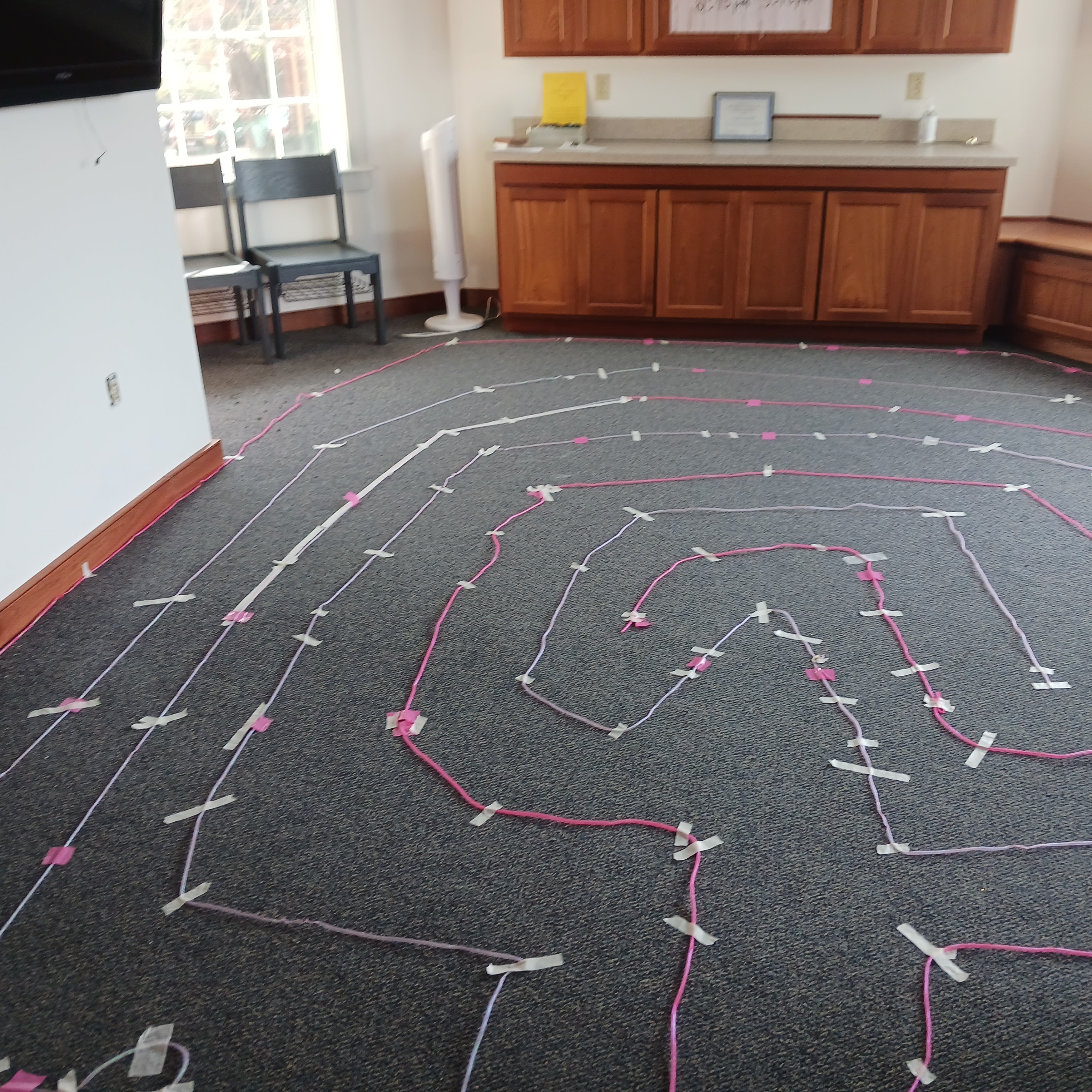
 A week ago, my sister came to my seminary apartment to pick me up to go to Williamsburg.  My mom was part of a planning team for the St. Stephens Lutheran Church women's retreat, and she invited us to attend.  She also invited me to offer a workshop on labyrinths.

St. Stephens doesn't have a labyrinth, so before the week-end, we brainstormed.  My mom reached out to nearby Episcopalians who have a canvas labyrinth.  It's 30 feet--30 feet--in diameter, so when we were together in February, we went around the church building measuring.  We determined that there was no indoor space for that canvas labyrinth.

Happily, I know how to lay out a labyrinth outline.  One could do this with rope or yarn, or even masking tape on a floor.  I got the labyrinth outline that we use for the Create in Me retreat:


My mom got some ropey nylon in two shades of pink at an after-Valentine's Day sale at the Dollar Store.  This labyrinth would be very hard for me to lay out without two shades of border, so I was glad to have it.

We spent about an hour on Friday laying out the labyrinth in a space off the narthex in the church.  We really could have used several more feet on the sides, but the space is bordered by a wall on one side and a window on another, so we had to work with what we had.  We scootched lines over and shifted, and soon enough, we were done:


The ropey nylon wanted to spring free of the tape, so we taped it more than we might have.  I didn't want to arrive on Saturday morning to have to lay it out again.

It wasn't a perfect labyrinth, but the people who came to my workshop were gracious about it.  They were grateful to have a way to try out this prayer practice (only 1/4 of the participants had ever walked one).


I did worry a bit that this experience, which was a bit too cramped and crowded to be truly meditative.  It wasn't the perfect first labyrinth walk, for those who had never tried it.  Happily, most people said that they saw the potential, and at the end of the workshop, they were strategizing about where to find a bigger labyrinth.

Thursday, February 16, 2023

Power and Paper Towels

In my Chapel Visuals class last week, we did an exercise which I haven't had a chance to record here yet.  So, let me do that today.

We arrived to class to see a table, a chair, and 6 rolls of paper towels in front of the classroom windows.  We were told to arrange the objects in a way that said "Power."  One person would make an arrangement, we'd ponder it in silence, and then another person would get up and do the same.  We went in no particular order; we got up as we were moved to do so.

The first arrangement was a stack of paper towels on the table followed by a variation or two.  When it was my turn, I decided to do something different, using the window ledge and latches:


With each turn, we did more and more to think about what we could do.  For example, one person put the chair on the table.  We were deep into the exercise when someone unrolled part of a paper towel roll.  Then I created the following tableau:


What you may not be able to see:  the roll of paper towels that looks like it's suspended in midair is being held by the sheet of paper towels tucked into and around the two upright rolls of paper towels.

I didn't want to take too many pictures--I thought my picture taking might change the dynamic, and I didn't want to risk that.  Also, some of what we did would have been hard to capture.  For example, at one point, I made a tower of paper towels, which I knocked over by holding a roll of paper towels like a bat and whacking the bottom of the tower. 

We then tried to process what we experienced by using "I see ____" "I feel ____" and "I think ____" statements.

I wanted to record this exercise because it seems like one that could lead to some interesting insights with a variety of groups.  Is it a team building exercise?  Perhaps, depending on the dynamics of the team.  Could it lead to interesting writing?  Perhaps.

I also like it because it uses fairly cheap supplies, and it could be tweaked in a variety of ways.  Perhaps we could explore something other than "power."  Perhaps we could work larger or smaller.  Perhaps we could use scraps of cloth and threads and a pine cone.  The possibilities seems endless!

Wednesday, February 1, 2023

Saint Brigid's Cross in Cloth

 In the past, I've felt sad as feast days come and go, and I have no time to do much more than a blog post (and often, it's a reposting of what I've done before).  If you were hoping for that kind of reading, head over to this blog post, where you can also enjoy a poem.

This year, as I thought about the feast day of Saint Brigid, I thought, I could make a woven cross.  Sure, I don't have reeds or rushes, but I have cloth.  I have so much cloth.  Just a year ago, I didn't have enough to even think about a small project, much less a bigger one.  But now I have enough cloth for several large projects and any small project I might want to do.  I used the directions here to walk me through it.

I cut 9 strips of cloth--in the end, I would need 12 strips.


I began weaving--so far, so good, although I did think that a stiffer reed or straw would make the weaving easy.


I was glad that I had the foresight to use pieces of cloth from across a wide range of colors:


Here's my finished project.  


And a close up of the middle of the cross, the knot, which is not nearly as tidy as it would be if I had used straw:


Now the question:  what to do with this cross?  I know that the traditional answer would be to hang it over a door, but to do that, I'll need to get something to stiffen the cloth:


I realize it's not over the door, but it's the only hook I had.

I am glad to have had this experience, although it took longer than I thought it would, about an hour from start to finish.  I tried to do it meditatively, giving thanks for women like Saint Brigid, who founded some of the first Christian monasteries in Ireland, most famously the legendary one in Kildare.  She also founded a school of art that focuses on metal working and illumination. 

Now let me go out for a walk.  We got our first dusting of snow last night, and it's beautiful to look at from inside.  Let me go get a closer look.

Thursday, January 26, 2023

Introductions: Asking Good Questions

My first week of seminary classes has come to a close, and I'm still inspired.  Hurrah!

As I think back over these classes, I think of the task of introducing ourselves.  In every class, we've done the basics:  name, type of degree we're pursuing, and where we are in relation to the end of our degree.  But we've also done more.  In one class, it's a fun fact or something unexpected.  In one class, it's why we signed up for that particular class.

In the second half of Church History, we had this additional prompt:  "First, in one sentence, what does the term or idea 'Protestant Reformation' mean to you? And second -- again, in a sentence -- when you hear the three-part tag or slogan Sola gratia, sola fide, sola scriptura ('By grace alone, by faith alone, by Scripture alone'), what does it mean to you?"

Here's how I answered that part:  "For years, 'Protestant Reformation' meant Luther and 1517, so imagine my surprise to discover that others had spearheaded other elements of reformation, although often with different motives (I'm thinking of Henry VIII, for example). When I hear the three-part tag or slogan Sola gratia, sola fide, sola scriptura ('By grace alone, by faith alone, by Scripture alone'), I think of all the ways that people have justified their departure from doctrine--or their adherence to doctrine."

In the class that takes a deep dive into the book of Luke, a class taught by Zoom (so we're all online but meeting at the same time), our teacher asked us to describe a class we'd like to teach.  I thought of a class that I did teach, my all-time favorite.  It was a creative writing class, but we did a number of other creative things too, processes that hopefully led us to the writing.  We collaged, we worked with watercolors, and now I can't remember the other activities.  It was great, and if I could teach those classes every term for the rest of my life, I'd be happy.

I like introductions that have us do more than tell our names and our student details.  I like getting to know a bit more about the people who will be my compatriots in the journey which is a seminary class.  Let me remember these techniques, since they'll be useful in more settings than just seminary class.

Friday, April 29, 2022

Prayers, Patterns, and Paper

 One of the great things about going to the Create in Me retreat is that I come home with all sorts of ideas. Let me record one of them here. This prayer practice would work well on one's own or in a group; we did it in a group.


We sat in groups of three or four around tables, and each table had a plastic bag with supplies: glue sticks, all sorts of papers (plain colors, pages from old hymn books, papers with patterns), and scissors. We also had larger squares of black paper on the table.


We were told to think about people, places, and situations in our lives in need of prayer. We were instructed to choose the three or four that most meeting and to pick a paper to represent that prayer. So, for example, If I choose my spouse, I might select a page from a paisley pattern, while the situation in Ukraine might call for a yellow piece of paper.


We were to choose a shape, and each prayer had the same shape. So my prayer for my spouse might be triangles, while my prayer for Ukraine might be squares. And then we set to work cutting the paper.


With my broken wrist, I could not cut, but I adapted. I tore some shapes, and then I realized they weren't all going to look the same, so I just didn't worry about trying to make them the same.


Once we had our shapes cut, we arranged them on the square of black paper and glued them; we were told to keep the center of the page uncovered. While we did the cutting and gluing process, we had music in the background; I believe I recognized George Winston. For me it helped me attain a meditative state, but I could see that working in silence might be good too.


When we were done, we put our prayers on the walls. We did this the first night, and it was good to move through the creativity retreat surrounded by prayers.


I like this activity because anyone can do it. I like thinking about prayers in a more tactile way. It's adaptable to those who can't cut or those who feel like they don't have an artistic bone in their body. It could lead to group discussion, but it doesn't have to. For those of us you need something to do as we settle into a meditative state, this practice could be a good one.