Saturday, May 31, 2025

The Feast Day of the Visitation in Sketches and Storytelling

Today is the feast day of the Visitation, the day when we celebrate the time that Mary, pregnant with Jesus, goes to visit her kinswoman Elizabeth, pregnant with John the Baptist.  Elizabeth's story, though rare, isn't completely original; scholars point out that the barren/old woman miraculously pregnant wouldn't be unfamiliar to ancient audiences.  Mary's story is much more unusual.  I've written about this feast day numerous times:  this post is a good example.

For my Biblical Storytelling class that I took in Fall of 2024, when I had to choose a passage to memorize to go with the first one I chose, the bleeding woman, I returned to Luke 1:  39-45.  I recorded it, and overall, I was pleased.  It won't win any awards, but that's fine.  You can view this effort here on my YouTube channel.


Lately I've started sketching this scene more.  I made the above and the below sketch as my Christmas and Easter seminary class discussed the passage.  


I decided not to write about the passage for my longer essay.  Instead, I wrote about Anna, the prophetess who gets much less space, but may be more important.  Here are two paragraphs that explain my approach:

"If we go back to take a closer look at Luke, we’ll see that older people and women have a starring role in many parts of the birth narrative. The main star, of course, is Mary, the woman who will incubate salvation in her womb and nurture the second part of the Trinity until he is able to move into the ministry activities for which he was born. Her story has been studied from many angles, and often it is the only one offered to those of us who want a vision of Jesus and the disciples that is more inclusive.

But what about women who aren’t young, women who don’t see the appeal in motherhood, women who don’t have a Joseph who will love them? Elizabeth might seem like an answer, but she, too, is finding fulfillment in a very patriarchal approved way, through pregnancy and motherhood. The story of Zechariah and Elizabeth (Luke 1: 5-25 and 39-80) might be the one most of us think of when we look for the presence of elders in the Nativity story or we might think of Simeon, a chapter later. Anna’s appearance, near the end of the second chapter of Luke, is much shorter, but also packed with meaning when we work on discerning the meaning of the incarnation."


Earlier this month, I started sketching, and I thought I'd do another sketch of Mary and Elizabeth.  But I didn't like the initial sketch, so I started rounding out the figures that began as the two women and ended up as chrysalises.  I love the sketch because it works on multiple levels.  The middle green part is both leaf and Holy Spirit.

It's not a traditional approach to the two women, but it's been one that has been delighting me, as I've worked on it during the month of May

Thursday, May 29, 2025

Feast Day of the Ascension

 Today is the Feast Day of the Ascension, 40 days after Easter, 10 days before Pentecost. This feast day commemorates Jesus being taken up into Heaven.


Imagine it from the eyes of those who have followed Christ from traipsing around Galilee, Crucifixion, and then Resurrection. You have just gotten your beloved Messiah returned to you, and then, poof, he's gone again. What a whipsawed feeling they must have had.

How do we celebrate this day, so many thousands of years later? Many churches have chosen to simply ignore it. We march on to Pentecost.

But let us take a minute to acknowledge the wonder of the Ascension. It's a fate reserved for very few in the Bible. And let us take a minute to think about Jesus, who has already suffered death, the fate which an ascension spared for the few others who experienced it.

Just like the first followers, just like Jesus, we don't get to stand around waiting for our chance to go to Heaven. There's work to be done on Earth. The coming Sundays of the Pentecost season remind us that we’re not put on Earth to wait to die. We are here to help God in the ultimate redemption of creation. Jesus began that work of that redemption. We are here to further it along, at least as much as we can during our very short time here.

And how do we do that? The possible answers to that question are as varied as humanity. Some of us will pray without ceasing. Some of us will fight for social justice. Some of us will create works (of art, of science, of theology, of gardens) that point others to God. Some of us will visit the lonely and the sick. Some of us will give away our money so that others have the resources to do the creation redeeming work that needs to be done.

Whatever we choose, it’s important that we get to work. We don’t want to get to the end of our time here, only to be asked, “Why did you stand there gaping, when there was so much work to do?”

For those of us who feel like we can't do much, consider this language from today's Gospel, the latter part of Luke 24:9: "so stay here in the city until you have been clothed with power from on high."

I love that language: clothed with power from on high--how would we behave if we truly believed we had been clothed with power from on high?

Pentecost will be here soon, the holiday that commemorates the first clothing with fire. But we've all been clothed in that way. We have all been clothed with power. Believe in that force--and then get to work in the claiming of creation.

Prayer for the Feast of the Ascension:

Ascending God, you understand our desire to escape our earthly bonds, to hover above it all, to head to Heaven now instead of later. Remind us of our earthly purpose. Reassure us that we have gifts and talents that are equal to the tasks that you need us to do. Help us close our gaping mouths and get to work.

Wednesday, May 28, 2025

Meditation on This Sunday's Gospel

The readings for Sunday, June 1, 2025:

First Reading: Acts 16:16-34

Psalm: Psalm 97

Second Reading: Revelation 22:12-14, 16-17, 20-21

Gospel: John 17:20-26

This Gospel always inspires Trinitarian thoughts when I read it: to whom does Jesus pray, when he prays? Why does Jesus have to pray, if we really believe in what we say we do, which is a Triune God? Is it a divine version of talking to oneself?

Archbishop Desmond Tutu recounts a story of asking the Dalai Lama about his prayer life. The Dalai Lama cracked a joke about talking to himself when he prays, since, of course, the Dalai Lama is the incarnation of the deity to Tibetan Buddhists.

Lately, I've been thinking about the prayer life of Christ, which we get a glimpse of in this Gospel. I find it deeply moving to think of Christ praying for me. I think of him praying for those that will come later (in our case, much later, 2000 years later) and want to weep in amazement. To the very end, Christ prays for his followers, for those that have been and those that will be. In these last prayers, he continues to focus on his central message of showing God's love to the world.

Christ also reminds God that he wants to share the glory that God has given him. He wants to give that glory to his followers. Think on that for a minute. What if you actually were capable of being like Jesus?

Many theologians would argue that we are, in fact, capable of being Christ like. If we but believe, anything Christ could do, we could do too. Of course, that would mean we'd have to shuck off the ideas of success, the way the world defines it. We'd have to give up our comfortable habits of anger, greed, meanness, looking out for our own skins. We'd have to practice radical love. The good news: the more we practice being Christlike vessels of radical love, the better we'll become at it.

There are many ways to be like Christ.  Some of them are hard, like giving away all that we own.  But many of them are easy.

Like Jesus, we are surrounded by people who are poor in spirit, people who are suffering terrible blows. You could be there for them. You could be the person in the office who always has a smile and a kind word and reassurance that all will be well and all manner of things will be well (to use mystic Julian of Norwich's words). You could sow the seeds of hope and help fight despair. You could be the person that makes people wonder and whisper, "I wonder what his secret is? What makes her so capable of being happy?" Maybe they'll ask and they'll really want to know, and you can talk about your faith. Maybe they'll just be drawn to you and hang out with you, and you can minister that way.

A smile is easy. Praying for the world, like Jesus does, is easy. And it's these little changes that lead to happier habits. Eventually, you've changed your trajectory and you didn't even realize it. Maybe you'll look back from a certain vantage point and say, "That was when I started to claim my glorious destiny. That's the starting point that led me on a road to be this close to the Christian God wants me to be." Begin today.

Monday, May 26, 2025

Recording of May 25, 2025 Sermon

I have posted my sermon for Sunday, May 25, 2025 on my YouTube channel; go here to view it.  If you'd like to read along, I posted the sermon manuscript in this blog post.

My writing process was stranger than usual this week.  When I sat down to write on Friday, I still had my colonoscopy on the brain.  I looked at the first verse of the Gospel reading, John 14: 23:  Jesus answered him, 'Those who love me will keep my word, and my Father will love them, and we will come to them and make our home with them.'"  

I know that the verse is sometimes interpreted "in them" not "with them," and I thought about God and Jesus making a home in my body.  I thought about my insides and what had been pouring out of me.  I thought about last week's reading from Acts, about pure and impure animals.

I created a very messy first draft, and decided that I just didn't want to do the revising it would take to make the various parts go together more smoothly.  Late Saturday afternoon, I started over.

I'm glad I did--yesterday's sermon was much stronger than the rough draft was ever likely to be.

Sunday, May 25, 2025

Sermon for May 25, 2025

May 25, 2025

By Kristin Berkey-Abbott


John 14:23-29


Christ is risen!


As I’ve been working on this sermon this week, I’ve been seeing people’s graduation and end of school year pictures. Our set of readings today gives me a similar kind of feeling.

When I listen to Jesus talking to the disciples, his speech sounds like some of the graduation speeches I’ve heard through the years. He’s telling the disciples that their time together is coming to an end—but it’s not the end of their education. No indeed. It’s just the beginning.

Jesus will not be their instructor in the next phase. The disciples still have much to learn. It will be the Holy Spirit who gives them the advanced lessons.

The Holy Spirit is an advocate, and those of us who teach, or who have had good teachers, know the role of an advocate. When I was interviewed for my current teaching job, I was asked to define good teaching. I said that the purpose of teaching was more than just delivering subject matter, but the real purpose of teaching was to make students know that they are more than their worst day, to remind them again and again of their potential. The best teaching reminds students of their better selves and what could be.

As I’ve thought about today’s Gospel text, I see the Holy Spirit as precisely this kind of Advocate. The Holy Spirit reminds us of all that Jesus has taught us and showed us and promised us. In this way, the Holy Spirit advocates for Jesus. But the Holy Spirit also advocates for us. The Holy Spirit has an imagination bigger than any individual can have. The Holy Spirit has a more expansive imagination than any group can have. The Holy Spirit knows that we are not the sum of our bad days. The Holy Spirit knows that we can be even better than our best days.

In the readings from Acts that we’ve had since Easter, we’ve seen what happens when the Holy Spirit empowers the disciples to claim a bolder vision. Last week Peter got instructions to include the Gentiles, and by following the teaching of the triune God, the inbreaking Kingdom of God spreads across the known land—and beyond. In today’s reading from Acts, we see Paul including women.

The cynical among us might say--but not just any woman. She’s a weaver of purple cloth, which tells us that she’s a woman of some wealth. But still, she’s a woman. The Holy Spirit comes to her and inspires her to be part of this brave new world. And again, the Kingdom of God comes breaking into the world in an interesting new way.

Our reading from Revelation shows us the ultimate end, what it will look like when God is finally done making all things new. We might wonder why it’s taking so long. We probably yearn for that time when there will be no more night. I know that 2025 has felt like a year when we have one long endless night of sliding into the abyss. I know how afraid we have been.

Let’s return to the words of Jesus. Jesus tells us not to let our hearts be troubled. Jesus is going on ahead of the disciples, but he’s giving them his peace. But more than that. Jesus gives us this intriguing picture of God and Jesus making a home with us, while the Advocate guides us towards this beautiful vision of a different world.

Yesterday we spent time with Carl’s brother, who is in the process of moving from Florida to South Carolina, and we spent time talking about his new neighborhood, along with old neighborhoods. After he left, I turned to other translations of today’s Gospel as I revised this sermon, and I was struck by the imagery of neighborhoods in the Message translation. Here’s the first verse of today’s Gospel in that translation: “’Because a loveless world,’ said Jesus, ‘is a sightless world. If anyone loves me, he will carefully keep my word and my Father will love him—we’ll move right into the neighborhood!’” It echoes the first chapter of John, all the way back to the beginning, John 1: 14: The Word became flesh and blood, and moved into the neighborhood.”

If we believed that God was living right next door, would it change our behavior? Would we be less afraid? Jesus paints a cozy picture, of God moving not into just our neighborhoods, but into our very bodies. Or maybe that’s because I often remember this text slightly differently: God making a home in us, not with us. I did look up the Greek, and I’m not sure that the English preposition of in us or with us really conveys the level of intimacy that I think the Greek conveys. The word in Greek has a generative quality or a quality of being joined together.

It's interesting to think of this concept as we get ready to celebrate both Pentecost and Trinity Sunday. Christians have spent a lot of time thinking about the three natures of God and what it means to have a God in three persons. But this passage speaks of something even more radical: a God joined to us, joined to our human bodies, our oh so frail and fragile human bodies.

I’m thinking of all the people who have ever asked me if I’ve invited Jesus into my heart to be my Lord and Savior, but I don’t think they truly thought that if I did so, Jesus would move into my literal heart and rearrange the space.

Just think for a minute how much easier life would be if we truly believed that God was with us: in our neighborhoods, in our very bodies. Here you might be hoping that I’m about to give you a cool trick that I learned in seminary for how to live that way, and trust me, if I had mastered this skill, I would share it with all of you.

Fear is part of the story of Jesus from the very beginning. The angels announce his coming and the first thing they say is “Fear not.” Jesus shows us ways to live in love, not in fear. Jesus doesn’t say that by following him we have nothing to fear ever again. The story of Jesus’ life reminds us that powerful forces can move against us, whether they be governments like Herod’s or Romes, or disease, or the ways that societal institutions are set up to make sure that humans do not flourish.

Jesus doesn’t say that we will never face those things—no, on the contrary, we will have our crosses to bear. But Jesus promises to be with us as we bear them. Jesus promises that the Triune God makes a home with us, to celebrate life’s sweetness and to help us navigate life’s set backs.

The Pentecost story shows us the power of acting out of love and not fear. Those earliest Christians demonstrate what can happen when a small group of people embody the teachings of Jesus and following the promptings of the Holy Spirit. Martin Luther too. We are part of that bold tradition. Jesus gives the disciples his peace and his assurance that they are never alone.

Here is one way to move through the fears we face. Remember the promise of Jesus, the promise that he literally breathes into them. Resurrect the pining for a better reality that the creator has placed in all of us. Recognize the promptings of the Holy Spirit and prepare to move with boldness into this next season.

Christ is risen!

Saturday, May 24, 2025

Fish Fries and Mission Questions

Yesterday afternoon we went over the mountain to Bristol, Tennessee for the last fish fry of the season as Faith Evangelical Lutheran Church.  It's one of the community events that the church does, usually 4 of them throughout the spring.  

It's an amazing deal.  Ten dollars per plate, which includes fried or baked fish, green beans, pierogi, mac and cheese, cole slaw, and a roll.  That ten dollars also includes a beverage and a vast array of desserts.  While most people don't treat the event as an all you can eat extravaganza, we do give seconds if asked.  The money raised goes local charities, primarily the food pantry.

It's not an evangelical event, not in the traditional way.  Most of the people who come to the event already have a home church.  Most of the people who come already know about the church.  It's a small community, so most of the people who come have a personal connection to those of us at the church preparing and serving the food.

In a variety of classes and workshops on mission, I've been told that an essential question for churches is this one:  would your larger community miss you if you were gone?  Does the larger community even know that you are here?

Long before Faith Lutheran starts to advertise, the phone calls come in January, phone calls asking when the first fish fry will be.  Our church raises not only money for the food bank, but members work there, distributing food to the community.  We don't do the kinds of things that other churches might do:  no one uses our building but us, for example.  We don't offer computer literacy lessons or other kinds of classes that community members might want.  We are far from the legislative places where big decisions are made--we won't be demonstrating as a single church.

I often think of what I might do if I was their full-time pastor.  I'm not convinced that the church can grow much in terms of gaining new members.  There might be more to do in terms of being an essential member of the community, in terms of networking.  But again, it's a small community, so it's likely already happening, although perhaps not in a way that mission experts would be able to quantify.

How many members, how many individuals impacted?  I am grateful that I don't have to think in terms of these numbers.   I can just show up to enjoy a great meal, exchange stories with people who come, and give thanks for a wonderful community.

Thursday, May 22, 2025

Graduation Good Wishes

As people have been responding to my graduation, I've been touched by the responses.  My mom brought a pile of happy graduation cards that people have sent to her.  Many of these cards are from people who have known me since birth and took time to write a personal note--what a gift.

I've had a Catholic friend who was once a priest tell me that he's looking forward to a day when he can have the eucharist that I will celebrate, when he can take the bread from my hand.  If we're being strict, that day is a long way off.  Lutherans and Catholics are not in formal communion with each other.  Pope Leo may change that.  Still, the comment meant a lot to me.

Similarly, my sister has said that if my church was nearby, she'd want me to be her pastor.  That comment means a lot to me.  We've experienced many lackluster pastors between us, so when she says she would love hearing my sermons each week, I know that she's not just giving me empty compliments.

I am also surprised by how many people watched the livestream of the graduation ceremony.  I've been to a lot of graduations, and I don't mind them.  Sometimes I even find them inspiring.  But I don't know that I'd tune in from a distance.  Maybe it's something I should think about in the future.

I also want to remember how much this has meant to me so that I can be the same sort of gift for others.  It's good to know that people are rooting for me.  I want to do the same for others going forward.

Wednesday, May 21, 2025

Thinking about CPE

This summer, starting June 9, I will be doing Clinical Pastoral Education at the Asheville VA Hospital.  It's another requirement on the path to ordination, and like so many of the requirements, I find myself with more paperwork to fill in.  Since it's the VA, there are some new elements.  I got an e-mail with instructions about how to log into the system so that I could fill in more paperwork.

When I was let go from my job in 2022, I did similar setting up to be able to get unemployment compensation.  There's a system, ID.me, that I used then and needed to use yesterday.  Happily, I still have the same cell phone number that I used then, and after a few glitches, I finally got logged in--only to discover that it transcribed only half my last name into the first form I needed to fill out.  So I clicked on the button to tell the VA about the mistake along with a photo of my driver's license to show my legal last name.  And now I wait to be able to continue with the forms.  Happily, there is time.

I don't know what to expect in terms of the weekly CPE schedule.  Will it be like a 9 to 5 job where I report to an office?  Will it be like a chaplain job where I spend time going to hospital rooms and talking to patients?  Will there be papers to write and/or debriefing sessions?  Will the schedule vary, with some overnight duties?

I don't know, so I haven't signed up for any volunteer duties at Lutheridge, and I'm trying to get some stuff done before CPE starts--some doctor visits (and a colonoscopy tomorrow), some sorting, some chores.

I also wonder if I'll have my own office.  Probably not.  Will I have a desk or a locker where I can keep things?  Will there be a place to heat up my beans and barley?  It's the meal that I take whenever I'm reporting to a place for a period of time that means I need to bring food to eat.  If I need to leave stuff locked in the car, I can do that.

When my parents were in town for the Lutheridge celebration in early May, we drove over to see the campus.  The Asheville VA Hospital looks lovely from the outside, more like a small college campus than a modern hospital.  The parking lots that stretched across the back of the property were mostly empty on a rainy Saturday afternoon, and I have no idea if they are ever filled.  Once they must have been.

I've been told that the Asheville VA Hospital is a great place to work and a great place to get care, and I hope that's true.  I've been told only good things about the CPE program there.  I'm looking forward to finding out more for myself.

Meditation on This Sunday's Gospel

The lessons for Sunday, May 25, 2025:

Acts 16:9-15

Psalm 67 (4)

Revelation 21:10, 22--22:5

John 14:23-29 or John 5:1-9


I find these post-Easter, pre-Ascension, pre-Pentecost lessons poignant. I feel this ache for both the disciples and Jesus. They've suffered an almost inconceivable trauma, a wrenching death--and now, some time for them to be together again, to have barbecues on the beach and a few last instructions. But Jesus must know that soon he'll be gone again. The older I get, the more this seems one of life's central lessons: our loved ones will soon enough be ripped away.

This Gospel lesson addresses that dilemma of being a biological being. Jesus promises us a Holy Spirit, a Counselor. He promises us His peace. He tells us that it is not peace as the world understands it, but a different kind of peace.

Of course, that's the central message of Christianity. The world offers us many false comforts. Feeling like someone's ripped a hole in your life? Buy more stuff. Feeling so rushed that you can't hear yourself think? All you need is a new cellphone that costs several hundred/thousand dollars to keep you more in touch. Hurry, hurry, busy, busy--all to keep earning money so that we can keep buying more stuff that doesn't fill our deep emptiness.

Christ came to show us the way to deal with the pain, loss, and emptiness of being human. Fix food for each other and then eat together. Again and again and again. Invite people who don't have enough food. Share our goods. Don't hoard our money for the future, but invest in community. Don't save up treasures on earth. Trust in God, who will not leave you orphaned and alone. Instead of hiding from pain, face the pain of our own lives and sit with the pain of others.

Jesus tells us plainly: "Let not your hearts be troubled, neither let them be afraid." That's a tough commandment for most of us these days. But Christ clearly tells us not to give in to our anxiety, to resist fear-based thinking, to cultivate a consciousness of abundance, instead of focusing on scarcity. There's enough for us all, and we will not be abandoned. Act like you believe Christ's words, and eventually you won't have to work so hard to believe it.

Jesus doesn't give us a view of a God who waves a magic wand to get rid of all our troubles. Jesus shows us a God that wants to be there with us, through all of life's events, both joyous and sad. Jesus shows us a God that will help us in our troubles if we ask, but not necessarily make them go away. Jesus shows us the idea of God as a partner, a partner with tremendous resources so that we need not be afraid or troubled.

Monday, May 19, 2025

Recording of May 18, 2025 Sermon

I have posted the recording of my sermon for May 18 on my YouTube channel; go here to view it.  If you want to read along, I posted a manuscript of the sermon, which you can read here.

Sunday, May 18, 2025

Sermon for May 18, 2025


May 18, 2025

By Kristin Berkey-Abbott


Gospel: John 13:31-35

---

May the words of my mouth and the meditation of my heart, be acceptable to you Oh Lord, my strength and my redeemer.


Christ is risen.

---

Those of us paying attention might wonder if we’ve got the correct Gospel—isn’t the love each other commandment the one we hear on Maundy Thursday, with the fancy Latin word maundatum, which means command, and why are we hearing it again today?


Those of us who have been parents, or teachers, or in relationships of any kind really—we know that repetition is needed.  This passage is indeed taken from the lesson that we heard on Maundy Thursday.  In the Gospel of John, Jesus washes the disciples’ feet after the meal, and then he goes back into teacher mode for several chapters.  It’s teacher at the end of the semester mode—it’s both an overview of the highlights of his teaching and a reinforcement of the most important concepts.


Many theologians see today’s Gospel as the key point of Jesus’ life, preaching, and ministry.  That’s not to say that we all agree on what Jesus meant.   I remember a church council meeting years ago at a Florida church where the paid music minister argued that we don’t need to do any community outreach or interfaith work because Jesus instructed only the original disciples to love each other, that Jesus only meant those original disciples, loving each other, not expanding the circle outward.


However, if we look at today’s passage from Acts, we see that the disciples came away from their discernment with a very different view.  In fact, if we go back and read the book of Acts in its entirety, we see this question consuming them—they’ve heard the good news, but now they need to answer the question, “Who is the good news for?”


Some of those earliest Christians say it’s for Jews.  Peter has this view at first too.  If Jesus is the Messiah and the completion of the covenant that God made generations ago, then the ministry of the disciples should be to the Jews.  Nobody else is eligible, unless they first become Jews—hence the focus on circumcision. 


In the early days of Christianity, followers of Jesus were seen as a sect of Judaism.  As such, they enjoyed the same protected class status as the Jews.  We don’t think of the time of Rome as being a time of religious freedom, but in some ways, for some Romans, it was.  If a religion had been around for centuries and didn’t threaten the empire politically, the Romans allowed the religion to continue.  Followers of the religion didn’t enjoy the same religious liberty as Romans did, but they had protections.  Romans like things that were old, and Judaism was old, older even than the Greek institutions that the Romans appropriated. 


So the decision to include Gentiles, and how they were included, had far reaching ramifications which may not be appreciated today.  If Christianity came to be seen as a new religion, they wouldn’t have protections; it could have meant a difference between life and death—and in fact, that is what happened.


It’s not a surprise that the disciples grapple with these ideas of inclusion and exclusion; the book of Acts is a remarkable insight into the process of how Christianity emerged in the earliest days.  In our current time, we see a similar conversation on a national level.  Who gets to count as a citizen?  Who gets protections and privileges?  Who can stay in the country?  Where can they stay?  Who gets to decide and whose argument makes sense?  To be fair, most groups of humans return to these questions again and again.  In a time of Lutheran Synod Assemblies heading into the Churchwide Assembly this summer, as a church we are likely going to be called to answer similar questions, which are really just one big question:  “How expansive do we believe God’s Good News can be?”  As we elect bishops on both the Southeast Synod level and the national level, I’ll be listening closely for clues as to how bishop candidates would answer this question—not that I, or most other people I know, have a vote on these decisions, but since we will be represented by these decisions, I’ll be paying attention.


When we look at God’s trajectory across the whole of the Bible, we see God becoming more and more expansive, becoming ever more available to all of humanity.  At first, God is available only to certain people and by certain ways, through certain kinds of sacrifice and access.  By the time Jesus arrives, we see Jesus wrestling with the question of his mission.  Is he here just for the Jewish people? 


Non-Jewish people come to him, hoping that his healing power will extend to them.  The Syro-Phoenician woman challenges his exclusive approach, and thereafter, we see Jesus in a more receptive and expansive mode.  The longest conversation that he has is with the Samaritan woman at the well, and as a result, the Good News of Jesus’ existence is spread beyond the immediate community.


We celebrate the Feast of Ascension this Thursday; imagine the quandary of the disciples.  What to do now?  You lose your savior, he rises from the dead, he’s taken up from you after giving you information about the Holy Spirit that you may not understand fully.  What to do next?  The book of Acts shows us the process of expansion of the mission field that Jesus began.  The Holy Spirit comes to the disciples and comes to Saul who will be called Paul, among others. God speaks to them all in yearnings and dreams and sometimes, with a direct voice.  Through these people, God’s good news travels all the way to the edges of the known world.


The book of Revelation, some of which we are reading each week in this time after Easter, shows the end game of our God, who is making all things new.  And yet, even in this vision of what God makes new, we have echoes of the old.  There’s a new Heaven and a new Earth.  Once again, God decides to come and dwell with mortals, as God has done from the beginning of time, when God went into the Garden to talk to Adam and Eve, as God did in the person of Jesus Christ, as God continues to do in the form of the Holy Spirit, moving into new neighborhoods to invite new populations into life abundant.


Jesus didn’t rise from the dead to return to life as it had been. Likewise, God invites us to unwind whatever grave clothes hold us in their smothering grasp—to love one another, but not to stop there.  Jesus calls us to expand our minds and hearts to the even more demanding mandatum, to love ALL as Christ loves us.  Martin Luther tells us that we are to fear and love God, to be of help and service to our neighbors, and in doing so, to be a model to them, and a help, by urging them to stay the course and fulfill their own responsibilities to loved ones and the larger community.


When I think of John of Patmos, in prison and writing his revelation, part of which we read today, I think of that new Heaven and new Earth that could be, as each one of us goes out to love as Jesus loved: friend, neighbor, and enemy alike.  We know how transformative this love can be—we saw it in the ancient world as the apostles created new communities close to home and across the globe.  Let us pray that we, too, can be part of this same transformation that is so needed today, our love this inspiring others to love similarly, the power of love rippling across the planet, transforming the world.

---

Christ is risen.


Saturday, May 17, 2025

Confirmation Class by Old-Fashioned U.S. Mail

I've been approaching Confirmation in a variety of ways.  The most traditional way has been the Sunday School format.  Decades ago, when I did Confirmation as a student, we had regular Sunday School class and then we met again for afternoon Confirmation class, followed by evening youth group.  Those days are not these days.

Even if the families were willing to return to church, we don't have that many youth for activities.  But I'm not living in the area, so even if the families were willing, I can't do it. I need to be back at my house in the NC mountains so that I can go to my teaching job in Spartanburg on Monday mornings.

I've also been hesitant to do a lot of Confirmation because I thought a new pastor might be coming soon, and I didn't want to overstep.  But now it's become clear that a new pastor isn't coming soon, so when we finished our study of the sacraments, I decided to move into a discussion of the creeds.  In the fall, if I'm still Synod Appointed Minister, we'll explore the 10 Commandments and then do a bit of Bible study in the spring.

I wasn't at church on May 11 because I was out of town for graduation.  But I wanted to give my students an assignment.  I decided to have the students mail them to me--a bonus, that I get mail, but also, they had additional incentive to do it.  

For our May 4 class, I gave them three sheets of paper and a stamped envelope addressed to me.  On one sheet of paper, I had them write God, on the second Jesus, and on the third, Holy Spirit.  I told them that the assignment was to draw or write or collage what they thought of when they heard these words and thought about these aspects of our Triune God.

I wasn't sure what to expect.  Would they even mail the envelopes to me?  I'm happy to report that they did.

I'm not going to post pictures because I said I wouldn't share their pictures.  But they are delightful, and they make me think that children in our churches are understanding far more than we might give them credit for.  And I want to remember that I, too, might be a more effective Confirmation teacher than I give myself credit for.

Wednesday, May 14, 2025

Meditation on This Sunday's Gospel


The readings for Sunday, May 18, 2025:

First Reading: Acts 11:1-18

Psalm: Psalm 148

Second Reading: Revelation 21:1-6

Gospel: John 13:31-35

When I was a child, I wished that my family was part of a more rigorous religion. I wanted to go to Confession every week. I wanted to do more penance than just saying I was sorry. I thought it would be neat to be a kosher Jew, with lots of laws to keep. The Lutheran concept of grace didn't thrill me very much. It just seemed so easy.

In today's Gospel, we get our marching orders: "I give you a new commandment, that you love one another. Just as I have loved you, you also should love one another. By this everyone will know that you are my disciples, if you have love for one another." (verses 34-35). When I was a child, I would have rolled my eyes and asked for a harder assignment.

Now that I am older, I think that loving each other is plenty hard enough. As a grown up, I think that following dietary laws would be an easier command. I think of all the other things Jesus could have required of us, and some part of me wishes for one of those.

Why is it so hard to love each other?  We don't want to get involved. We don't know what to say. We don't know how to act. So, we take the easier route and lose ourselves in our busy routines. We get so frantic with our schedules that we don't have time for ourselves, much less each other, much less God.

But Jesus tells us firmly that we are to love each other. He doesn't tell us how, but he shows us. This Gospel lesson comes after the washing of the disciples' feet and a leisurely dinner.

If we don't know how to love each other, we might start by sharing meals together. We have to eat, no matter how fast-paced our lives. Why not take some time to slow down as we nourish ourselves? Why not take some time to nourish ourselves in other ways? By sharing meals, we open up the door to love.

We might engage in other behaviors that open our hearts to love. We might try not saying negative things about each other. It's so easy to gossip. It's so easy to make ourselves feel good by pointing out the faults of others. But why do that? Why not focus on the good of our fellow travelers with us on our journeys?

Refusing to bash others verbally could be our modern equivalent of foot washing. We could show our care not by lavishing attention on physical bodies, but by lavishing our attention on the good qualities of others.

We live in a culture that prefers to argue, to fight, to tear down. Focusing on the good qualities of others seems as intimate in our current climate as foot washing must have seemed in the time of Jesus.

Of course, to focus on those good qualities, we have to get to know each other well enough to know what those good qualities are. Back to the dinner table!

I've only focused on two ways of loving each other; the ways to love are infinite. Choose the one that calls to you and decide that this will be your ministry. Know that you will have to gently refocus your efforts time and time again, as you move along. Fortify your efforts by asking God to help you, so that you can glorify God, so that everyone will know the God you serve by the efforts you make to serve others.

Tuesday, May 13, 2025

Graduation Recap

Yesterday at the end of graduation, I said to one of my professors that I didn't think I would have many more experiences that were that meaningful in my remaining years on the earth.  My professor started to protest, and then we looked at each other, and she said, "You're probably right."  A graduation ceremony in the national cathedral, a graduation where we were lifted up and affirmed before being sent out into the world to do the work we're called to do--no, it won't get much better than that.

I knew that my graduation would be livestreamed, and I hoped that it would be available as a recording too.  Hurrah--it is!  You can view it here, and be sure to watch the benediction at the end, at hour 1, minute 58.  It was the most passionate benediction that I've ever seen, and I felt so blessed--not in the "Have a blessed day" kind of blessed, but the "I am casting a spell of protection over you as I give you your marching orders" kind of blessed.

We got to the cathedral in plenty of time, and there were still parking places left in the parking garage.  I took leave of my family to go wait in the Joseph of Arimathea chapel.  We stood in alphabetical order and waited and waited for it to be time to walk to the back of the cathedral.  


It was great to have that downtime before graduation, a chance to chat with my fellow students.  I reconnected with a student who invited me to go to a Carolyn Forche reading with her in the spring of 2023 (I wrote this blog post about it).  We talked about how rewarding it had been to be in classes, instead of learning on our own.  Before I went to seminary, I wondered if I couldn't just accomplish a similar amount of learning if I bought a lot of books and read them.  Perhaps I could have come up with something similar, but I wouldn't have been able to replicate the insights that came from professors and fellow students.

At first my heart fell a bit when I saw the program; it shouldn't come as a surprise when a seminary graduation is more like a worship service.  I was happy that all of the presentations and acceptance speeches and the main speech were so compelling.  More than once I reflected on how grateful I am to have been part of a seminary that is so committed to social justice, to diversity, to acceptance, to being a faithful and powerful witness in the heart of the nation's capital.

Soon it was time to get our diplomas.  We went to wait our turn, and then, suddenly, there's my name being called, and I made my way across the platform.  We got our actual diplomas, and I was happy that my name was correct--no reason that it shouldn't be, but it's more common that some part of my name is misspelled than that various entities get it right.


We got our fiery benediction, and off we went, out into the cloudy afternoon.  I was grateful that the rain held off, grateful that I was able to find my family, and so, so grateful that I was in a space where I could be fully present.  I didn't have a boss who told me that I couldn't go or who said that I needed to check in.  All of my jobs have been at a stopping point, a serendipity that I couldn't have engineered any more perfectly.


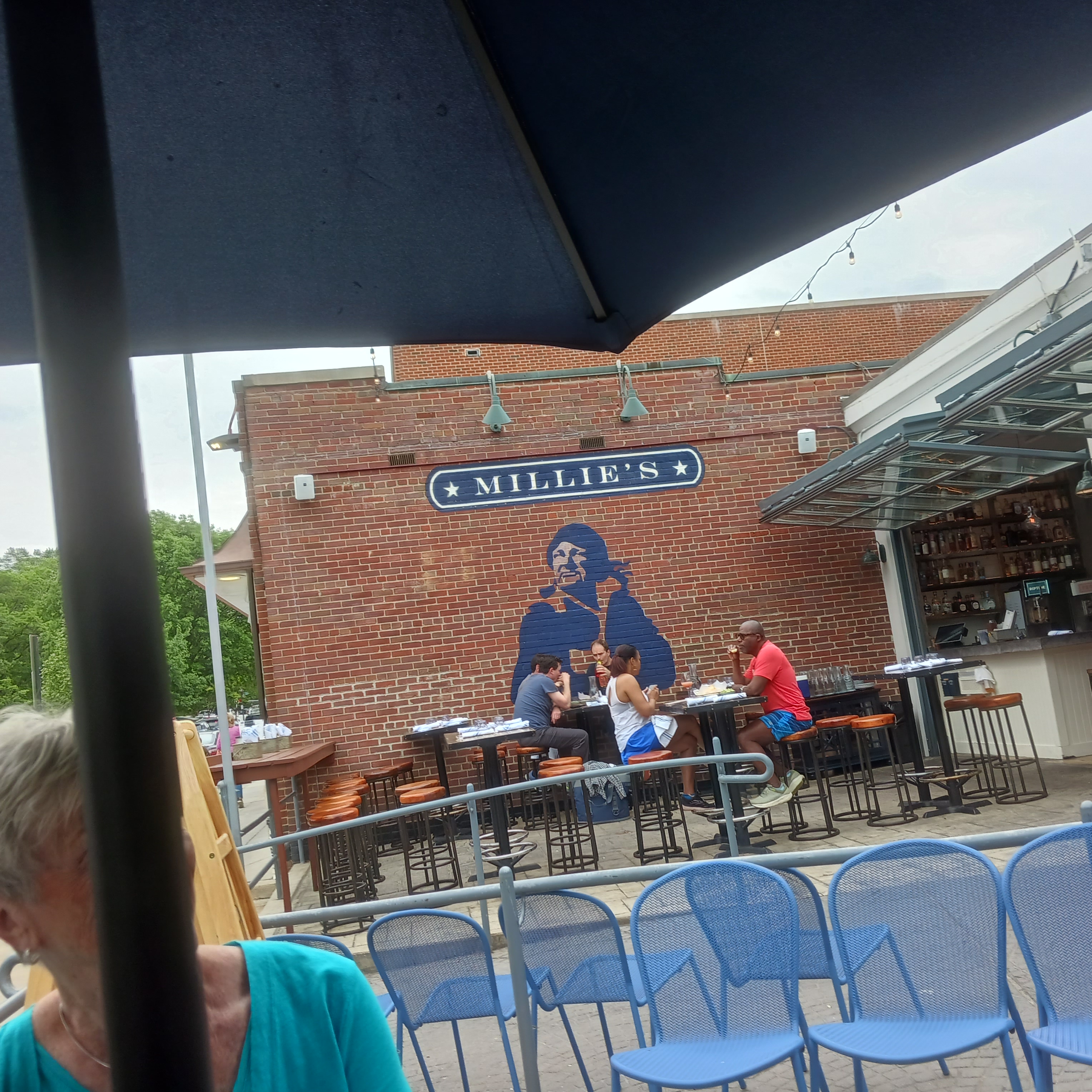
We ate dinner at Millie's, which had a synchronicity that delighted me.  During my first walk as a seminary resident, I discovered Millie's and came back for an ice cream--that became my occasional treat.  My sister and I ate there a few times.  The first time I had the steak salad, it was amazing.  It hasn't been that wonderful since, but I was happy to have it one last time with my family:  salads and wine and a dessert that a fellow student had sent to us.  What an expansive generosity yesterday we experienced yesterday!

At the end of the day, my spouse gave me a gift that he picked out at the cathedral gift shop:  beautiful blue prayer beads on a bracelet, with a charm that contains a small bit of paper with a Bible verse that reminds me not to worry.  I think of how many worries I've had about seminary:  could I do the work, would I have enough internet bandwidth, could I maintain all the kinds of balance I want to maintain?

I am glad to have the answers to those questions.


I am happy to have this diploma, this degree completed.

Monday, May 12, 2025

Graduation Morning

 It is graduation morning, a day which may have seemed improbable years ago, before Covid, before seminaries started experimenting with distance learning, before higher education began its long and then sudden decline, before, before, before.

I have earned an MDiv from Wesley Theological Seminary, and later today, I'll participate in the graduation ceremony that happens in the National Cathedral.  It starts at 2, and you could watch from a distance by way of this livestream link:  https://youtube.com/live/hAGLcoosBYo?feature=share

I am not sure what to expect, beyond the usual:  lots of folks in caps and gowns, walking across some sort of stage to get a diploma.  I have participated in many graduations, but rarely as the one getting the diploma.

I have sensible shoes, and I'll wear the olive skirt with the pockets, not the black but pocketless skirt that would blend with the gown better.  I am not nervous about the graduation ceremony.  I'm not speaking, after all.  My family will park the car, and I'm hoping we'll be early enough that they can get a space in the parking garage.

Because the Eucharist ceremony was on Thursday, we've spent several days here in the DC area, days with family members, precious time.  Some of us have been in a local hotel, sharing space with lots and lots of soccer players who are in town for various championship games.  This morning, I'm hearing sniffling and sneezing and hoping it's just allergies.  I have avoided airline flights for a variety of reasons, but belatedly, I'm thinking about the risks of crowded hotels.  We haven't lingered in common spaces or crowded spaces, so hopefully we'll be O.K.

I'm thinking about the last time I stayed in this hotel, back in October for the onground intensive week.  At that time, it seemed more populated by business travelers.  I remember feeling so exhausted, not just from the intensive work, but also from the cumulative fatigue that comes from having a natural disaster fall on one's head.

It's good to remember that it hasn't all been easy. I still feel a bit weird, like people are making too much fuss over me.  After all, I've enjoyed my classes and most of the work felt like it came naturally to me.  But as I think about this 4 year journey, I am reminded of all the ways it has taken perseverance.  It's good to celebrate these milestones.

Sunday, May 11, 2025

Thinking about Anna the Prophetess on Mother's Day

It's interesting to arrive at Mother's Day after I've spent time this semester thinking about the depictions of women in the birth narratives of Jesus.  I took a seminary class on Christmas and Easter, and I knew I would need to write a paper.  I thought about Elizabeth, who has been interesting to me for years, as I got older, and I started to realize how few older women are in the narratives of Jesus and how rarely we focus on older people at all.

So, I decided to write about Anna.  Here's what I wrote in part of my final project:

When I think of Anna, I compare her to Elizabeth, who is also very old. For many years, I looked to Elizabeth as a model of a way to be a post-menopausal woman in society. As you know, I think that the Church needs to do more to minister to the spiritual needs of people at midlife, particularly at the far side of midlife, the side that is closer to old age than adolescence. In some ways, Elizabeth is a great example. Finally her deferred dreams come true—how glorious! 

But her story offers a particularly patriarchal fulfillment, in the form of a baby. I do understand the kind of currency that a baby represents in the first century. But it is a vision of wish fulfillment that may not speak to twenty-first century Christians of any gender or age, particularly for those of us who are older. If offered a baby in my old age, a baby that I had to grow in my previously empty womb, I would say no thank you.

----

Back to me, writing this blog post.  It seems strange to be sounding anti-mother, on this Mother's Day.  We'll likely hear/read lots of rah-rah posts/sermons/articles on mothers today, and I have nothing against that.  I also suspect we'll hear lots of folks reminding us of how painful the topic of motherhood is and reminding us how many people around us might have tried to have children without success and might have been silent about the subject.  We'll also see/hear plenty about how so many of us nurture, even without biological connection.

But there are plenty of women who don't have much connection with this nurturing angle.  And there are plenty of men who might wonder why we're still so gendered when it comes to this subject.

Let me finish with the conclusion to my seminary project.  It seems a good way of thinking about all these angles:

As you can see, Anna’s story is full of important reminders for us today. If we’re feeling old and washed up, God still has a place for us. If we’re feeling young and insignificant, God has opportunities that the rest of our culture may not offer. No matter how many ways we feel barren, new growth is possible. God’s good news is more inclusive than we dared imagine. And we are at a hinge point of history where it is more important than ever to deliver that good news to a world that is so hungry to hear it.

Friday, May 9, 2025

Prayers of Blessing at a Seminary Eucharist Service

Yesterday was an even more interesting juxtaposition of events than I thought that we would have when I first wrote a blog post in the morning.  In the morning, I learned of the death of Martha Silano.  In a way, it wasn't a surprise.  I knew of her ALS diagnosis, and her latest poems showed how quickly the disease was progressing.  Here is her May 3 Facebook post:  “If I could eat just one sliver of Genoa salami … and maybe a bite of crispy bagel …. I’d give back every poem I’ve ever written.”

Those words have haunted/inspired me in the days since, the idea that we never know when the things we enjoy might become unavailable to us, because of disease or the forces of history or the lack of time or tariffs or any other reason we want to plug in.  I think of all the times when I've been worried about something (weight gain or would I have enough money to pay the bills or would a teaching schedule come through or why did someone wrinkle their face a weird way which might mean that they are annoyed with me) when I should have been cherishing the moment in a different way, a savoring the richness way.

I thought of Martha Silano at lunch.  My mom, dad, spouse, and I had gone up to Fredericksburg, MD, and we ate at The Wine Kitchen.  It was the perfect day to enjoy their patio seating that overlooked the Carroll Creek, which had a vibe that was both commercial and natural; the weather was perfect with a light breeze, and it was shady.  They had a lunch special that included a glass of wine.  I had the glass of wine for many reasons:  because it went so well with the mushroom strudel, because it was a good deal, because it was part of a perfect lunch.  In my head, I made a toast to Martha Silano and all the wise ones who have reminded me that we need to enjoy life as we can, in all the ways that we can.

During the afternoon, we found out that we have a new pope.  There was some time in the afternoon between lunch and leaving for seminary for the Eucharist service, and I did some reading.  Pope Leo seems like an interesting choice (a Chicago native who spent so many years in Peru that he became a naturalized citizen of Peru).

And then we headed down to D.C.  We left early, because one can never be sure about rush hour traffic.  We got there a bit early, but that was good, because I could get the tickets my family will need to get into the graduation ceremony.  There was a moment when the person in charge of tickets looked at the list, and I felt this fear that maybe I wasn't on the list, that maybe there was some requirement I had forgotten.  Happily, that fear was ungrounded.  I got the tickets, and we went to the chapel.

It was wonderful to sit in the chapel, being surrounded by classmates and family members.  I was touched by how many people remembered me from my brief time living on campus; a few people could still call me by name.  The Eucharist service included a blessing of graduates-to-be by individual faculty members.  We waited in a line, and as each person was free, we processed to them.  I felt lucky to be blessed and prayed over by a faculty member whom I liked:  I took both her Ethics class and her Stories of Power class.  Some of the faculty members I didn't know, and I wondered how that prayer would have been--much more generic, I imagine.

My prayer/blessing included mention of me as a Literature professor, as someone who inspires good in the world, as someone who is both confident but with humility.  I found myself wishing I could have recorded it in some way.

But then I thought about how much I have recorded, which often means I'm not truly in the moment.  I tried to concentrate on staying present and tried not to think about how much concentration it takes to stay present with the moment.

There was a reception afterwards, with heavy appetizers, which made our evening meal.  We ended with a glass of wine each back at the hotel, a wonderful end to a wonderful day.

We live in a time where everyone uses the word "blessed" so much that it seems stripped of meaning:  "How are you today?"  "Blessed"--or "Have a blessed day."  But I really do feel blessed, along with the guilt that comes along with that.  Why do I get to enjoy a day like yesterday when a talented poet like Martha Silano does not get a longer time on the earth?  Even theological thinkers have some trouble with that question.

In the end, let me just remember that if we're lucky, we have good days, and the good days aren't a sure thing.  Let me remember to live with intention, to seek out the good days, to arrange my life so that good days are more likely. 

Thursday, May 8, 2025

Contemplating Julian of Norwich During Graduation Week

Today is the feast day of Julian of Norwich, at least for Lutherans, Episcopalians, and Anglicans; Catholics will celebrate on May 13. Tonight I will go back to my seminary campus for the Eucharist service for students who are graduating with their Masters degrees, and there's a dinner and reception afterward.  How wonderful to be celebrated this way!

And how different from how Julian of Norwich has been celebrated, or ignored, through the centuries.  She was alive from roughly 1343 to 1416, a tumultuous time with the Black Death making its first appearance in England and a revolt of peasants that spread across the country.  She lived in Norwich, which was a center of commerce and a center of religion.  

I've been interested in Julian of Norwich for a long time.  When I first started teaching the British Literature survey class in 1992, the Norton Anthology had just added her to the text used in so many survey classes.  Why had I not heard of her before?  After all, she was the first woman writing in English, at least the first one whose writing we still have.

My students and I found her writing strange, and I found her ideas compelling.  She had a series of visions, which she wrote down, and spent her life elaborating upon. She wrote about Christ as a mother--what a bold move! After all, Christ is the only one of the Trinity with a definite gender. She also stressed God is both mother and father. Here in the 21st century, we're still arguing about gender and Julian of Norwich explodes the gender binary and gives us a vision of God the Mother, God the Wife--and it's not the Virgin Mary, whom she also sees in her visions.

Her visions showed her that God is love and compassion, an important message during the time of the Black Death.  She is probably most famous for this quote, "All shall be well, and all shall be well, and all manner of things shall be well," which she claimed that God said to her. It certainly sounds like the God that I know too.

Although she was a medieval mystic, her work seems fresh and current, even these many centuries later. How many writers can make such a claim?

A few years ago, I read her complete works, which I didn't enjoy as much as I thought I would.  The writing seemed circular, coming back to many ideas again and again, with lots of emphasis on the crucified, bleeding Jesus, lots of focus on suffering and sin. The excerpts that most of us read, if we read her at all, are plenty good enough.  I was both disappointed to discover that, and yet happy.

Not for the first time, I wonder what's been lost to history in terms of writing. If she was thinking about some of these explosive ideas, might others have been even more radical? What happened to them?

I'm grateful that we have her work--at least there's something that gives us a window into the medieval mind, which was more expansive than we usually give credit for.  And I'm grateful that so many people have discovered her in the decades since the Norton Anthology first included her.

I'll keep her in mind today, as I participate in ancient rituals, like Communion, that she, too, celebrated.  I'll keep her in mind as I discern next steps on the path.  My path would seem as strange to her as hers does to me--although I will confess that the cell of an anchoress/anchorite is appealing on some days.  I love the idea of ancient church rites and rituals that connect us across centuries--may they continue!

Wednesday, May 7, 2025

Getting Ready for Graduation

Part of what I will do during this brief May break is going to various doctors.  Nothing is wrong, but I am at that time of life where preventative maintenance takes more time.  Specifically, I have my first colonoscopy two weeks from now.


Yesterday I went to an ENT.  I've had various doctors look at my left ear, and the audiologist referred me to the ENT because she wasn't comfortable with the amount of hard wax that was in my left ear.  I made the appointment and then got very intentional about using the earwax softening drops every night.  Happily, it worked.  The ENT was able to get the impacted wax out with injections of warm water, which was unpleasant but not as painful as scraping would be.

Still, it all left me a bit sore and unsettled, which was not a surprise, which was why I postponed this appointment until the week when I didn't have teaching or seminary classes to take.  I spent much of yesterday afternoon sitting and sewing and waiting for the aspirin to take effect.  In the evening, I packed a bit for the upcoming graduation festivities.

I feel a bit strange, doing all the graduation festivities.  But I've always done them.  It feels important to mark the time that way.  It feels a bit self-indulgent, although I remind myself that no one has to come see me.  And it's not like I have to take time off work to do all the graduation festivities.  

Life reminds me over and over again that I may think I have lots of chances to travel, to be with loved ones, to do out of the ordinary activities--but that's getting less and less true, as I get older.  

Plus, this graduation is in the National Cathedral--this graduation will likely be the only one I've ever had in the National Cathedral. 

Tuesday, May 6, 2025

Meditation on This Sunday's Gospel

The readings for Sunday, May 11, 2025:

First Reading: Acts 9:36-43

Psalm: Psalm 23

Second Reading: Revelation 7:9-17

Gospel: John 10:22-30

This week's Gospel reading takes us back to the metaphor of the sheep. Those of us living post-agricultural lives probably don't know how stupid sheep are. The idea that we are sheep is not attractive. And yet we have a shepherd who loves us and calls to us, no matter how many times we wander away and get into scrapes.

What would a more modern metaphor be? That of the clueless student, who nonetheless can respond to a specific voice? That of a computer that is just a dumb box of electronics until the right programmer comes along? The electrical circuits that are mute until electricity flows from the power plant?

We might also ponder the nature of the questioners in this passage. They say to Jesus, "If you're the Messiah, we wish that you would just say so."

This moment must be one of those that would drive Jesus to thoughts of taking up a really bad habit to deal with the pain of these people who just don't get it. Jesus must have considered just giving up on the whole salvation project since he was undergoing so much to save such clueless people. How many more ways did he have to say/demonstrate/show that he was the Messiah before people could understand?

Before we spend too much time congratulating ourselves for recognizing the voice of our shepherd, we might consider all the ways that Christ calls to us and we refuse to hear. Christ tells us to give away our wealth, and we rationalize: surely he didn't mean all of it. Jesus tells us to care for the sick, and we do a good job of that, some of us, as long as we liked the sick person back when that person was well. Jesus tells us to visit those in prison. I haven't done that--have you? In short, Jesus tells us to care for the poor and oppressed and to work for a more just society. How many of us do that?

This idea that we should focus on the poor and the oppressed is revolutionary.  Jesus knows that if we do that, we can change the world.  But even if that change takes awhile (and it does), in the process, we change ourselves in essential ways.

Jesus reminds us again and again that we're not just doing charity work, but we're also trying to create a more just world.  We don't share our food just to fill the hungry stomachs, although that's important.  We should also work to transform the social structure that keeps people hungry.

We have many opportunities to work for justice. Most of us don't because we lead lives that leave us tired. But often, a group that works for good in the world can energize us. Find a group that works to alleviate a social injustice that particularly pains you and join it. Write letters to your elected officials. Help build a Habitat house. At the very least, you can give food (real food, not just the castaways from your pantry) to a food bank. At the very least, you can clean out your closets and give your perfectly good clothes to the poor.

In this way, we can help God, who is making a new creation. In this way, we respond to the call of our shepherd.

Monday, May 5, 2025

Recording of May 4, 2025 Sermon

The recording of my sermon for Sunday, May 4, can be viewed here, on my YouTube channel.  If you want to read along,  my sermon manuscript is in this blog post.

I was pleased with how the sermon went, how I didn't need to refer to my manuscript very often.  I liked my energy and the energy from the congregation.  It was a good morning.

Sunday, May 4, 2025

Sermon for Sunday, May 4, 2026

 May 4, 2025

By Kristin Berkey-Abbott


Gospel: John 21:1-19


I was going to write a different sermon.  I had it planned out in my head.  It was going to be about the disciples not knowing what to do with all they had seen, so they go back to the life they had known before, their pre-Jesus life, their fishing life.  I thought that the previous chapter of John was vague enough about which disciples had seen the risen Lord that maybe they don’t even know about the Resurrection yet.


And then I went to seminary class on Thursday night, my very last seminary class, where we studied the Resurrection narrative in the book of John, which includes this chapter.  My seminary professor mentioned that this is the first time in the book of John that the disciples fish.  Sure, they are still from Galilee, a fishing culture to be sure, but the depictions of the disciples as fisherman come from other Gospels.


I knew that John had been written last of all the Gospels, so I asked if the writer of John knew of those Gospels.  My professor said that scholars have a 50/50 split—50%of them think that the writer did know, and 50 think not.  And it’s been this way since we’ve had the Gospel of John, unlike other Gospels, where our thinking about them may have changed radically along the way.


And when John mentions “the disciples,” the way that he does in the previous passage of John, the one we heard last week when the resurrected Jesus appears to the disciples in the locked room, the writer of John usually means all the 12 disciples, and probably more.  In today’s reading, it’s only 7 of them, and they’re named.


So, back to today’s passage and the strange response to the resurrected Jesus which happened in the previous chapter.  Instead of focusing on why Peter decides to go fishing, and I don’t really have the answer for that, let’s focus on the ways this passage feels familiar.  We know that the Gospel of John was written last, and there’s never been a manuscript of John without this last chapter—so the writer intended it to be there.  We also know that several hundred years later, when church fathers decided which books would become the Bible, they chose only these 4 Gospels, and they decided to put John last.  Modern readers and believers might be frustrated at all the ways the Gospel writers create stories about Jesus that don’t always agree with each other.  The early Church fathers chose these four Gospels because of how they work together to give us a more complete picture, not because they are the four that are the most accurate.


This last chapter of John feels like a fitting conclusion to all 4 Gospels.  There’s the fishing, which ties the book of John to the earlier Gospels and connects us to the idea of the new mission of these disciples, to go and fish for people.  They are fishing on the Sea of Tiberias, which is really the Sea of Galilee, renamed when a Roman ruler wanted to feel important.  The shadow of empire is long, even in this post-resurrection world.


The men have fished all night and caught nothing—another familiar element, another tie to earlier Gospels.  Jesus tells them to try again, and now they have so many fish that they can’t haul the nets into the boat—they have to drag it to shore behind the boat.  In some ways, it’s a foreshadowing of what Jesus says will happen to Peter when he’s older and will need to be led.


This abundance of nets full of fish that will be used for food—that’s a reference back to an earlier abundance, the feeding of the 5000 in the sixth chapter of John, which also happened by the Sea of Tiberias.  Over and over again, Jesus shows us the contrast between God’s power and the power of earthly empires.  An earthly ruler renames the Sea of Galilee after himself and raises the taxes so high that most people can barely survive.  And what does Tiberias do with the money?  Beautify the royal palace, of course.


Jesus, on the other hand, offers miraculous provision:  more fish and bread than we can eat, and basket after basket of left overs.  Jesus shows us who has the power to provide, and it’s not the earthly empires that demand our allegiance.


It is this abundance that enables the men to recognize Jesus, and even though they are only 100 yards from shore, less than a tenth of a mile, Peter cannot wait—he jumps in the water and swims ahead.  Jesus has cooked them breakfast


Jesus has been cooking breakfast over a charcoal fire—the only other time we see a charcoal fire in the book of John is when Peter betrays Jesus, saying not once but three times that he doesn’t know Jesus, as the people try to warm themselves beside a charcoal fire and determine if a traitor is among them.


Jesus gives Peter another chance to answer questions—three times, Peter has a choice to decide on his allegiance.  In much less scary circumstances, Peter has a chance to claim Jesus—and this time, he does.  It’s a powerful lesson for Peter, and a powerful lesson for us.  Here once again, as with Thomas last week, Jesus meets a disciple where he is.


Notice this final lesson in the book of John.  Jesus leaves the tomb and doesn’t look back.  Still bearing the physical wounds of betrayal, Jesus goes back to his friends.  He wants to share a meal, and that’s what he does.  I imagine it’s what we’d like to do with all the loved ones we have lost.


You might be looking at that rather ominous part of the message, about being led where we do not want to go.  The Resurrection message can be lost in the magic of the chance to have a meal again.  Post-resurrection life is not a return to the old life, even if it does have some of the markers of the old life:  a meal of fish and bread, a command to care for others similarly, an abundance that earthly powers cannot match.  It’s one of the central mysteries of our faith:  through Jesus, the powers of death are defeated, but for much of our lives, it very much appears that they are still in control, as we succumb to doubt and perhaps denial.


But rest assured, by the Sea of Tiberias, and forward through human history, the story of Jesus is one not of reversal of power, but of a redefinition of power.  Jesus shows us what is important in the breaking of the bread, the drinking of the wine, in all that those acts mean.  From the beginning of his ministry to the last meal on the beach, Jesus commands us to love God and love each other, and Jesus shows us what that love looks like.  Jesus shows us a quality of mercy and models that mercy for us—we can forgive each other the way that Jesus forgives Peter.  Jesus shows us how to feed each other physically and spiritually. 


We live in a world where Powers and Principalities don’t feed us, but instead try to train us to fight over the scraps left over from imperial rulers who don’t have our best interests at heart.  Jesus shows us that another world is possible, a world of abundance for all, not just for the ones at the top.  Let us show the same enthusiasm as Peter, diving into the water, an all-in response to our savior who waits on the beach, cooking us breakfast, offering forgiveness again and again. Let us cast down our nets again, even if we’re sure that it’s a pointless endeavor.  Let us recognize the abundance God offers, nets full to the point of breaking, breakfast waiting on the shore, sustenance for us all.

Friday, May 2, 2025

Last Seminary Paper Submitted

Last night, after my final seminary class session, I turned in my final seminary paper.  It was about recovering the voice of the prophet Anna, who we meet for 3 verses in the second chapter of Luke (36-38) after Simeon has hogged the spotlight.  We don't get Anna's words, but we do get her actions:  she sees Jesus and goes out to tell everyone the Messiah has come, which makes her the first evangelist after the birth of Jesus.  Thirty some odd years later, Mary Magdalene will also testify, but Anna is first.

It was a fun paper to write for a cool assignment.  In the first part of the assignment, 8-10 pages, we were to write an academic essay that looked in depth at the text that we chose, mostly exploring what others have said about the passage, and in the last part of the assignment, we had much more leverage to be creative:  we could write a sermon or a skit or an outline of something longer, but we had to explain the relevance of the material to a modern listener.

Much of the week, I've been focused on this assignment, but every so often, I let myself think about the whole seminary process, and what all has changed since I first explored the Wesley website, in February of 2021.  In a way, I'm very lucky:  the website described the seminary as it was before Covid.  Even now, as I look at the website, I see pictures of the largest lecture rooms on campus full of people.  When I was there, taking classes in person, we were able to space out across the room, and I was glad.  But the lower in-person attendance did mean that many of the campus opportunities described, like food service, no longer existed.

When I first applied to seminary, the school where I had my full-time job had been sold, but we weren't sure about the implications.  For a time, the new owners talked about consolidating, then they expanded, then they closed most of the campuses, then they closed them all.  I'm glad that I didn't count on them for future income.  I've never regretted leaving academic administration; I was always wanting to protect the interests of faculty and students, and people higher up wanted me to figure out how the school could make more money (they hired me, a PhD in English, and wondered why I couldn't figure out how to transform a campus into a money-making machine).

When I first applied to seminary, we had a house with a mortgage in a flood zone, less than a mile from the Atlantic Ocean.  In between then and now, we moved to a condo in downtown Hollywood, which we only lived in for 10 months before buying the house we own outright now, in the mountains of North Carolina.  We also moved some of our stuff to a seminary apartment, which I only lived in for 9 months.  It seemed certain that the building would be bulldozed to make room for a brand new building, but that hasn't happened yet.  I have no regrets about making the decision to move back to North Carolina.  I've been able to take the classes I need in the modality I need.

I do feel lucky that I got to experience seminary classes in a wide variety of modalities--and such a wide variety of classes.  I've taken art classes where I got to work in mediums that were new to me.  I've taken theology classes and Bible classes and preaching classes.  I've taken classes that didn't fit neatly into the subject matter.  I've had amazing professors who have astonishing credentials.

We've weathered a variety of disasters.  One was a disaster in the traditional definition of that term:  Hurricane Helene.  I expected that a hurricane might disrupt seminary when I lived in South Florida, but not in North Carolina.  The extent of the devastation still shocks me.  I broke my wrist, which was a survivable disaster, but it did require surgery (three years ago, on this very day), and it did complicate the end of my second semester (thank goodness for talk-to-text technology) and made the move to North Carolina harder than it had to be, since I couldn't pick up anything at all.  My husband's brother died suddenly, just six weeks after graduating from seminary himself.  I've spent my seminary years worrying that one of our parents would die, but I didn't expect a younger member of the family to drop dead.

My job trajectories have surprised me.  When I did all the pre-candidacy interviews, at the point after I described my job history, more than one person mentioned how my face lit up when I talked about teaching.  And here I am, teaching full-time in a face to face modality again.  When I first applied to seminary, I had never heard of Spartanburg Methodist College.  Now I don't understand why more people haven't heard of it:  it's a solid school with an amazing scholarship program. 

I've also had the opportunity to serve as a part-time Synod Appointed Minister, which has given me a lot of the joys of being part of church leadership with none of the headaches.  When I started applying to seminary, I would not have thought that I would be a good fit for a rural church in the mountains of east Tennessee.  Nothing has deepened my appreciation for worship like this appointment has.

Even though I'm finishing my MDiv, I'm still a distance from being ordained.  Because I went to a Methodist seminary, I have some Lutheran things to do, like CPE and at least one class in Lutheran theology and an internship (as of right now, my SAM experience can't count for an internship).  But I have no regrets about my seminary route.  It's been a wonderful experience, one that has shaped me, one that I will miss.

Thursday, May 1, 2025

May Days and Feast Days

Here we are in the merry month of May--how can it already be May? The first day of May has ancient roots as a celebration of Spring and new growth and the return of warm weather. More recently, the first day of May has become a celebration of workers.


So let's think about some ways we could make the day special:

--The traditional way would be flowers, traditionally flowers that we would leave on dark porches for people to discover when they woke up. It's probably too late for that approach, but it's not too late to appreciate flowers. You could buy some flowers or a flowering plant. Or, for future enjoyment, you could do what we did: buy some seed packets, plant them, water them, and see what happens.

--It is probably also too late to weave long ribbons around a Maypole. But we could braid ribbons or strips of cloth and meditate on the types of joy we'd like to invite into our lives.

--Today is a good day to think about workers, workers of all sorts. We're having more of a national conversation these days about work, about gender, about who takes care of children and elders while people work, about the locations of work. I look forward to seeing how it all turns out--I'm holding onto hope for positive change, even as I'm afraid we can never make the improvements that need to be made.

--If we're one of the lucky types of workers, the ones who aren't under threat by bosses or by globalization or by robots, we can support those who aren't as lucky. Send some money to organizations that work for worker's rights. I'm impressed with the Coalition of Immokalee Workers, which works to protect the migrant workers in the fields of Florida, but you certainly have plenty to choose from.

--Can't afford to make a donation? Write letters on behalf of the unemployed, the underemployed, everyone who needs a better job or better working conditions. Write to your representatives to advocate for them. What are you advocating? A higher minimum wage? Safer worksites? Job security? Work-life balance?

--Today, Anglicans, Episcopalians, and Lutherans celebrate the feast day of Philip and James; others will celebrate May 3. These are not the most well-known disciples. Today you could reread the Gospels, a kind of literary Easter egg hunt, to try to find them.

--Can you create something that weaves these strands together? Here are some possibilities: a sculpture made out of ribbons that explores the world of migrant workers. A poem that celebrates flowers and contemplates the ways that we love some blooms (flowers) but not others (algae, cancer). A painting that uses weaving in some ways to think about the past century of efforts to enlarge the workplace and make it safer. A short story that updates the story of Philip--who would he be today?